
By: News Desk 92Pavilion
The arrest of Anmol, better known by her alias “Pinky,” has quickly become one of the most talked-about stories in Karachi. For years, Pinky was rumored to be one of the city’s most elusive and powerful drug dealers, allegedly running a network that supplied high-grade cocaine to students, professionals, and even influential figures across Pakistan. On May 12, 2026, her luck finally ran out when Garden Police, working with intelligence agencies, carried out a targeted operation that led to her capture. What they uncovered shocked even seasoned investigators: a mobile drug laboratory, semi-prepared cocaine, capsules ready for distribution, and a stash of chemicals used to refine narcotics. Alongside the drugs, police seized weapons and bottles of homemade premium wine, painting a picture of a woman who lived lavishly while profiting from addiction and crime.
The bust was hailed as one of the largest in Karachi’s recent history, not only because of the quantity of narcotics recovered but also because of the sophistication of Pinky’s operation. Reports suggest she was producing specialized variants of cocaine, branded as “White Coke” and “Golden Coke,” which were sold at premium prices to select clients. This level of branding and marketing within the drug trade underscored the scale of her enterprise and the kind of clientele she targeted. For law enforcement, her arrest was a major victory against organized crime, but the story quickly took a controversial turn when Pinky was presented in court.
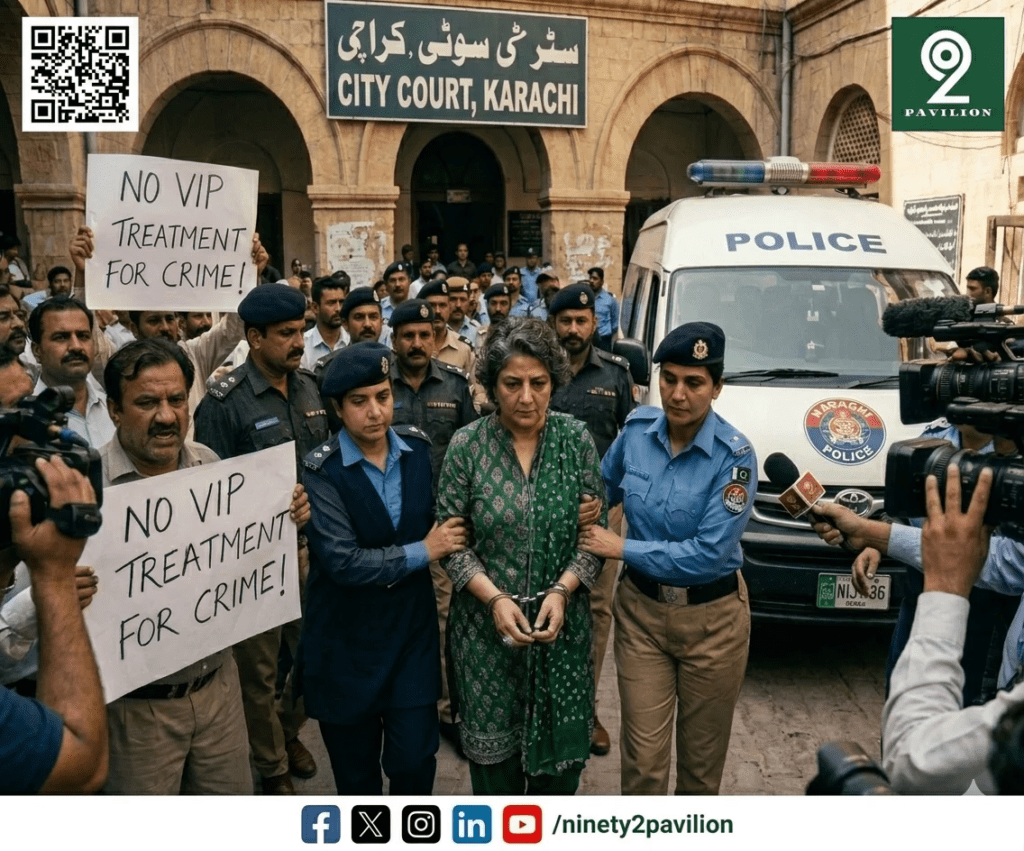
Instead of being treated like a dangerous criminal, Pinky appeared in court without handcuffs, escorted almost as if she were a VIP. Videos circulated online showing her smiling, confidently walking into the courtroom, and even using her phone during proceedings. The optics of this moment sparked outrage across social media, with many accusing the police of giving preferential treatment to a notorious drug dealer. The backlash was swift: senior police officials involved in her presentation were suspended, and inquiries were launched to determine why she had been afforded such leniency. For the public, the incident raised uncomfortable questions about corruption, influence, and whether powerful criminals can manipulate the system to their advantage.
In court, prosecutors requested six days of physical remand to interrogate Pinky further and trace her network. They argued that her arrest was only the beginning, and that uncovering her connections could lead to dismantling a much larger cartel. However, the court denied the request and instead sent her to judicial remand, a decision that many observers felt weakened the investigation. Critics pointed out that without extended custody, authorities might struggle to extract crucial information about her suppliers, distributors, and international links. This fueled speculation that her influence might extend beyond the drug trade into the corridors of power.
Beyond the courtroom drama, Pinky’s arrest has reignited debate about the state of law enforcement in Pakistan. On one hand, the operation demonstrated that police can successfully target high-profile criminals when backed by intelligence support. On the other, the mishandling of her court appearance highlighted systemic flaws that undermine public trust. For ordinary citizens, the sight of a drug dealer being treated with respect while countless addicts suffer from the consequences of her trade was deeply unsettling. It reinforced the perception that justice in Pakistan can be uneven, especially when wealth and connections are involved.
The Pinky case is more than just a sensational crime story; it is a mirror reflecting the challenges Karachi faces in tackling narcotics, corruption, and organized crime. Her arrest may have disrupted one network, but the controversy surrounding her treatment shows that the battle is far from over. Whether this case leads to meaningful reforms or fades into yet another scandal remains to be seen. For now, Pinky’s name has become synonymous with both the scale of Pakistan’s drug problem and the fragility of its justice system, a reminder that catching criminals is only half the fight—the other half is ensuring they face accountability without privilege.