By: News Desk 92Pavilion
The world celebrates the power of athletics to foster unity and resilience, the state of sports within Pakistani educational institutions presents a stark and sobering paradox. While the nation’s streets and alleys are filled with raw talent, the formal nurseries of this talent—schools, colleges, and universities—are largely failing to provide the physical infrastructure and regulatory framework necessary to transition from street play to professional excellence. The lack of standardized sports facilities and a coherent institutional framework is not merely a logistical failure; it is a systemic crisis that is depriving millions of Pakistani youths of their right to holistic development, physical health, and international representation.
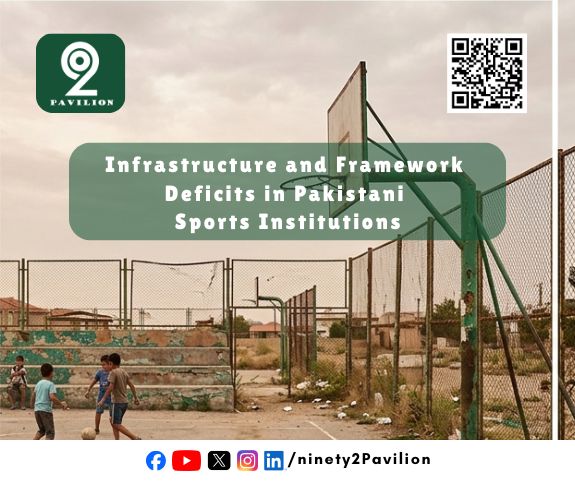
The most visible facet of this crisis is the physical “shrinking” of the sports landscape. In 2026, a significant majority of private educational institutions, particularly in urban centers like Karachi, Lahore, and Islamabad, operate in multi-story buildings or converted residences with zero access to playgrounds. For these institutions, “sports” has been reduced to indoor tabletop games or occasional visits to public parks, effectively stripping the curriculum of its physical vitality. Even in public sector schools, where land is often available, the infrastructure is frequently in a state of decay. Dilapidated tracks, uneven fields, and a total absence of modern equipment like gymnasiums or swimming pools are the norm. This “infrastructure deficit” creates an environment where sports are viewed as a luxury rather than a fundamental component of the academic experience.
Beyond the lack of brick and mortar, Pakistani institutions suffer from a profound “Framework Fragility.” As of 2026, the governance of sports in educational bodies remains fragmented and disorganized. The role of the Director of Physical Education (DPE) in most colleges is marginalized, often reduced to administrative duties rather than active coaching or talent identification. There is a critical absence of a standardized National Sports Curriculum that integrates physical education with academic credits, leading to a culture where students are actively discouraged from pursuing sports by both educators and parents who view it as a “distraction” from exams. This lack of a professional pathway means that even the most gifted athletes at the school level often drop out of sports by the time they reach university, as there is no framework to support their transition into professional leagues or provide them with job security.
However, the landscape in 2026 is showing early signs of a top-down intervention. The federal government’s recent initiative, “Khelega Islamabad, Taleem ke Sath,” which makes sports mandatory in all schools and madrassas, is a step toward institutionalizing athletics. Similarly, the 2026 school-based program to revive hockey—involving over 19 Dutch ambassadors and local education boards—seeks to rebuild the “grassroots pipeline” that once made Pakistan a global force in field hockey. Yet, these initiatives face the uphill task of overcoming decades of neglect. Without a binding legal statute that requires every registered educational institution to provide a minimum standard of sports facilities—and a dedicated budget that moves beyond just salaries to actual development—these programs risk becoming mere “ribbon-cutting” exercises.
Furthermore, the “Gender Gap” in sports infrastructure remains a glaring institutional failure. In 2026, female students in Pakistani institutions face double the barriers, with many girls’ schools lacking even basic privacy-walled courts or female coaches. The lack of safe, inclusive spaces for women in sports is a direct violation of the UN Sustainable Development Goals (SDG 5) that Pakistan is committed to. For a nation that takes immense pride in its occasional Olympic or Cricketing glory, the reality on the ground is that the institutional foundations are hollow. Bridging this gap requires a radical shift: viewing sports not as an “extra-curricular” activity, but as a central pillar of national development. Only by mandating infrastructure and professionalizing the institutional framework can Pakistan transform its youthful energy into a sustainable legacy of sporting excellence