Latest Posts
Building a Vibrant Cultural FutureA Journey Towards ProsperityArab nations face an inevitable declineBlogging Revenue in Pakistan’s 2026 EconomyWhy China is Investing in Pakistan’s Gwadar PortThe Rising Spirit of Pakistani SportsVoice-Over Economy in Pakistan 2026India’s Investment in Iran,Chabahar PortEvent Management Business in Pakistan 2026The Volatile Trajectory of Pakistan-Afghanistan Relations in 2026Why Pakistan Must Overhaul Its InfrastructureEvolution of Goods and Equipment in Modern SportsThe Current Situation of Sports in PakistanGovernment Initiatives for Sports in PakistanAssessing Sports Infrastructure and Facilities in PakistanSialkot and the Renaissance of Pakistan’s Sports Goods IndustryEmerging Sports Trends in 2026Legacy of Popular Traditional SportsJourney Through the Background of Sports in PakistanInfrastructure and Framework Deficits in Pakistani Sports InstitutionsLevelling the Field of SportsThe Roadmap for Pakistan’s Islamic Financial TransitionApartheid Structure in Occupied KashmirThe Strategic Role of the SCO in 2026Complexities of Illegal Immigrant RepatriationPakistan’s Strategic Role in Regional Power DynamicsPakistan’s Strategic Role in the South Asian Power PlayPakistan’s Strategic Tightrope in the US-China RivalryPakistan-China Relations in a Changing Geopolitical EnvironmentForeign Relation of Pakistan with Neighboring CountriesGlobal Response and the Reshaping World Order in 2026Impacts of International Structure on Pakistan’s Foreign PolicyEnduring Conflict Between India and Pakistan

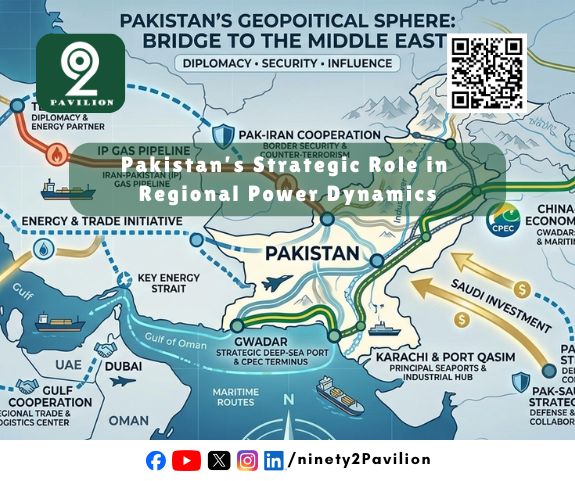
Pakistan’s Strategic Role in Regional Power Dynamics

Pakistan’s Strategic Role in Regional Power Dynamics

By: News Desk 92Pavilion

In the complex geopolitical theater of 2026, Pakistan has emerged as a critical fulcrum in the power dynamics of the Middle East. While historically a South Asian power, Pakistan’s unique blend of military strength, nuclear status, and strategic geography has transformed it into an indispensable mediator and security partner for the Arab world. As of April 2026, Islamabad’s role is no longer merely peripheral; it has become a central node in a “multipolar de-escalation” strategy, navigating the intense rivalries between the United States, Iran, Saudi Arabia, and Israel. This pivot represents a sophisticated evolution of Pakistan’s foreign policy—transitioning from a state seeking financial bailouts to a strategic actor providing diplomatic stability to a region on the brink of widespread conflict.

The most defining element of Pakistan’s 2026 role is its successful emergence as a “Power Broker” in the US-Iran Crisis. Hosting high-stakes negotiations in Islamabad, the Pakistani government managed to facilitate a 45-day two-phased truce plan that effectively paused direct hostilities between the United States, Israel, and Iran. This achievement was possible because Pakistan maintains a rare, multifaceted trust with all parties. To Tehran, Islamabad is a neighbor with shared security concerns in Balochistan and a historical ally that has consistently refused to join anti-Iran military blocs. To Washington, the Pakistani military remains a key security partner with significant regional intelligence depth. By leveraging these long-running relationships, Pakistan has successfully flexed its “geopolitical muscles,” proving that middle-tier powers can shape major global outcomes when they occupy the right diplomatic space.

Parallel to its role as a mediator, Pakistan remains a vital pillar of the Gulf Security Architecture. The Strategic Mutual Defense Agreement signed with Saudi Arabia in September 2025 has cemented a “limited alignment” where Pakistan provides military expertise and potential air defense support without becoming a direct combatant in regional wars. In 2026, the Pakistan Navy’s Operation Muhafiz-ul-Bahr highlighted this importance; as the Strait of Hormuz faced partial blockades, the Pakistani fleet took a lead role in escorting merchant vessels and ensuring the flow of energy supplies to South and East Asia. This operational capability makes Pakistan the “quiet architect” of regional stability, offering the Gulf states a reliable military alternative to declining Western security guarantees while simultaneously acting as a bridge for Chinese security interests in the Arabian Sea.

However, Pakistan’s Middle Eastern engagement is also a survival strategy rooted in Economic and Security Interdependence. With over 5.5 million Pakistanis residing in the Gulf, the flow of remittances is the lifeblood of Pakistan’s domestic economy. Any destabilization in Riyadh or Dubai directly impacts Islamabad’s financial solvency. Furthermore, the 2026 “Iran War” triggered a severe energy crisis in Pakistan, necessitating emergency austerity measures. By acting as a peace broker, Pakistan is not merely pursuing altruism; it is protecting its own energy corridors and preventing a “spillover” of sectarian violence or refugee influxes across its 900-kilometer border with Iran. This fusion of national interest and regional mediation has elevated Pakistan’s international credibility, positioning it as a sophisticated rival to other regional players like Turkey in the contest for Middle Eastern influence.

Ultimately, the role of Pakistan in the Middle East power dynamics of 2026 is one of Active Neutrality. By refusing to become a proxy for any single power, Islamabad has made itself valuable to all. Whether it is facilitating direct talks between Riyadh and Tehran or ensuring maritime security in the Gulf, Pakistan’s value lies in its ability to bridge the gap between competing blocs. As we move further into 2026, the success of the “Islamabad Process” will determine if the region moves toward a sustainable peace or returns to a state of perpetual friction. For Pakistan, the path is clear: it must continue to use its military and diplomatic weight to remain the anchor of a stable Middle Eastern order, ensuring that its own future remains secure in an increasingly volatile world

Share

Introduction

Pakistan’s political environment in 2026 remains dynamic and highly influential in shaping the country’s future. From parliamentary debates and economic policy decisions to opposition movements and electoral reforms, recent developments are playing a crucial role in determining national direction.

In this report by Eye of Pakistan, we analyze the latest political developments, government strategies, and opposition responses.

Government’s Policy Priorities in 2026

The federal government has emphasized:

  • Economic stabilization

  • Institutional reforms

  • Energy sector restructuring

  • Strengthening foreign diplomatic ties

Recent cabinet meetings focused on controlling inflation, stabilizing the Pakistani Rupee, and implementing fiscal discipline under ongoing economic reform programs.

Officials claim these measures aim to restore investor confidence and ensure sustainable growth.

Opposition’s Response and Political Strategy

Major opposition parties have intensified criticism of government policies, particularly regarding:

  • Rising inflation

  • Unemployment

  • Tax reforms

  • Utility price increases

Opposition leaders argue that economic pressure on the public has increased and demand greater transparency in parliamentary proceedings.

Political rallies and public gatherings have increased across major cities including Karachi, Lahore, and Islamabad.

Parliamentary Developments

Recent National Assembly sessions have seen heated debates over:

  • Budget allocations

  • Electoral reforms

  • Accountability laws

  • Provincial autonomy issues

Lawmakers from both treasury and opposition benches continue to exchange strong viewpoints, reflecting a vibrant yet tense political atmosphere.

Election Reforms and Democratic Process

Discussions around electoral transparency and digital voting mechanisms remain central to political discourse.

The Election Commission is reportedly reviewing:

  • Voter verification systems

  • Polling station security

  • Overseas voting procedures

Analysts believe these reforms could significantly impact future general elections.

Public Reaction and Political Climate

Public opinion appears divided. While some citizens support structural reforms and long-term stabilization plans, others express concerns over economic hardships and governance challenges.

Political analysts suggest that the coming months will be critical in determining whether current policies translate into tangible relief for the public.

Conclusion

Pakistan’s political landscape in 2026 is marked by active debate, institutional reforms, and strategic maneuvering from both government and opposition parties. As policy decisions continue to unfold, their impact on economic stability and democratic processes will remain under close observation.

Stay connected with Eye of Pakistan for reliable and timely political updates.