
By; News Desk 92Pavilion
The entertainment landscape of 2026 is defined by a fundamental fusion of creative artistry and innovative technology, creating a flourishing ecosystem where the boundary between the viewer and the content has effectively dissolved. We have moved past the era of digital experimentation into a period of structural maturity, where technologies like Generative AI, Extended Reality (XR), and high-fidelity cloud computing have become the core infrastructure of the creative world. This shift has transformed entertainment from a series of static products into a “Synthetic Symphony”—a dynamic, interactive experience that responds in real-time to the audience’s intent, environment, and emotional state.
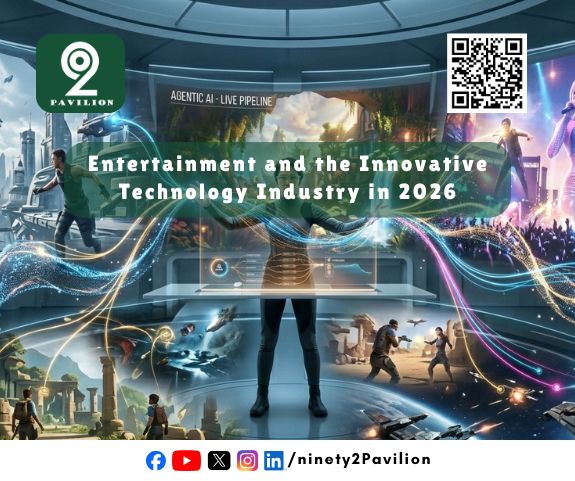
The most significant driver of this transformation is the evolution of Generative AI from a novelty tool into a foundational “AI Backbone.” In 2026, the global market for generative AI in media and entertainment has surpassed $3.1 billion, reflecting its role in every stage of production. High-end studios now use “Agentic AI” systems that don’t just respond to prompts but autonomously orchestrate complex production pipelines, from real-time language localization to the procedural generation of vast, open-world gaming environments. This technology has enabled “hyper-personalization,” where streaming platforms and games actively reshape their narratives and music based on a user’s immediate context, effectively making every viewer a co-creator of their own entertainment.
The physical experience of entertainment has been redefined by the maturation of Extended Reality (XR) and spatial computing. With the widespread adoption of high-refresh-rate headsets and lightweight AR glasses, the industry has moved toward “Frictionless Entertainment.” No longer confined to 2D screens, audiences can step directly into the heart of a story, experiencing the cool breeze of a fantastical landscape or the visceral pulse of a virtual concert. The integration of 5G and multi-CDN strategies has ensured that these high-fidelity, 8K experiences are delivered with ultra-low latency, making virtual social interactions feel as immediate and authentic as physical ones.
Furthermore, the rise of the “Next-Generation Bundle” in 2026 has simplified the fragmented streaming landscape. Tech giants and legacy media houses have moved toward unified aggregation, where live sports, interactive gaming, and cinematic content are all accessible through a single, intelligent interface. This convergence has empowered the “Creator Economy,” allowing independent artists to use innovative tools to produce professional-grade content that reaches a global audience without traditional gatekeepers. Ultimately, the partnership between entertainment and innovative technology in 2026 is not about replacing the human element; it is about amplifying it, using the digital forge to create experiences that are more immersive, inclusive, and profoundly personal than ever before