By: News Desk 92pavilion
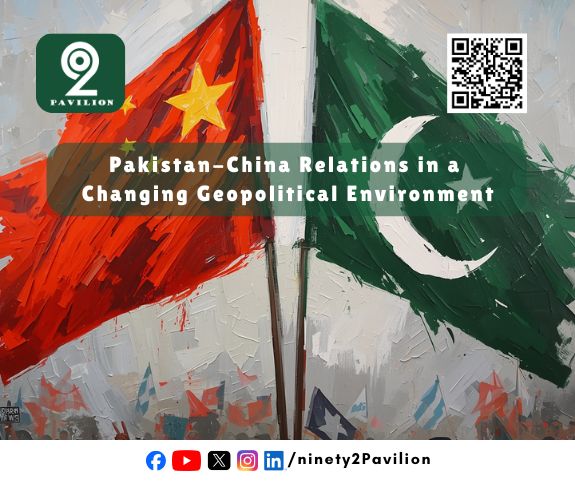
The relationship between Pakistan and China, often famously described as being “higher than the mountains and deeper than the oceans,” is currently navigating one of its most transformative periods. In 2026, as the world settles into a complex multipolar order, this “ironclad” friendship has evolved from a primarily security-driven alliance into a comprehensive strategic partnership that serves as a cornerstone for regional stability. However, this evolution is occurring against a backdrop of intensifying great-power rivalry, regional volatility, and the internal economic restructuring of both nations. For Pakistan, the challenge in 2026 is no longer just about maintaining this bond, but about optimizing it within a geopolitical environment that is increasingly fragmented and demanding.
The primary driver of this relationship remains the China-Pakistan Economic Corridor (CPEC), which has officially transitioned into “Phase 2.0.” While the first decade focused on alleviating Pakistan’s chronic energy shortages and building a skeletal infrastructure of roads and ports, 2026 marks a decisive shift toward industrialization and high-tech collaboration. The launch of the “Industrial Cooperation Action Plan (2025–2029)” has begun the process of relocating Chinese manufacturing units to Pakistan’s Special Economic Zones (SEZs), such as Rashakai and Allama Iqbal Industrial City. This shift is critical; it moves the bilateral economic narrative away from debt-heavy infrastructure toward export-led growth and job creation, aiming to integrate Pakistan more deeply into global supply chains.
However, the international structure of 2026 imposes new constraints. The intensifying rivalry between the United States and China has forced Pakistan into a delicate “constrained hedging” strategy. While Islamabad remains China’s closest strategic partner in South Asia, it has simultaneously worked to maintain a functional relationship with Washington, particularly in the realms of counter-terrorism and climate resilience. This balancing act is further complicated by the deepening strategic partnership between the U.S. and India. As New Delhi is increasingly positioned as a counterweight to Beijing in the Indo-Pacific, Pakistan and China have naturally tightened their security and defense cooperation, ensuring that Pakistan’s conventional and nuclear deterrents remain robust in the face of a shifting regional balance of power.
Regionally, 2026 has seen China take on a more visible role as a diplomatic mediator, particularly in the strained relations between Pakistan and the Taliban-led government in Afghanistan. Following cross-border tensions earlier this year, Beijing’s active engagement in the China-Pakistan-Afghanistan trilateral dialogue has been instrumental in de-escalating hostilities along the Durand Line. For China, stability in Pakistan’s western border is essential to safeguard CPEC investments and prevent the spillover of militancy into Xinjiang. For Pakistan, China’s mediatory role provides a diplomatic alternative to Western intervention, reinforcing the “Asian-led” security model that Beijing promotes through the Global Security Initiative.
Security remains the “Achilles’ heel” of the partnership. In 2026, the safety of Chinese personnel and institutions in Pakistan is a top-tier priority in bilateral dialogues. Both nations have moved toward a more integrated security framework, combining Pakistani ground intelligence with Chinese surveillance technology to protect CPEC 2.0 projects from extremist threats. Despite these challenges, the symbolic weight of the relationship remains immense, as both nations celebrate the 75th anniversary of their diplomatic ties this year. Ultimately, Pakistan-China relations in 2026 are defined by a pragmatic resilience. By aligning their developmental goals and navigating the stormy waters of global competition together, they are not just maintaining a bilateral link; they are attempting to build a regional order that favors stability, connectivity, and mutual economic survival