Latest Posts
Building a Vibrant Cultural FutureA Journey Towards ProsperityArab nations face an inevitable declineBlogging Revenue in Pakistan’s 2026 EconomyWhy China is Investing in Pakistan’s Gwadar PortThe Rising Spirit of Pakistani SportsVoice-Over Economy in Pakistan 2026India’s Investment in Iran,Chabahar PortEvent Management Business in Pakistan 2026The Volatile Trajectory of Pakistan-Afghanistan Relations in 2026Why Pakistan Must Overhaul Its InfrastructureEvolution of Goods and Equipment in Modern SportsThe Current Situation of Sports in PakistanGovernment Initiatives for Sports in PakistanAssessing Sports Infrastructure and Facilities in PakistanSialkot and the Renaissance of Pakistan’s Sports Goods IndustryEmerging Sports Trends in 2026Legacy of Popular Traditional SportsJourney Through the Background of Sports in PakistanInfrastructure and Framework Deficits in Pakistani Sports InstitutionsLevelling the Field of SportsThe Roadmap for Pakistan’s Islamic Financial TransitionApartheid Structure in Occupied KashmirThe Strategic Role of the SCO in 2026Complexities of Illegal Immigrant RepatriationPakistan’s Strategic Role in Regional Power DynamicsPakistan’s Strategic Role in the South Asian Power PlayPakistan’s Strategic Tightrope in the US-China RivalryPakistan-China Relations in a Changing Geopolitical EnvironmentForeign Relation of Pakistan with Neighboring CountriesGlobal Response and the Reshaping World Order in 2026Impacts of International Structure on Pakistan’s Foreign PolicyEnduring Conflict Between India and PakistanAncient Roman and Modern EntertainmentCultivating Pakistan’s Future Tech WorkforceBuilding, Champions of the WorldDeciphering the Boundary Between Art and EntertainmentDevelopment of Pakistan’s Entertainment Industry

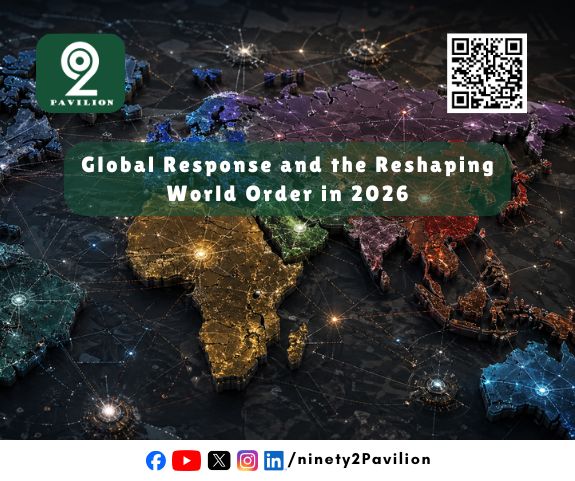
Global Response and the Reshaping World Order in 2026

Global Response and the Reshaping World Order in 2026

By: News Desk 92Pavilion

As we navigate the second half of this turbulent decade, the international system in 2026 is no longer in “transition”—it is in a state of profound “rupture.” The post-1945 rules-based order, once anchored by Western-led institutions and a unipolar security framework, has fractured into a mosaic of competing power centers. This reshaping world order is defined by a shift from multilateralism to what experts call “negotiated pluralism,” where stability is maintained not through a single set of global rules, but through a complex web of regional alliances, transactional deals, and spheres of interest. In 2026, the global response to this fragmentation is not passive; it is an era of intense strategic self-preservation, where middle powers and regional blocs are seizing agency to ensure they are not crushed by the friction between the United States and China.

The defining characteristic of 2026 is the rise of “Multipolarity without Multilateralism.” While the number of influential actors has grown, the capacity for collective action through traditional bodies like the United Nations has reached a historic nadir. In response, we have seen the emergence of a “Middling Order”—an alliance of middle powers from Northern Europe, Southeast Asia, and the Gulf that are building autonomous coalitions to hedge against superpower volatility. A landmark event in early 2026 was the formation of the “Transatlantic Neutrality Bloc,” a group of six Western nations that, for the first time since World War II, excluded the United States from a major defense and industrial agreement. This move signaled a seismic shift in the Western bloc, as allies seek a “third path” that prioritizes regional resilience over rigid alignment with Washington’s unilateralism.

Economically, the world order is being reshaped by the “Weaponization of Interdependence.” In 2026, economic statecraft has become as lethal as kinetic warfare. The global response has been a retreat into “Sovereign Resilience,” where nations are prioritizing industrial autonomy and secure supply chains over cost-efficiency. This has birthed a new landscape of powerful trade blocs, with ASEAN and the Gulf Cooperation Council (GCC) emerging as dominant negotiators. These blocs are no longer mere trade facilitators; they are geopolitical actors that dictate the terms of access to their markets and resources. The “Steel Silk Road” and the “Digital Gateway” initiatives are now the primary vehicles for growth, ensuring that regional groupings, rather than a single global market, call the shots in the international political economy.

Furthermore, the contest for the “Global Commons”—outer space, the Arctic, and the digital frontier—has entered a critical phase. In 2026, space is officially a contested military domain, with major powers preparing for conflict on a scale not seen since the Cold War. The global response to these “frontier risks” has been fragmented, with nations racing to establish their own norms and technological “walled gardens.” The proliferation of AI-driven disinformation has further eroded the trust necessary for international cooperation, leading to a world where “values are at war.” However, even amid this competition, a pragmatic reality remains: shared challenges like climate change and pandemic preparedness still force ad-hoc collaborations, creating a world that is paradoxically more connected yet more divided than ever before.

Ultimately, the reshaping world order of 2026 is a “dog-eat-dog” environment that rewards those who can master the art of the deal over the adherence to the rule. For the Global South, this shift offers a historic opportunity to demand a fairer share of global wealth and a seat at the table of new power structures. For the West, it is a moment of painful reckoning and forced adaptation. The global response in 2026 proves that the old world is gone, and the new one is being built in real-time—not in the halls of Geneva or New York, but in the industrial zones of Riyadh, the tech hubs of Singapore, and the corridors of power in a resurgent, multipolar Eurasia
Share

Introduction

Pakistan’s political environment in 2026 remains dynamic and highly influential in shaping the country’s future. From parliamentary debates and economic policy decisions to opposition movements and electoral reforms, recent developments are playing a crucial role in determining national direction.

In this report by Eye of Pakistan, we analyze the latest political developments, government strategies, and opposition responses.

Government’s Policy Priorities in 2026

The federal government has emphasized:

  • Economic stabilization

  • Institutional reforms

  • Energy sector restructuring

  • Strengthening foreign diplomatic ties

Recent cabinet meetings focused on controlling inflation, stabilizing the Pakistani Rupee, and implementing fiscal discipline under ongoing economic reform programs.

Officials claim these measures aim to restore investor confidence and ensure sustainable growth.

Opposition’s Response and Political Strategy

Major opposition parties have intensified criticism of government policies, particularly regarding:

  • Rising inflation

  • Unemployment

  • Tax reforms

  • Utility price increases

Opposition leaders argue that economic pressure on the public has increased and demand greater transparency in parliamentary proceedings.

Political rallies and public gatherings have increased across major cities including Karachi, Lahore, and Islamabad.

Parliamentary Developments

Recent National Assembly sessions have seen heated debates over:

  • Budget allocations

  • Electoral reforms

  • Accountability laws

  • Provincial autonomy issues

Lawmakers from both treasury and opposition benches continue to exchange strong viewpoints, reflecting a vibrant yet tense political atmosphere.

Election Reforms and Democratic Process

Discussions around electoral transparency and digital voting mechanisms remain central to political discourse.

The Election Commission is reportedly reviewing:

  • Voter verification systems

  • Polling station security

  • Overseas voting procedures

Analysts believe these reforms could significantly impact future general elections.

Public Reaction and Political Climate

Public opinion appears divided. While some citizens support structural reforms and long-term stabilization plans, others express concerns over economic hardships and governance challenges.

Political analysts suggest that the coming months will be critical in determining whether current policies translate into tangible relief for the public.

Conclusion

Pakistan’s political landscape in 2026 is marked by active debate, institutional reforms, and strategic maneuvering from both government and opposition parties. As policy decisions continue to unfold, their impact on economic stability and democratic processes will remain under close observation.

Stay connected with Eye of Pakistan for reliable and timely political updates.

Education in Pakistan 2026

By: News Desk 92Pavilion Education in Pakistan stands as a complex paradox of modest statistical gains and deep-rooted systemic crises. As of 2026, the national

Share
Read More »