By: News Desk 92Pavilion
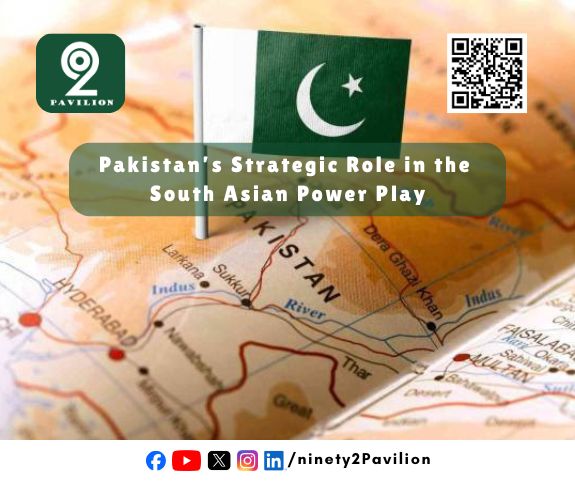
South Asia remains one of the most volatile yet geostrategically significant regions in the global landscape, characterized by a complex “Power Play” where traditional rivalries intersect with the interests of global superpowers. At the center of this storm lies Pakistan, a nation whose role has evolved from being a traditional security-oriented state into a “pivotal state” that bridges the interests of the East and the West. The current regional order is defined by India’s aspirations for hegemony, China’s expanding footprint, and the shifting role of the United States. In this environment, Pakistan’s foreign policy is no longer just about survival; it is about navigating a multipolar reality where geography remains its most potent asset and its greatest challenge.
The primary axis of the South Asian power play is the enduring competition between Pakistan and India. While India seeks to project itself as the preeminent regional leader and a “net security provider” in the Indian Ocean, Pakistan serves as the primary structural check on this ambition. In 2026, this rivalry has transcended traditional borders, manifesting in a struggle for influence in Afghanistan and the wider Central Asian region. Pakistan’s strategic depth is reinforced by its nuclear status and its professional military, which ensure a “balance of power” that prevents regional unilateralism. However, the nature of this play has shifted toward “geo-economics.” Islamabad’s 2026 National Security Policy prioritizes economic connectivity over tactical confrontation, aiming to transform Pakistan into a transit hub for Central Asian energy and trade, thereby creating a regional interdependence that raises the cost of conflict for New Delhi.
China’s role as a “resident power” in South Asia has fundamentally altered Pakistan’s position in the regional hierarchy. Through the China-Pakistan Economic Corridor (CPEC) 2.0, Beijing has provided Islamabad with the infrastructure and investment necessary to resist external economic pressures. This partnership has created a “triangular dynamic” where the China-Pakistan axis acts as a counterweight to the deepening U.S.-India strategic partnership. For China, Pakistan is the gateway to the Arabian Sea and a vital partner in the “Global Security Initiative.” For Pakistan, this relationship provides a degree of strategic autonomy, allowing it to negotiate from a position of relative strength. However, this alignment also places Pakistan at the heart of the “New Cold War,” where any regional move is viewed through the lens of the U.S.-China rivalry, forcing Islamabad to play a delicate game of “strategic hedging” to avoid total isolation from Western financial markets.
On its western flank, Pakistan continues to play a decisive role in the “Great Game” over Afghanistan. In 2026, the stability of the Taliban-led government remains a core interest for the region. Pakistan acts as the primary intermediary between Kabul and the international community, leveraging its historical ties to manage the threat of cross-border terrorism while advocating for regional economic integration. The success of the “Trans-Afghan Railway” project, connecting Uzbekistan to Pakistan’s ports, depends entirely on Islamabad’s ability to facilitate a stable regional environment. This role as a regional “stabilizer” gives Pakistan diplomatic leverage that extends to the Gulf states and Moscow, both of whom view Pakistan as an essential partner in managing the “Eurasian Heartland.”
Ultimately, Pakistan’s role in the South Asian power play is defined by its resilience and its ability to turn geopolitical pressure into strategic opportunity. In 2026, the nation is moving toward a policy of “active neutrality,” seeking to maintain functional relationships with all major powers while safeguarding its core interests in Kashmir and the Indus Waters. The future of South Asia depends on whether this power play results in a “zero-sum” conflict or a collaborative regional architecture. For Pakistan, the path forward lies in utilizing its unique geography to foster a “connectivity-led” peace, ensuring that it remains the indispensable anchor of the South Asian regional order rather than its most vulnerable fault line