Latest Posts
Building a Vibrant Cultural FutureA Journey Towards ProsperityArab nations face an inevitable declineBlogging Revenue in Pakistan’s 2026 EconomyWhy China is Investing in Pakistan’s Gwadar PortThe Rising Spirit of Pakistani SportsVoice-Over Economy in Pakistan 2026India’s Investment in Iran,Chabahar PortEvent Management Business in Pakistan 2026The Volatile Trajectory of Pakistan-Afghanistan Relations in 2026Why Pakistan Must Overhaul Its InfrastructureEvolution of Goods and Equipment in Modern SportsThe Current Situation of Sports in PakistanGovernment Initiatives for Sports in PakistanAssessing Sports Infrastructure and Facilities in PakistanSialkot and the Renaissance of Pakistan’s Sports Goods IndustryEmerging Sports Trends in 2026Legacy of Popular Traditional SportsJourney Through the Background of Sports in PakistanInfrastructure and Framework Deficits in Pakistani Sports InstitutionsLevelling the Field of SportsThe Roadmap for Pakistan’s Islamic Financial TransitionApartheid Structure in Occupied KashmirThe Strategic Role of the SCO in 2026Complexities of Illegal Immigrant RepatriationPakistan’s Strategic Role in Regional Power DynamicsPakistan’s Strategic Role in the South Asian Power PlayPakistan’s Strategic Tightrope in the US-China RivalryPakistan-China Relations in a Changing Geopolitical EnvironmentForeign Relation of Pakistan with Neighboring CountriesGlobal Response and the Reshaping World Order in 2026Impacts of International Structure on Pakistan’s Foreign PolicyEnduring Conflict Between India and Pakistan

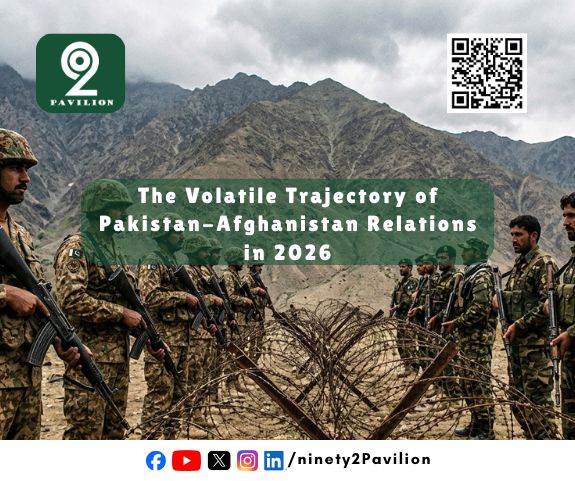
The Volatile Trajectory of Pakistan-Afghanistan Relations in 2026

The Volatile Trajectory of Pakistan-Afghanistan Relations in 2026

By: News Desk 92Pavilion

The relationship between Pakistan and Afghanistan in 2026 has reached a historic and dangerous inflection point, characterized by a transition from traditional diplomatic friction to what observers now describe as a state of “near-war.” While the two nations share deep-rooted ethnic, linguistic, and religious ties, the contemporary landscape is dominated by a profound trust deficit and a violent cycle of cross-border escalations. As of April 2026, the optimism that once surrounded the Taliban’s return to power in Kabul has been entirely replaced by a grim reality of military strikes, drone incursions, and a complete breakdown of the border security framework. For both Islamabad and Kabul, the inability to find common ground on the issue of non-state actors has turned the 2,600-kilometer Durand Line into the most volatile flashpoint in South Asia.

The primary catalyst for this deterioration remains the presence and activity of the Tehreek-e-Taliban Pakistan (TTP). In early 2026, Pakistan declared “open war” on militant sanctuaries within Afghanistan following a series of devastating attacks in Islamabad and Balochistan. The Pakistani military establishment maintains that the Afghan Taliban provides not only safe haven but tactical support to the TTP, a claim Kabul consistently denies. This culminated in February and March 2026 with “Operation Ghazab Lil-Haq,” a major Pakistani aerial campaign targeting militant camps across 11 Afghan provinces, including a high-profile strike in Kabul. Afghanistan’s response—dubbed “Radd al-Zulm”—saw the introduction of experimental drone technology used to strike deep into Pakistani territory, reaching as far as the outskirts of Islamabad. This tit-for-tat escalation has displaced nearly 100,000 civilians and decimated border infrastructure, leaving the humanitarian situation in the eastern provinces of Afghanistan in a state of emergency.

Despite the intensity of the conflict, 2026 has also seen a desperate flurry of regional diplomacy. As of early April, China has stepped in as the primary mediator, hosting high-level “comprehensive solution” talks in Urumqi. These negotiations follow previous failed truces brokered by Qatar, Saudi Arabia, and Türkiye. The central challenge for these mediators is the “ideological entanglement” between the Afghan Taliban and the TTP; Islamabad demands a verifiable crackdown on militants, while Kabul insists on a political solution that respects its sovereignty. The Urumqi talks represent a fragile hope for a lasting ceasefire, but they are haunted by the failures of 2025, where similar agreements collapsed within weeks. The regional powers, particularly Beijing, view a stable Pakistan-Afghanistan border as essential for the security of the “Eurasian Heartland” and the continued viability of the Belt and Road Initiative.

Economically, the conflict has been catastrophic for bilateral trade, which had reached $2.1 billion in 2024. Constant border closures at Torkham and Chaman have interrupted the flow of essential goods like rice and medicaments from Pakistan, and raw cotton and coal from Afghanistan. In 2026, the “Informal Economy” has surged as formal channels remain blocked by military operations, leading to a rise in smuggling and a loss of revenue for both cash-strapped governments. For Pakistan, the instability on its western frontier remains a significant drain on its fiscal resources and a distraction from its “geo-economic” pivot. For Afghanistan, the hostility with its primary trading partner exacerbates its international isolation and deepens the domestic humanitarian crisis.

Ultimately, the Pakistan-Afghanistan relationship in 2026 is a study in the limits of traditional diplomacy. The shared history of these “brotherly nations” is currently being rewritten in the language of artillery fire and drone strikes. Moving forward, the only sustainable path out of this “near-war” status lies in a fundamental reassessment of regional security. Without a robust, verifiable mechanism to manage the Durand Line and address the TTP’s presence, any ceasefire will remain a temporary pause rather than a permanent peace. The coming months will determine whether the “Urumqi Process” can bridge this cavernous trust deficit or if the two nations will continue their drift toward a conflict that could destabilize the entire region for decades to come
Share

Introduction

Pakistan’s political environment in 2026 remains dynamic and highly influential in shaping the country’s future. From parliamentary debates and economic policy decisions to opposition movements and electoral reforms, recent developments are playing a crucial role in determining national direction.

In this report by Eye of Pakistan, we analyze the latest political developments, government strategies, and opposition responses.

Government’s Policy Priorities in 2026

The federal government has emphasized:

  • Economic stabilization

  • Institutional reforms

  • Energy sector restructuring

  • Strengthening foreign diplomatic ties

Recent cabinet meetings focused on controlling inflation, stabilizing the Pakistani Rupee, and implementing fiscal discipline under ongoing economic reform programs.

Officials claim these measures aim to restore investor confidence and ensure sustainable growth.

Opposition’s Response and Political Strategy

Major opposition parties have intensified criticism of government policies, particularly regarding:

  • Rising inflation

  • Unemployment

  • Tax reforms

  • Utility price increases

Opposition leaders argue that economic pressure on the public has increased and demand greater transparency in parliamentary proceedings.

Political rallies and public gatherings have increased across major cities including Karachi, Lahore, and Islamabad.

Parliamentary Developments

Recent National Assembly sessions have seen heated debates over:

  • Budget allocations

  • Electoral reforms

  • Accountability laws

  • Provincial autonomy issues

Lawmakers from both treasury and opposition benches continue to exchange strong viewpoints, reflecting a vibrant yet tense political atmosphere.

Election Reforms and Democratic Process

Discussions around electoral transparency and digital voting mechanisms remain central to political discourse.

The Election Commission is reportedly reviewing:

  • Voter verification systems

  • Polling station security

  • Overseas voting procedures

Analysts believe these reforms could significantly impact future general elections.

Public Reaction and Political Climate

Public opinion appears divided. While some citizens support structural reforms and long-term stabilization plans, others express concerns over economic hardships and governance challenges.

Political analysts suggest that the coming months will be critical in determining whether current policies translate into tangible relief for the public.

Conclusion

Pakistan’s political landscape in 2026 is marked by active debate, institutional reforms, and strategic maneuvering from both government and opposition parties. As policy decisions continue to unfold, their impact on economic stability and democratic processes will remain under close observation.

Stay connected with Eye of Pakistan for reliable and timely political updates.