Latest Posts
Building a Vibrant Cultural FutureA Journey Towards ProsperityArab nations face an inevitable declineBlogging Revenue in Pakistan’s 2026 EconomyWhy China is Investing in Pakistan’s Gwadar PortThe Rising Spirit of Pakistani SportsVoice-Over Economy in Pakistan 2026India’s Investment in Iran,Chabahar PortEvent Management Business in Pakistan 2026The Volatile Trajectory of Pakistan-Afghanistan Relations in 2026Why Pakistan Must Overhaul Its InfrastructureEvolution of Goods and Equipment in Modern SportsThe Current Situation of Sports in PakistanGovernment Initiatives for Sports in PakistanAssessing Sports Infrastructure and Facilities in PakistanSialkot and the Renaissance of Pakistan’s Sports Goods IndustryEmerging Sports Trends in 2026Legacy of Popular Traditional SportsJourney Through the Background of Sports in PakistanInfrastructure and Framework Deficits in Pakistani Sports InstitutionsLevelling the Field of SportsThe Roadmap for Pakistan’s Islamic Financial TransitionApartheid Structure in Occupied KashmirThe Strategic Role of the SCO in 2026Complexities of Illegal Immigrant RepatriationPakistan’s Strategic Role in Regional Power DynamicsPakistan’s Strategic Role in the South Asian Power PlayPakistan’s Strategic Tightrope in the US-China RivalryPakistan-China Relations in a Changing Geopolitical EnvironmentForeign Relation of Pakistan with Neighboring CountriesGlobal Response and the Reshaping World Order in 2026Impacts of International Structure on Pakistan’s Foreign PolicyEnduring Conflict Between India and Pakistan

Event Management Business in Pakistan 2026

Event Management Business in Pakistan 2026

By: News Desk 92Pavilion

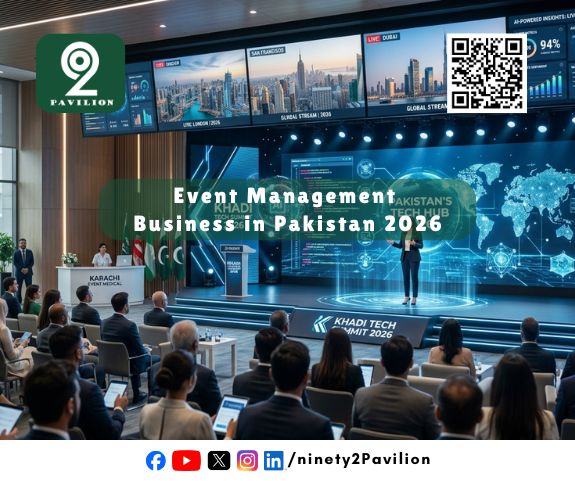
In the current economic landscape of April 2026, event management in Pakistan has transitioned from a purely aesthetic service into a high-stakes strategic industry. While the country faces inflationary pressures, the “Experience Economy” remains a dominant force, driven by a culturally ingrained commitment to social milestones and a corporate sector that has pivoted toward hybrid engagement. Today, a professional event manager in Pakistan is no longer just a decorator; they are a logistics expert, a digital strategist, and a risk manager. The running business situation is currently defined by a “Tiered Spend” model. High-net-worth individuals in urban centers like Karachi, Lahore, and Islamabad continue to invest heavily in “destination-style” weddings within Pakistan, favoring coastal luxury in Karachi or farmhouse grandeur in Lahore. These events remain the primary revenue engine, where managers earn through a combination of flat project fees and a percentage-based commission on the total budget, which often ranges from 10% to 20% depending on the complexity of the execution.

The corporate sector in 2026 has introduced a more consistent, year-round revenue stream through the rise of “Strategic Hybrid Events.” Following the major High-Level EU-Pakistan Business Forum earlier this month, local firms are increasingly hiring event managers to execute conferences that blend high-end in-person networking with global digital accessibility. To earn money in this space, managers are providing “Full-Stack” solutions that include international-standard AV setups, secure digital streaming, and post-event lead analytics. This shift toward measurable ROI has allowed agencies to move away from one-off vendor roles toward lucrative long-term retainers with multinational corporations and local tech startups. Furthermore, the monetization model has expanded to include “Digital Sponsorship Management,” where the event manager acts as a broker between the brand and the venue, taking a cut of the sponsorship packages they help secure.

Another significant development in the 2026 Pakistani market is the professionalization of “Micro-Events.” As massive public gatherings face higher security and logistical costs, there is a booming market for standardized, high-quality small gatherings—boutique product launches, private leadership retreats, and high-end community workshops. These events offer higher profit margins because they require less manpower but demand extreme attention to detail and exclusivity. Event managers are now productizing these experiences, offering “Event-in-a-Box” solutions for brands that need to roll out multiple small touchpoints across various regions. Additionally, sustainability has become a core billing component; agencies are now charging premium “Green Fees” to consult on zero-waste logistics and eco-friendly venue designs, reflecting a growing societal shift toward social responsibility in the Pakistani corporate world.

However, the running situation also presents the challenge of rising operational costs, specifically in imported lighting and sound technology. Successful managers are navigating this by investing in local fabrication and forming “Equipment Collectives” to share the burden of high-end gear. To stay profitable, the modern Pakistani event manager is also leaning heavily on AI-driven project management tools to automate vendor coordination and guest list tracking, significantly reducing overhead. In summary, the event management business in Pakistan in 2026 is a resilient and maturing field. It rewards those who can bridge the gap between traditional Pakistani hospitality and the technical demands of a globalized digital economy, proving that even in a challenging fiscal environment, the demand for human connection and professionally curated experiences remains an essential part of the national business fabric

Share

Introduction

Pakistan’s political environment in 2026 remains dynamic and highly influential in shaping the country’s future. From parliamentary debates and economic policy decisions to opposition movements and electoral reforms, recent developments are playing a crucial role in determining national direction.

In this report by Eye of Pakistan, we analyze the latest political developments, government strategies, and opposition responses.

Government’s Policy Priorities in 2026

The federal government has emphasized:

  • Economic stabilization

  • Institutional reforms

  • Energy sector restructuring

  • Strengthening foreign diplomatic ties

Recent cabinet meetings focused on controlling inflation, stabilizing the Pakistani Rupee, and implementing fiscal discipline under ongoing economic reform programs.

Officials claim these measures aim to restore investor confidence and ensure sustainable growth.

Opposition’s Response and Political Strategy

Major opposition parties have intensified criticism of government policies, particularly regarding:

  • Rising inflation

  • Unemployment

  • Tax reforms

  • Utility price increases

Opposition leaders argue that economic pressure on the public has increased and demand greater transparency in parliamentary proceedings.

Political rallies and public gatherings have increased across major cities including Karachi, Lahore, and Islamabad.

Parliamentary Developments

Recent National Assembly sessions have seen heated debates over:

  • Budget allocations

  • Electoral reforms

  • Accountability laws

  • Provincial autonomy issues

Lawmakers from both treasury and opposition benches continue to exchange strong viewpoints, reflecting a vibrant yet tense political atmosphere.

Election Reforms and Democratic Process

Discussions around electoral transparency and digital voting mechanisms remain central to political discourse.

The Election Commission is reportedly reviewing:

  • Voter verification systems

  • Polling station security

  • Overseas voting procedures

Analysts believe these reforms could significantly impact future general elections.

Public Reaction and Political Climate

Public opinion appears divided. While some citizens support structural reforms and long-term stabilization plans, others express concerns over economic hardships and governance challenges.

Political analysts suggest that the coming months will be critical in determining whether current policies translate into tangible relief for the public.

Conclusion

Pakistan’s political landscape in 2026 is marked by active debate, institutional reforms, and strategic maneuvering from both government and opposition parties. As policy decisions continue to unfold, their impact on economic stability and democratic processes will remain under close observation.

Stay connected with Eye of Pakistan for reliable and timely political updates.