Latest Posts
Building a Vibrant Cultural FutureA Journey Towards ProsperityArab nations face an inevitable declineBlogging Revenue in Pakistan’s 2026 EconomyWhy China is Investing in Pakistan’s Gwadar PortThe Rising Spirit of Pakistani SportsVoice-Over Economy in Pakistan 2026India’s Investment in Iran,Chabahar PortEvent Management Business in Pakistan 2026The Volatile Trajectory of Pakistan-Afghanistan Relations in 2026Why Pakistan Must Overhaul Its InfrastructureEvolution of Goods and Equipment in Modern SportsThe Current Situation of Sports in PakistanGovernment Initiatives for Sports in PakistanAssessing Sports Infrastructure and Facilities in PakistanSialkot and the Renaissance of Pakistan’s Sports Goods IndustryEmerging Sports Trends in 2026Legacy of Popular Traditional SportsJourney Through the Background of Sports in PakistanInfrastructure and Framework Deficits in Pakistani Sports InstitutionsLevelling the Field of SportsThe Roadmap for Pakistan’s Islamic Financial TransitionApartheid Structure in Occupied KashmirThe Strategic Role of the SCO in 2026Complexities of Illegal Immigrant RepatriationPakistan’s Strategic Role in Regional Power DynamicsPakistan’s Strategic Role in the South Asian Power PlayPakistan’s Strategic Tightrope in the US-China RivalryPakistan-China Relations in a Changing Geopolitical EnvironmentForeign Relation of Pakistan with Neighboring CountriesGlobal Response and the Reshaping World Order in 2026Impacts of International Structure on Pakistan’s Foreign PolicyEnduring Conflict Between India and PakistanAncient Roman and Modern EntertainmentCultivating Pakistan’s Future Tech WorkforceBuilding, Champions of the WorldDeciphering the Boundary Between Art and EntertainmentDevelopment of Pakistan’s Entertainment Industry

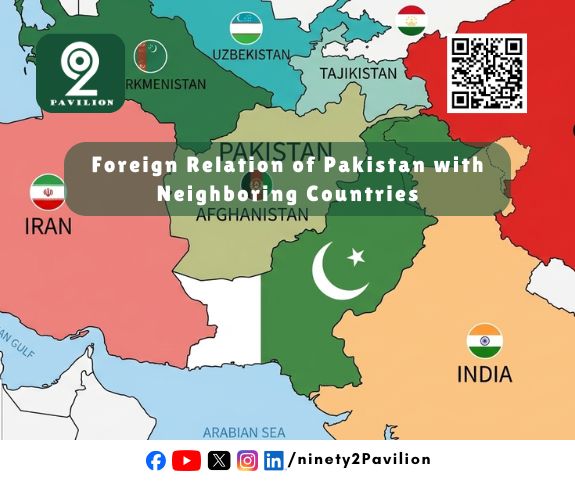
Foreign Relation of Pakistan with Neighboring Countries

Foreign Relation of Pakistan with Neighboring Countries

By: News Desk 92Pavilion

Pakistan’s foreign policy is defined by a delicate and often turbulent balancing act. Positioned at the crossroads of South Asia, Central Asia, and the Middle East, the nation serves as a critical geostrophic bridge, yet it remains hemmed in by a neighborhood characterized by shifting alliances and deep-seated historical frictions. As of April 2026, Islamabad is navigating a paradoxical landscape where it has successfully brokered peace on one front while facing the specter of “open war” on another. This evolving reality underscores a shift from traditional security-centric doctrines toward a “geo-economic” vision that seeks to leverage connectivity, though persistent regional instability remains the primary obstacle to this transformation.

The most dramatic development of 2026 has been Pakistan’s emergence as a pivotal diplomatic intermediary in the Middle East. Following months of high-stakes mediation, Islamabad played a defining role in facilitating a historic ceasefire between the United States and Iran. This achievement has significantly bolstered Pakistan’s international standing, transforming its image from a peripheral regional actor into a credible global intermediary. Domestically, this diplomatic success offers vital economic lifelines. The potential lifting of sanctions on Tehran has revived hopes for the long-delayed Iran-Pakistan (IP) gas pipeline, a project essential for Pakistan’s energy security. By navigating the friction between Washington and Tehran, Islamabad is attempting to secure affordable energy imports while positioning itself as a cornerstone of regional stability.

However, this success stands in stark contrast to the deteriorating situation on Pakistan’s western border. In late 2025 and early 2026, relations with Afghanistan reached a historic nadir. Despite initial hopes that the Taliban-led government in Kabul would curb cross-border militancy, a surge in attacks by the Tehreek-e-Taliban Pakistan (TTP) led to a direct military confrontation. By April 2026, the border regions have become a theater of “open war,” with both nations conducting airstrikes and ground offensives. This conflict has complicated Pakistan’s “Eurasian bridge” ambitions, as instability in Afghanistan threatens the viability of trade routes to Central Asia. The Durand Line remains a flashpoint of contention, requiring Islamabad to balance its security imperatives with the need for a functional, albeit strained, diplomatic channel with Kabul.

Conversely, the relationship with China remains the most stable and strategic pillar of Pakistan’s foreign policy. In 2026, the two nations have officially inaugurated Phase 2 of the China-Pakistan Economic Corridor (CPEC). Moving beyond foundational infrastructure, “CPEC 2.0” focuses on industrial cooperation, high-tech agriculture, and the full operationalization of Gwadar Port as a regional hub. This partnership remains “all-weather” in nature, providing Pakistan with a consistent economic and military counterweight. Yet, even this relationship faces the challenge of the “New Cold War,” as the intensifying rivalry between Beijing and Washington forces Pakistan to engage in a sophisticated “strategic hedging” strategy to maintain its ties with Western financial institutions without alienating its primary investor.

Meanwhile, relations with India remain in a state of “cold peace.” While the 2003 ceasefire along the Line of Control (LoC) largely holds, the diplomatic freeze that began in 2019 persists. In early 2026, “minimalist engagement” is the norm, with trade and high-level dialogue stalled over the unresolved status of Jammu and Kashmir. Although “cricket diplomacy” occasionally offers a fleeting sense of soft-power reconciliation, the structural trust deficit prevents a meaningful breakthrough. Ultimately, Pakistan’s foreign relations in 2026 reflect a nation in transition—one that is successfully carving out a niche as a global mediator but remains deeply entangled in the local conflicts of its own backyard. Success will depend on whether Islamabad can convert its newfound diplomatic clout into lasting regional stability

Share

Introduction

Pakistan’s political environment in 2026 remains dynamic and highly influential in shaping the country’s future. From parliamentary debates and economic policy decisions to opposition movements and electoral reforms, recent developments are playing a crucial role in determining national direction.

In this report by Eye of Pakistan, we analyze the latest political developments, government strategies, and opposition responses.

Government’s Policy Priorities in 2026

The federal government has emphasized:

  • Economic stabilization

  • Institutional reforms

  • Energy sector restructuring

  • Strengthening foreign diplomatic ties

Recent cabinet meetings focused on controlling inflation, stabilizing the Pakistani Rupee, and implementing fiscal discipline under ongoing economic reform programs.

Officials claim these measures aim to restore investor confidence and ensure sustainable growth.

Opposition’s Response and Political Strategy

Major opposition parties have intensified criticism of government policies, particularly regarding:

  • Rising inflation

  • Unemployment

  • Tax reforms

  • Utility price increases

Opposition leaders argue that economic pressure on the public has increased and demand greater transparency in parliamentary proceedings.

Political rallies and public gatherings have increased across major cities including Karachi, Lahore, and Islamabad.

Parliamentary Developments

Recent National Assembly sessions have seen heated debates over:

  • Budget allocations

  • Electoral reforms

  • Accountability laws

  • Provincial autonomy issues

Lawmakers from both treasury and opposition benches continue to exchange strong viewpoints, reflecting a vibrant yet tense political atmosphere.

Election Reforms and Democratic Process

Discussions around electoral transparency and digital voting mechanisms remain central to political discourse.

The Election Commission is reportedly reviewing:

  • Voter verification systems

  • Polling station security

  • Overseas voting procedures

Analysts believe these reforms could significantly impact future general elections.

Public Reaction and Political Climate

Public opinion appears divided. While some citizens support structural reforms and long-term stabilization plans, others express concerns over economic hardships and governance challenges.

Political analysts suggest that the coming months will be critical in determining whether current policies translate into tangible relief for the public.

Conclusion

Pakistan’s political landscape in 2026 is marked by active debate, institutional reforms, and strategic maneuvering from both government and opposition parties. As policy decisions continue to unfold, their impact on economic stability and democratic processes will remain under close observation.

Stay connected with Eye of Pakistan for reliable and timely political updates.

Education in Pakistan 2026

By: News Desk 92Pavilion Education in Pakistan stands as a complex paradox of modest statistical gains and deep-rooted systemic crises. As of 2026, the national

Share
Read More »