By: News Desk 92Pavilion
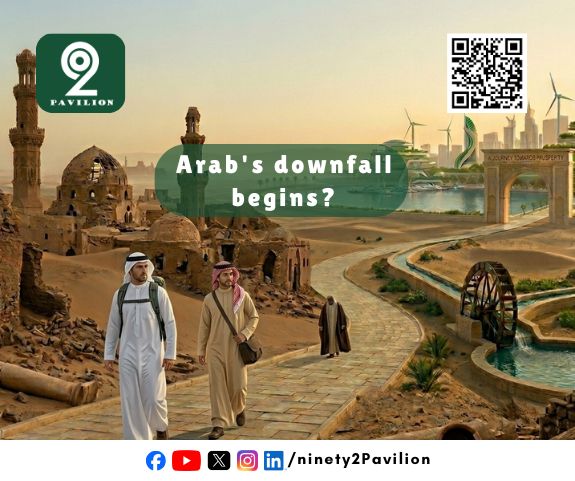
For decades, the Arab world has been defined by a paradox of immense subterranean wealth and persistent institutional fragility. As we move through 2026, the cracks in this foundation have become visible fissures. While high-rise skylines in the Gulf once suggested a region on a permanent ascent, a cold analysis of economics, demographics, and the devastating fallout of the ongoing 2026 Iran-U.S. War reveals a region approaching an inevitable systemic collapse.
The most immediate catalyst for this decline is the recent military confrontation between the United States, Israel, and Iran, launched in late February 2026 as Operation Epic Fury. While the kinetic strikes primarily targeted Iranian nuclear and military infrastructure, the “collateral damage” to the Arab world has been existential.
The closure of the Strait of Hormuz on March 4, 2026, effectively decapitated the economic models of the Gulf Cooperation Council (GCC). With 20% of global oil and LNG supplies stranded, nations like Qatar and the UAE have seen their primary revenue streams evaporate almost overnight. Furthermore, the conflict triggered a “grocery supply emergency” across the Gulf states, which rely on the Strait for over 80% of their food imports. By mid-March, food prices in major cities like Dubai and Doha surged by 40–120%, forcing state-led airlifts of basic staples. The war has shattered the “safety mirage,” proving that even the most modern Arab cities are helplessly tethered to a volatile geopolitical landscape they cannot control.
The End of the Rentier Era
Even without the scars of war, the Arab world’s traditional economic model is failing. Most Arab states have operated as “rentier” economies, where the state provides for its citizens in exchange for political acquiescence, funded entirely by hydrocarbons. As the global energy transition accelerates, this primary source of leverage is disappearing. The 2026 war merely accelerated the “end of the narrative” that the Gulf is a permanently safe haven for foreign investment and tourism. When the “rent” disappears, the social contract that has kept these autocracies stable for generations will likely shatter.
Demographics and Ecology
Compounding these issues is an ecological and demographic time bomb. The Middle East remains the most water-stressed region on Earth. By 2026, disputes over the Tigris, Euphrates, and Nile rivers have transitioned from diplomatic friction to matters of national survival.
As temperatures rise and desertification claims arable land, mass migration follows. With a “youth bulge”—millions of young people entering a job market that no longer has a functioning public sector to absorb them—the region faces a permanent class of educated but unemployed individuals.
The “inevitable decline” of the Arab world is not a prophecy of sudden disappearance, but a warning of structural obsolescence. The 2026 Iran-U.S. war has exposed the region’s extreme sensitivity to external shocks and the fragility of its wealth. Without a fundamental shift toward transparent governance and true economic liberalization, the current order will eventually buckle under the weight of its own contradictions. The mirage of stability is fading, leaving behind a reality that the region can no longer afford to ignore