
By: News Desk 92Pavilion
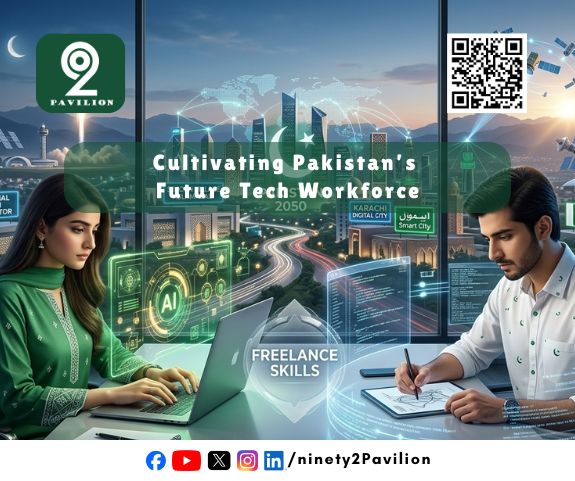
In 2026, Pakistan has firmly positioned itself as a rising star in the global digital economy, driven by a massive, government-led surge in IT skill development for its youth. Recognizing that nearly 60% of the population is under the age of 30, the state has transitioned from traditional vocational models to high-tech, market-driven training programs. This strategic shift is designed to transform the country’s demographic bulge into a “digital dividend,” aiming to push national IT exports past the $5 billion milestone. By equipping young men and women with specialized certifications in Artificial Intelligence, semiconductor design, and cloud computing, Pakistan is not just addressing local unemployment but is actively supplying the global talent pipeline.
At the forefront of this movement are flagship initiatives like the Prime Minister’s Youth Skill Development Program (PMYSDP) and the DigiSkills 3.0 platform. As of April 2026, DigiSkills has successfully launched its latest batch with over 300,000 seats, offering free courses in high-demand fields such as AI using Python, UI/UX design, and cybersecurity. These programs are meticulously designed to be accessible, allowing students in remote areas of Balochistan and Gilgit-Baltistan to learn from top-tier industry experts via digital learning management systems. The focus has moved beyond basic literacy toward “advanced freelancing,” enabling young Pakistanis to earn foreign exchange from their homes and contribute significantly to the country’s socioeconomic stability.
Furthermore, 2026 marks a historic entry into specialized hardware sectors through the National Semiconductor HR Development Program (INSPIRE). Under this Rs. 4.8 billion initiative, the Ministry of IT and Telecom has partnered with leading academic institutions like GIKI and NED University to train thousands of students in semiconductor digital design and verification. This upskilling program is a bold step toward integrating Pakistan into the global semiconductor value chain, an industry traditionally dominated by East Asian economies. By training youth in such niche, high-value technical domains, the government is ensuring that the workforce remains relevant in an era of rapid automation and technological disruption.
The impact of these training initiatives is already visible in the thriving startup ecosystem and the rising volume of IT remittances. Provincial programs, such as the CM Punjab Free IT Courses, complement federal efforts by providing localized workshops and mentorship in 3D animation and VR simulation. These collective efforts have fostered a culture of innovation where “tech-entrepreneurship” is becoming the preferred career path for the new generation. As the global demand for skilled digital labor continues to outpace supply, Pakistan’s commitment to mass-scale IT training is more than an educational reform—it is a comprehensive national security strategy that ensures long-term economic resilience and a seat at the table of the fourth industrial revolution