Latest Posts
Building a Vibrant Cultural FutureA Journey Towards ProsperityArab nations face an inevitable declineBlogging Revenue in Pakistan’s 2026 EconomyWhy China is Investing in Pakistan’s Gwadar PortThe Rising Spirit of Pakistani SportsVoice-Over Economy in Pakistan 2026India’s Investment in Iran,Chabahar PortEvent Management Business in Pakistan 2026The Volatile Trajectory of Pakistan-Afghanistan Relations in 2026Why Pakistan Must Overhaul Its InfrastructureEvolution of Goods and Equipment in Modern SportsThe Current Situation of Sports in PakistanGovernment Initiatives for Sports in PakistanAssessing Sports Infrastructure and Facilities in PakistanSialkot and the Renaissance of Pakistan’s Sports Goods IndustryEmerging Sports Trends in 2026Legacy of Popular Traditional SportsJourney Through the Background of Sports in PakistanInfrastructure and Framework Deficits in Pakistani Sports InstitutionsLevelling the Field of SportsThe Roadmap for Pakistan’s Islamic Financial TransitionApartheid Structure in Occupied KashmirThe Strategic Role of the SCO in 2026Complexities of Illegal Immigrant RepatriationPakistan’s Strategic Role in Regional Power DynamicsPakistan’s Strategic Role in the South Asian Power PlayPakistan’s Strategic Tightrope in the US-China RivalryPakistan-China Relations in a Changing Geopolitical EnvironmentForeign Relation of Pakistan with Neighboring CountriesGlobal Response and the Reshaping World Order in 2026Impacts of International Structure on Pakistan’s Foreign PolicyEnduring Conflict Between India and Pakistan

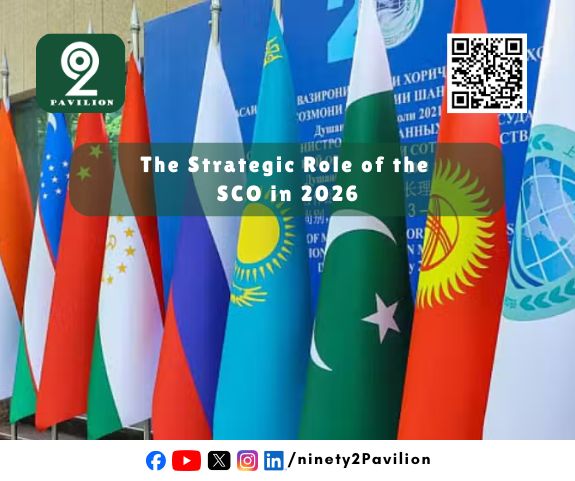
The Strategic Role of the SCO in 2026

The Strategic Role of the SCO in 2026

By: News Desk 92Pavilion

The geopolitical landscape of 2026, the Shanghai Cooperation Organization (SCO) has evolved from a regional security pact into one of the most significant pillars of a multipolar global order. Representing over 40% of the world’s population and nearly a quarter of its global GDP, the SCO now functions as a primary alternative to Western-led institutional frameworks. By bridging the interests of major powers like China, Russia, India, and Pakistan, alongside the resource-rich nations of Central Asia and new members like Iran and Belarus, the organization has created a unique “Eurasian Shield.” Its role in 2026 is defined by a sophisticated “Dual-Track” strategy: maintaining hard security against regional threats while aggressively pursuing a “Geo-Economic” agenda that emphasizes technological sovereignty and financial independence.

The foundational role of the SCO remains the preservation of regional stability through its “Three Evils” doctrine—combating terrorism, separatism, and extremism. In 2026, this mandate has become more institutionalized with the full operationalization of four specialized security centers launched at the 2025 Tianjin Summit. These centers, focused on transnational organized crime, information security, and anti-drug cooperation, work in tandem with the Regional Anti-Terrorist Structure (RATS) in Tashkent. As unconventional threats like cyber-warfare and digital radicalization rise, the SCO’s role has shifted toward “Collective Cyber-Defense.” By harmonizing security protocols across member states, the organization prevents regional flashpoints from escalating into broader conflicts, ensuring that the “Eurasian Heartland” remains a stable environment for trade and development.

Economically, the SCO’s role in 2026 is defined by the historic Development Strategy 2026–2035. This roadmap marks the organization’s transition from a talk shop to a financial powerhouse. The establishment of the SCO Development Bank has provided a dedicated funding mechanism for cross-border infrastructure, reducing the region’s reliance on the World Bank and the IMF. Furthermore, the organization is spearheading the “Logistics 2030” roadmap, which integrates ports and logistics centers across the member states. This creates a seamless “Steel Silk Road” that connects the Pacific to the Baltic and the Arabian Sea. By facilitating the “Free Movement of Goods and Capital,” the SCO is not just building roads; it is creating a unified market that leverages the collective energy reserves of Russia and Iran with the industrial capacity of China and India.

Perhaps the most significant role of the SCO in 2026 is its function as a Diplomatic Hedge in an era of great-power competition. As trade protectionism and “bloc mentalities” rise globally, the SCO provides a neutral ground where rivals—such as India and China, or India and Pakistan—can engage in pragmatic dialogue under the “Shanghai Spirit” of mutual trust and equality. The organization’s expansion into Southeast Asia, with the inclusion of Laos as a partner and the strengthening of ties with ASEAN, demonstrates its growing appeal as a model for non-prescriptive cooperation. Unlike Western alliances that often require political alignment, the SCO offers a partnership model based on “Win-Win” economic results and respect for national sovereignty.

Ultimately, the role of the SCO in 2026 is to act as a stabilizer in a fragmented world. It serves as a laboratory for “Non-Western Governance,” proving that diverse political systems can unite around shared interests in security and prosperity. By championing the “Energy Silk Road,” digital innovation, and local-currency trade, the SCO is ensuring that Eurasia remains the engine of global growth. For its member states, the organization is more than a treaty; it is a strategic insurance policy, ensuring that in the face of global uncertainty, the region can dictate its own destiny through collective strength and integrated action


Share

Introduction

Pakistan’s political environment in 2026 remains dynamic and highly influential in shaping the country’s future. From parliamentary debates and economic policy decisions to opposition movements and electoral reforms, recent developments are playing a crucial role in determining national direction.

In this report by Eye of Pakistan, we analyze the latest political developments, government strategies, and opposition responses.

Government’s Policy Priorities in 2026

The federal government has emphasized:

  • Economic stabilization

  • Institutional reforms

  • Energy sector restructuring

  • Strengthening foreign diplomatic ties

Recent cabinet meetings focused on controlling inflation, stabilizing the Pakistani Rupee, and implementing fiscal discipline under ongoing economic reform programs.

Officials claim these measures aim to restore investor confidence and ensure sustainable growth.

Opposition’s Response and Political Strategy

Major opposition parties have intensified criticism of government policies, particularly regarding:

  • Rising inflation

  • Unemployment

  • Tax reforms

  • Utility price increases

Opposition leaders argue that economic pressure on the public has increased and demand greater transparency in parliamentary proceedings.

Political rallies and public gatherings have increased across major cities including Karachi, Lahore, and Islamabad.

Parliamentary Developments

Recent National Assembly sessions have seen heated debates over:

  • Budget allocations

  • Electoral reforms

  • Accountability laws

  • Provincial autonomy issues

Lawmakers from both treasury and opposition benches continue to exchange strong viewpoints, reflecting a vibrant yet tense political atmosphere.

Election Reforms and Democratic Process

Discussions around electoral transparency and digital voting mechanisms remain central to political discourse.

The Election Commission is reportedly reviewing:

  • Voter verification systems

  • Polling station security

  • Overseas voting procedures

Analysts believe these reforms could significantly impact future general elections.

Public Reaction and Political Climate

Public opinion appears divided. While some citizens support structural reforms and long-term stabilization plans, others express concerns over economic hardships and governance challenges.

Political analysts suggest that the coming months will be critical in determining whether current policies translate into tangible relief for the public.

Conclusion

Pakistan’s political landscape in 2026 is marked by active debate, institutional reforms, and strategic maneuvering from both government and opposition parties. As policy decisions continue to unfold, their impact on economic stability and democratic processes will remain under close observation.

Stay connected with Eye of Pakistan for reliable and timely political updates.