By: News Desk 92Pavilion
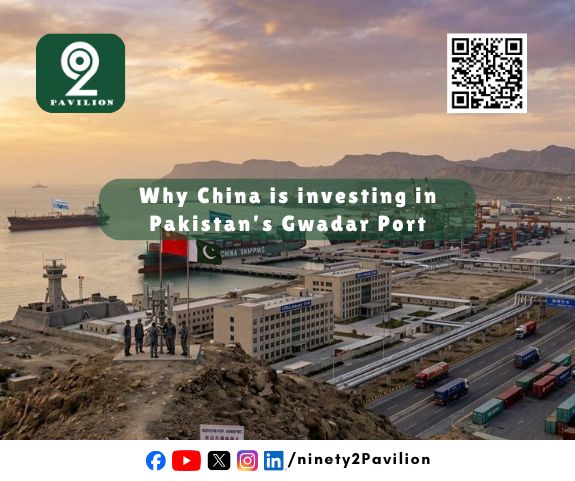
In the global theater of 2026, few infrastructure projects carry as much weight as Gwadar Port. Situated at the apex of the Arabian Sea in Pakistan’s Balochistan province, Gwadar is the crown jewel of the China-Pakistan Economic Corridor (CPEC). For Beijing, the port is not merely a commercial terminal; it is a vital strategic “escape route” designed to safeguard its energy security and project influence across the Indian Ocean.
The “Malacca Dilemma” and Energy Security
China’s primary motivation for investing billions into Gwadar is to solve the “Malacca Dilemma.” Currently, over 80% of China’s oil imports pass through the narrow Strait of Malacca, a chokepoint that could be easily blockaded by the U.S. Navy in the event of a conflict.
By developing Gwadar, China creates a direct 3,000-kilometer land route connecting the Arabian Sea to its landlocked western province of Xinjiang. This allows oil tankers from the Middle East to offload at Gwadar, with the crude being transported via pipelines and roads through Pakistan, effectively bypassing the South China Sea and the Malacca bottleneck.
Gwadar as a Sanctuary Amidst the 2026 U.S.-Iran War
The importance of Gwadar has surged in the wake of the military conflict between the United States and Iran that escalated in early 2026. As “Operation Epic Fury” saw the Strait of Hormuz become a high-risk combat zone, global shipping routes faced unprecedented disruptions.
- The Hormuz Alternative: While Iranian ports like Bandar Abbas faced naval blockades and kinetic strikes, Gwadar—located safely outside the Persian Gulf—emerged as a critical maritime sanctuary.
- Logistical Resilience: During the 2026 crisis, China utilized Gwadar as a “transshipment hub,” moving cargo and energy supplies away from the volatile Iranian coast.
- U.S.-China Friction: The 2026 war has also highlighted Gwadar’s dual-use potential. While Beijing maintains it is a commercial venture, the U.S. views the fortified port as a potential naval base for the People’s Liberation Army (PLA). As regional tensions peak, Gwadar provides China with a “listening post” to monitor U.S. naval movements in the Arabian Sea and the Persian Gulf.
Countering the “Golden Gate”: Gwadar vs. Chabahar
China’s investment is also a tactical move to counter India’s influence in the region. Just 170 kilometers to the west lies the Indian-backed Chabahar Port in Iran. By establishing a dominant presence in Gwadar, China ensures that India and its partners do not hold a monopoly over Central Asian trade routes. Gwadar’s deep-sea capabilities far exceed current regional alternatives, positioning it as the primary gateway for landlocked Central Asian republics looking to reach the global market.
As of April 2026, Gwadar has evolved from an economic corridor into a “security imperative.” For China, the investment is a hedge against a future where sea lanes are weaponized. Despite the local security challenges and the fallout of the U.S.-Iran war, Beijing’s commitment remains firm. In the high-stakes game of 21st-century geopolitics, Gwadar is the anchor that allows China to look past its maritime vulnerabilities and secure a permanent foothold in the West Asian theater