By: News Desk 92Pavilion
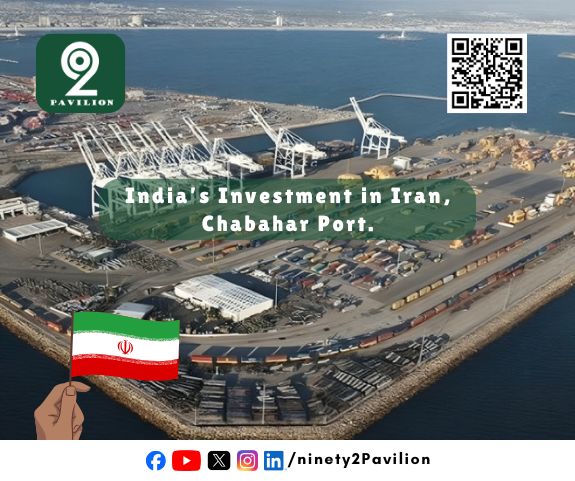
In the complex landscape of West Asian geopolitics, India’s investment in the Chabahar Port in Iran has transitioned from a mere commercial project into a critical lifeline for India’s strategic autonomy. Located on the Makran coast of Iran, Chabahar is India’s “Golden Gate” to Afghanistan and Central Asia. As of early 2026, the project is facing its most intense pressure yet, caught between the shifting sands of the 2026 U.S.-Iran conflict and India’s long-term economic ambitions.
The Geopolitical Imperative: Bypassing the Pakistan Bottleneck
India’s primary motivation for the Chabahar project is geographical. For decades, land access to Afghanistan and the resource-rich Central Asian Republics was blocked by Pakistan. By developing the Shahid Beheshti Terminal, India has created a transit bypass that avoids Pakistani territory entirely.
In May 2024, India signed a landmark 10-year contract to operate the port, committing $120 million for equipment and a $250 million credit line. By August 26, 2025, India fulfilled its primary financial obligations, signaling to the world that its partnership with Tehran is a long-term strategic pillar that New Delhi will not easily abandon.
Chabahar as a Sanctuary: The 2026 U.S.-Iran War
The ongoing military confrontation between the United States and Iran has redefined the port’s value. Following the escalation in early 2026, the Strait of Hormuz—the world’s most sensitive oil chokepoint—has faced frequent blockades and high-risk military activity.
- Geographic Safety: Unlike Iran’s main port at Bandar Abbas, which sits deep inside the Persian Gulf, Chabahar is an oceanic port located outside the Strait of Hormuz.
- The Humanitarian Corridor: During the 2026 “Operation Epic Fury,” while other Iranian ports were throttled by naval tension, Chabahar emerged as a vital sanctuary for humanitarian aid and grain shipments.
- The Sanctions Tightrope: Historically, the U.S. granted India “carve-outs” (sanctions waivers) for Chabahar due to its role in Afghan reconstruction. However, as of March 2026, the U.S. has placed India on a countdown, with the current conditional sanctions waiver set to expire on April 26, 2026. This has forced Indian diplomats into a high-stakes balancing act: maintaining its “Comprehensive Global Strategic Partnership” with Washington while protecting its “civilizational ties” with Tehran.
A Counterweight to China’s Presence
Beyond the U.S.-Iran friction, Chabahar is a direct strategic answer to China’s Belt and Road Initiative (BRI). Just 170 kilometers to the east lies the Pakistani port of Gwadar, funded and operated by China. For India, maintaining its presence in Chabahar is essential to prevent a Chinese naval monopoly in the North Arabian Sea and to secure its role in the International North-South Transport Corridor (INSTC).
For India, Chabahar is not just an investment in cranes and concrete; it is a symbol of strategic sovereignty. Despite the clouds of war and the looming April 26 deadline, New Delhi remains engaged with all parties. In an era where global trade routes are weaponized, Chabahar stands as a testament to India’s resolve to keep its window to the West open, no matter the geopolitical cost