
By: News Desk 92Pavilion
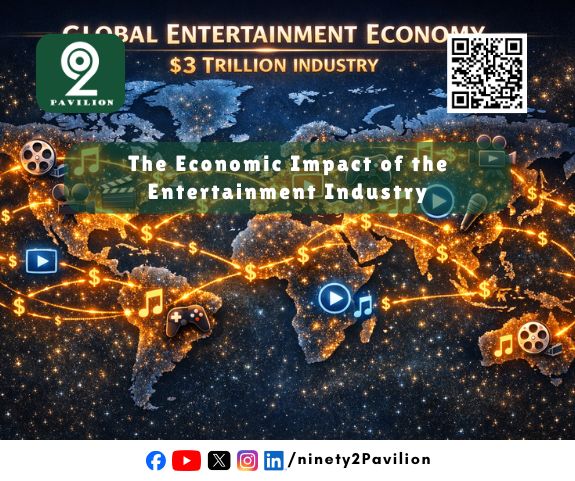
In 2026, the entertainment industry has transcended its traditional role as a source of leisure to become a primary pillar of the global economy. Valued at over $3 trillion, the sector is growing at a compound annual growth rate of approximately 7.7%, significantly outpacing many traditional industrial sectors. This economic powerhouse—often referred to as the “Orange Economy”—is no longer a peripheral luxury but a technology-intensive infrastructure that drives GDP, fosters massive employment, and stimulates secondary growth in sectors ranging from tourism to telecommunications. As digital transformation matures, the entertainment industry is effectively rewriting the script for modern economic resilience.
The direct economic contribution of the industry is staggering. By mid-2026, global advertising spend is projected to exceed $1 trillion, with nearly 69% of that investment flowing into digital channels. This surge is fueled by the integration of 5G technology and AI-driven hyper-personalization, which have turned every screen into a direct-to-consumer marketplace. In high-growth regions like the Asia-Pacific, the industry is expanding at over 5% annually, driven by a rising middle class with increased disposable income and a voracious appetite for localized digital content. These revenues provide critical tax bases for governments, which are increasingly offering tax credits and incentives to attract large-scale film and digital production hubs to their shores.
Beyond direct revenues, the “multiplier effect” of entertainment is perhaps its most significant economic trait. For every dollar spent on a major film production or a large-scale music festival, approximately $2.50 is generated in the wider economy. This is particularly evident in the “Experience Economy,” where live entertainment events stimulate local businesses, including hotels, restaurants, and transportation services. In 2026, live event revenues for major promoters have expanded beyond $25 billion, revitalizing urban centers and acting as a catalyst for regional tourism. Furthermore, the burgeoning “Creator Economy” has democratized income generation, allowing millions of independent creators to bypass traditional gatekeepers and contribute to global trade through digital exports.
Employment remains the industry’s most vital social contribution. The sector currently supports over 30 million jobs worldwide, ranging from high-tech roles in animation and visual effects (VFX) to logistics and event management. In 2026, demand for specialized skills in AI-voice cloning, virtual production, and cybersecurity for digital assets has created a new class of high-wage technical occupations. While automation has shifted some traditional roles, the net effect has been a labor market expansion, particularly for “tech-creative” professionals who can navigate the intersection of storytelling and spatial computing.
Ultimately, the entertainment industry in 2026 functions as a strategic capability for national economies. It is a sector built on intellectual property, which remains a durable asset even in times of physical resource scarcity. By investing in the creative and technological foundations of entertainment, nations are ensuring long-term competitiveness in a world where “attention” is the most valuable currency. As we move toward the 2030s, the flourishing world of entertainment will continue to prove that the imagination is not just a cultural playground, but a relentless engine of economic prosperity