Latest Posts
Building a Vibrant Cultural FutureA Journey Towards ProsperityArab nations face an inevitable declineBlogging Revenue in Pakistan’s 2026 EconomyWhy China is Investing in Pakistan’s Gwadar PortThe Rising Spirit of Pakistani SportsVoice-Over Economy in Pakistan 2026India’s Investment in Iran,Chabahar PortEvent Management Business in Pakistan 2026The Volatile Trajectory of Pakistan-Afghanistan Relations in 2026Why Pakistan Must Overhaul Its InfrastructureEvolution of Goods and Equipment in Modern SportsThe Current Situation of Sports in PakistanGovernment Initiatives for Sports in PakistanAssessing Sports Infrastructure and Facilities in PakistanSialkot and the Renaissance of Pakistan’s Sports Goods IndustryEmerging Sports Trends in 2026Legacy of Popular Traditional SportsJourney Through the Background of Sports in PakistanInfrastructure and Framework Deficits in Pakistani Sports InstitutionsLevelling the Field of SportsThe Roadmap for Pakistan’s Islamic Financial TransitionApartheid Structure in Occupied KashmirThe Strategic Role of the SCO in 2026Complexities of Illegal Immigrant RepatriationPakistan’s Strategic Role in Regional Power DynamicsPakistan’s Strategic Role in the South Asian Power PlayPakistan’s Strategic Tightrope in the US-China RivalryPakistan-China Relations in a Changing Geopolitical EnvironmentForeign Relation of Pakistan with Neighboring CountriesGlobal Response and the Reshaping World Order in 2026Impacts of International Structure on Pakistan’s Foreign PolicyEnduring Conflict Between India and PakistanAncient Roman and Modern EntertainmentCultivating Pakistan’s Future Tech WorkforceBuilding, Champions of the WorldDeciphering the Boundary Between Art and EntertainmentDevelopment of Pakistan’s Entertainment Industry

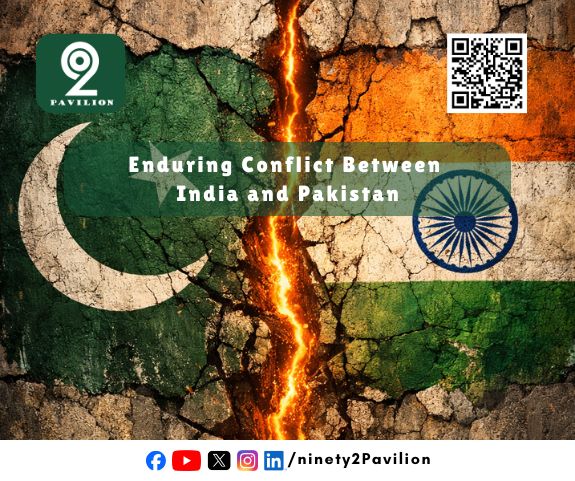
Enduring Conflict Between India and Pakistan

Enduring Conflict Between India and Pakistan

By: News Desk 92Pavilion

The relationship between India and Pakistan remains one of the most complex and volatile geopolitical standoffs in modern history, a rivalry rooted in the traumatic bloodletting of the 1947 Partition. As we navigate through 2026, the conflict continues to be defined by a delicate balance of nuclear deterrence, territorial disputes, and deep-seated historical grievances that have shaped the national identities of both South Asian giants. What began as a disagreement over the administrative transition of the British Raj has evolved into a multi-generational struggle for regional hegemony and ideological validation. At the heart of this discord is the disputed region of Kashmir, a territory that has sparked three major wars and countless skirmishes, remaining the ultimate flashpoint in a region home to nearly two billion people.

The roots of the conflict are often traced back to the “Two-Nation Theory,” which argued that Hindus and Muslims were distinct nations that could not coexist within a single state. The resulting partition of the subcontinent led to one of the largest mass migrations in human history, characterized by communal violence that left an indelible mark on the collective psyche of both nations. India, established as a secular democracy, and Pakistan, founded as a homeland for Muslims, found themselves immediately at odds over the princely state of Jammu and Kashmir. India’s claim is bolstered by the 1947 Instrument of Accession, while Pakistan maintains that the region’s Muslim majority necessitates its integration into Pakistan. This fundamental disagreement has turned the Line of Control (LoC) into one of the most militarized borders in the world, where cross-border shelling and seasonal escalations remain a grim reality even in 2026.

The 1998 nuclear tests by both nations fundamentally altered the nature of the conflict, moving it into a “Cold War” paradigm where total war became an unthinkable catastrophe. This nuclear umbrella, however, has not prevented “limited” conflicts or the rise of unconventional warfare. India has frequently accused Pakistan of harboring and supporting militant groups to wage a “war of a thousand cuts,” leading to high-profile attacks like those in Mumbai in 2008 and Pulwama in 2019. In response, India has shifted its policy toward “surgical strikes” and diplomatic isolation of its neighbor. Conversely, Pakistan points to human rights concerns in the Kashmir valley and views India’s 2019 revocation of Article 370—which stripped Jammu and Kashmir of its special autonomous status—as an illegal annexation that violates international law and UN resolutions.

In the mid-2020s, the conflict has expanded into new arenas, including water security and digital influence. The Indus Waters Treaty, which has survived previous wars, is under increasing strain as both nations grapple with climate change and the need for hydroelectric power. Furthermore, the rise of social media has turned the conflict into a 24-hour information war, where nationalist rhetoric is amplified, making diplomatic de-escalation a politically risky move for leaders in both New Delhi and Islamabad. Despite several “back-channel” attempts at peace and occasional glimmers of hope through cricket diplomacy or religious corridors like Kartarpur, the trust deficit remains cavernous.

Ultimately, the India-Pakistan conflict is not merely a border dispute; it is a clash of narratives. For India, the focus is on regional stability, economic growth, and the suppression of cross-border terrorism. For Pakistan, the focus remains on the “unfinished business” of Partition and the self-determination of the Kashmiri people. As global powers like the United States and China increasingly align with different sides of this rivalry, the bilateral tension takes on a broader significance for international security. Resolving this deadlock requires more than just a redrawing of maps; it demands a courageous reimagining of a shared future where the ghosts of 1947 are finally laid to rest, allowing the subcontinent to fulfill its immense human and economic potential

Share

Introduction

Pakistan’s political environment in 2026 remains dynamic and highly influential in shaping the country’s future. From parliamentary debates and economic policy decisions to opposition movements and electoral reforms, recent developments are playing a crucial role in determining national direction.

In this report by Eye of Pakistan, we analyze the latest political developments, government strategies, and opposition responses.

Government’s Policy Priorities in 2026

The federal government has emphasized:

  • Economic stabilization

  • Institutional reforms

  • Energy sector restructuring

  • Strengthening foreign diplomatic ties

Recent cabinet meetings focused on controlling inflation, stabilizing the Pakistani Rupee, and implementing fiscal discipline under ongoing economic reform programs.

Officials claim these measures aim to restore investor confidence and ensure sustainable growth.

Opposition’s Response and Political Strategy

Major opposition parties have intensified criticism of government policies, particularly regarding:

  • Rising inflation

  • Unemployment

  • Tax reforms

  • Utility price increases

Opposition leaders argue that economic pressure on the public has increased and demand greater transparency in parliamentary proceedings.

Political rallies and public gatherings have increased across major cities including Karachi, Lahore, and Islamabad.

Parliamentary Developments

Recent National Assembly sessions have seen heated debates over:

  • Budget allocations

  • Electoral reforms

  • Accountability laws

  • Provincial autonomy issues

Lawmakers from both treasury and opposition benches continue to exchange strong viewpoints, reflecting a vibrant yet tense political atmosphere.

Election Reforms and Democratic Process

Discussions around electoral transparency and digital voting mechanisms remain central to political discourse.

The Election Commission is reportedly reviewing:

  • Voter verification systems

  • Polling station security

  • Overseas voting procedures

Analysts believe these reforms could significantly impact future general elections.

Public Reaction and Political Climate

Public opinion appears divided. While some citizens support structural reforms and long-term stabilization plans, others express concerns over economic hardships and governance challenges.

Political analysts suggest that the coming months will be critical in determining whether current policies translate into tangible relief for the public.

Conclusion

Pakistan’s political landscape in 2026 is marked by active debate, institutional reforms, and strategic maneuvering from both government and opposition parties. As policy decisions continue to unfold, their impact on economic stability and democratic processes will remain under close observation.

Stay connected with Eye of Pakistan for reliable and timely political updates.

Education in Pakistan 2026

By: News Desk 92Pavilion Education in Pakistan stands as a complex paradox of modest statistical gains and deep-rooted systemic crises. As of 2026, the national

Share
Read More »