
By: News Desk 92Pavilion
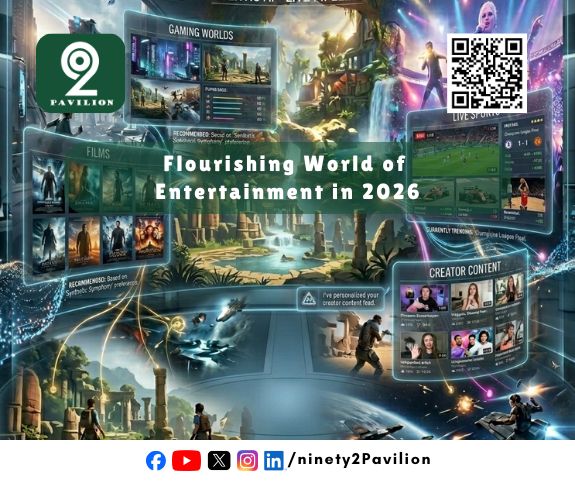
The entertainment landscape of 2026 has transitioned from a period of digital fragmentation into a cohesive, flourishing ecosystem defined by “frictionless” experiences and deep personalization. As we move through the mid-2020s, the traditional boundaries between cinema, gaming, social media, and live performance have blurred, creating a multidimensional world where the audience is no longer just a spectator but a central participant. This evolution is powered by the maturation of generative AI and immersive technologies, which have shifted the industry’s focus from mere content volume to the quality of high-fidelity, interactive engagement.
At the heart of this flourishing world is the “Next-Generation Bundle,” a strategic consolidation where tech giants and legacy media houses have moved beyond the “streaming wars” to offer unified platforms. These services now integrate live sports, short-form creator content, and premium long-form series into a single, AI-curated interface. Discovery fatigue, a major hurdle of previous years, has been mitigated by hyper-personalized recommendation engines that learn not just a user’s history, but their current mood and environmental context. In 2026, the global entertainment market is projected to reach approximately $3.1 trillion, driven by this newfound ease of access and the resurgence of bundled value.
Gaming has solidified its position as the apex of modern entertainment. No longer a niche hobby, it has become a primary social infrastructure where music, fashion, and film converge. Virtual concerts within persistent game worlds now draw tens of millions of concurrent “attendees,” offering a level of agency that traditional broadcasting cannot match. Parallel to this is the rise of “Mixed Reality” (MR) and spatial computing. With the widespread adoption of high-fidelity headsets and AR glasses, storytelling has become modular; a fan can watch a series on their screen and then “step into” the scene using AR to explore the set or interact with digital twins of the characters.
Furthermore, 2026 marks a turning point for authenticity and the creator economy. While AI handles the heavy lifting of production workflows—from automated video editing to real-time language localization—human-led “authentic experiences” have become the most valuable currency. Creators are now treated as independent media entities with total IP ownership, often partnering with major studios to turn social media micro-moments into global franchises. This synergy between “Big Media” and “Boutique Creators” has ensured a constant flow of diverse, culturally relevant content that resonates with specific niche communities.
Ultimately, the flourishing world of entertainment in 2026 is defined by its ability to meet the user wherever they are. Whether through “shoppertainment” that merges streaming with instant commerce, or the “slow media” movement that prioritizes sustainability and mental well-being, the industry has finally stopped chasing technology for its own sake. Instead, it is using these tools to craft a world where every story is a shared experience, and every experience is limited only by the imagination