
By: News Desk 92Pavilion
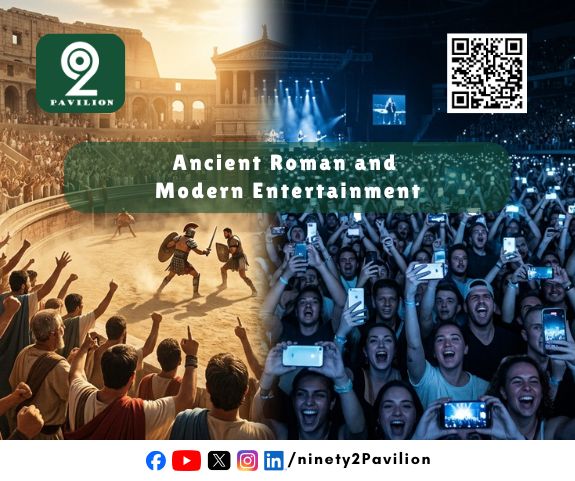
The human desire for diversion is a constant thread that binds the distant past of Ancient Rome to the high-tech reality of 2026. While the methods of delivery have shifted from stone amphitheatres to digital clouds, the underlying psychology of entertainment—the craving for shared spectacle, competitive thrill, and emotional escape—remains remarkably consistent. In Ancient Rome, entertainment was a tool of political stability, famously encapsulated by the satirical poet Juvenal as “bread and circuses.” Today, while the stakes of survival have changed, entertainment remains the primary vehicle through which society processes its values and finds respite from the pressures of modern life.
In the Roman world, the pinnacle of entertainment was the live, visceral spectacle. The Colosseum, which could hold upwards of 50,000 spectators, was the epicenter of gladiatorial combat, while the Circus Maximus hosted chariot races for crowds exceeding 150,000. These events were multisensory experiences: the smell of sawdust, the roar of the crowd, and the visual drama of life-and-death stakes. These ludi, or public games, were often free to the citizens, funded by the elite to secure public favor and distract the populace from political unrest. They provided a sense of social cohesion and a release for collective aggression, functioning as the ultimate “live event” that dictated the rhythm of urban life.
Fast forward to 2026, and the “stadium” has become both a physical landmark and a virtual space. While we still gather in massive arenas for football or concerts, a significant portion of modern entertainment is consumed in the “infinite amphitheatre” of the digital world. The bloodlust of the gladiator pits has been sublimated into the high-stakes world of professional e-sports and hyper-realistic gaming. Instead of physical chariots, we witness the digital precision of simulation racing. The “bread” of the past has evolved into the “subscription model,” where for a monthly fee, citizens have unlimited access to a digital buffet of films, music, and interactive media. Yet, the core appeal remains the same: the thrill of the contest and the communal experience of watching a master at their craft.
The most profound difference lies in the democratization and personalization of the experience. Roman entertainment was a top-down affair, curated by the state and dictated by the calendar. In 2026, technology has handed the remote to the individual. Through AI-driven personalization and mobile connectivity, entertainment is no longer a scheduled pilgrimage to a stone arena; it is a constant, ambient companion. We have moved from the “mass spectacle” to the “personalized niche,” where algorithms curate a private Colosseum of content for every user. However, even in this fragmented landscape, the “event” still reigns supreme. Whether it is a global streaming premiere or a virtual reality concert, we still seek those moments that allow us to feel part of something larger than ourselves.
Ultimately, the transition from Ancient Rome to today reveals that while our tools have become more sophisticated and our morals more refined, our nature is unchanged. We are still a species that gathers to watch a story unfold, to cheer for a champion, and to escape the mundane through the power of performance. Whether stone or silicon, the arena remains the heart of the human experience