
By: News Desk 92Pavilion
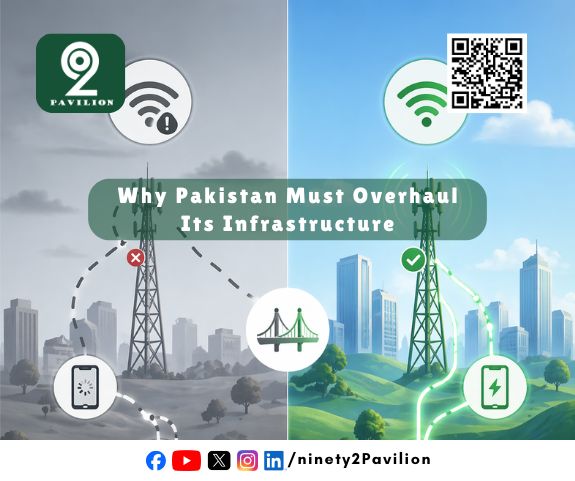
The global economy has transitioned into a hyper-connected era where digital infrastructure is no longer a luxury but the primary determinant of national sovereignty and economic survival. For Pakistan, a country possessing the world’s fourth-largest freelance workforce and a massive youth population, the mandate is clear: improving digital infrastructure is a foundational necessity. While the nation has seen significant growth in mobile penetration and early 5G adoption, the current landscape is marred by systemic fragilities that threaten to derail its digital ambitions. To unlock the full potential of its people, Pakistan must aggressively address its connectivity bottlenecks, upgrade its physical fiber-optic backbone, and ensure that high-speed internet is treated as a basic, uninterrupted public utility rather than an urban privilege.
The most pressing issue facing the country in April 2026 is the lack of “Submarine Resilience” and domestic fiber density. Pakistan’s reliance on a limited number of aging submarine cables has led to frequent and catastrophic nationwide internet outages, often triggered by technical faults or maritime accidents. For a service-led economy that generates billions in IT export remittances, these disruptions are devastating, eroding international trust and leading to the cancellation of high-value contracts. Improving digital infrastructure requires a massive influx of investment to increase the number of international gateway stations and expand the domestic “Fiber-to-the-Home” (FTTH) network. Currently, Pakistan’s fiber-to-tower ratio remains significantly lower than its regional competitors, which stifles the performance of even the most advanced 4G and 5G nodes. Without a dense, resilient physical network, the digital revolution remains a hollow promise, unable to support the data-intensive demands of modern AI and cloud-based systems.
Furthermore, the “Digital Divide” between urban centers and rural peripheries remains a glaring structural failure. While cities like Lahore, Karachi, and Islamabad enjoy relatively stable connectivity, the vast majority of rural Pakistan—the nation’s agrarian and manufacturing heartland—is left in a state of digital isolation. This geographic disparity prevents millions of young people from accessing global educational resources and remote-work opportunities. Improving infrastructure must involve a “Last-Mile Connectivity” strategy that leverages satellite internet and rural broadband initiatives to bridge this gap. By championing equal access, the state can ensure that a child in a village in Balochistan or Gilgit-Baltistan has the same digital tools as their peers in the provincial capitals. This is not just about social equity; it is about tapping into the full intellectual reservoir of the nation to drive aggregate economic growth.
The role of the government and regulatory bodies in this transition is critical. In 2026, the industry continues to advocate for the removal of heavy taxes on digital devices and infrastructure equipment, which act as a barrier to modernization. A truly prepared digital infrastructure requires a stable, pro-investment regulatory environment that encourages private telecom operators to invest in long-term capacity rather than short-term survival. This includes streamlining the “Right of Way” (RoW) policies that currently make the laying of fiber-optic cables a bureaucratic nightmare. By simplifying these processes and offering incentives for localized production of networking hardware, Pakistan can reduce its reliance on expensive imports and build a self-sustaining tech ecosystem.
Ultimately, the goal for late 2026 must be to transform the internet from an “optional extra” into a robust, high-availability public utility. The global response to Pakistan’s tech potential is immense, but international investors and tech giants require a stable “Digital Ground” to plant their investments. The current situation, where connectivity is often at the mercy of aging cables or opaque regulatory firewalls, must change. By investing in a resilient, high-capacity, and inclusive digital infrastructure, Pakistan is not just buying faster speeds; it is buying into the future of work, education, and governance. The next decade will be written in code, and for Pakistan to lead, it must first ensure that its people have the tools and the stability to stay connected to the world