
By: News Desk 92Pavilion
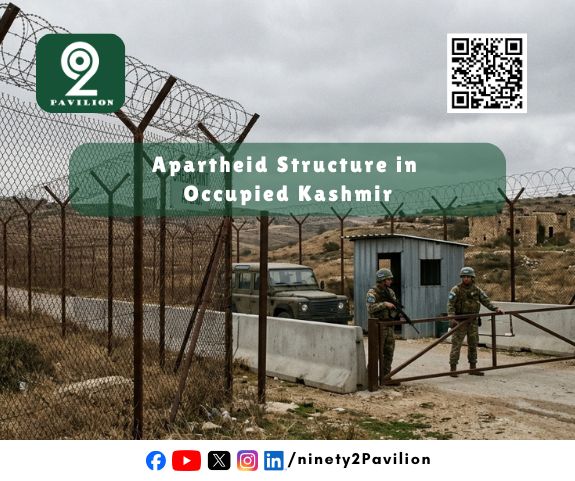
The geopolitical discourse of 2026, the situation in Jammu and Kashmir is increasingly defined through the lens of “settler-colonialism” and “apartheid.” What was once framed primarily as a bilateral territorial dispute between India and Pakistan has evolved into a localized struggle against a systematic institutional framework designed to marginalize the indigenous population. Since the unilateral revocation of Article 370 in 2019, the region has undergone a profound structural transformation. Critics and international human rights observers argue that the current administration has implemented a tiered system of citizenship and residency that mirrors historical apartheid structures, aimed at fundamentally altering the demographic, cultural, and political landscape of the only Muslim-majority territory under Indian control.
The foundational element of this perceived apartheid system is the New Domicile Rules introduced in 2020. By lowering the threshold for non-locals to acquire residency, property rights, and government jobs, the administration has facilitated a demographic shift that indigenous Kashmiris view as an existential threat. In 2026, the impact of these policies is visible in the rapid redistribution of land and resources. The “Land Grants Rules” have allowed the state to lease out vast tracts of land to non-local corporations and individuals, often under the guise of industrial development or national security. For the local population, this translates into a loss of ancestral heritage and economic disenfranchisement, creating a society where the indigenous majority is increasingly relegated to the fringes of the formal economy while outsiders are granted preferential access to the region’s wealth.
Furthermore, the militarization of daily life in Kashmir remains unparalleled. With one of the highest soldier-to-civilian ratios in the world, the region is characterized by an intrusive security apparatus that regulates movement, speech, and assembly. The use of “draconian” laws like the Public Safety Act (PSA) and the Unlawful Activities (Prevention) Act (UAPA) allows for indefinite detention without trial, often targeting journalists, academics, and human rights defenders. In 2026, the “digital siege” has become a permanent feature of this control; localized internet shutdowns and the sophisticated monitoring of social media have effectively criminalized dissent. This environment of surveillance and “preventive” policing creates a dual reality: a normalized facade for tourists and a high-security enclosure for the local population, where basic civil liberties are suspended in the name of “counter-insurgency.”
The cultural and religious dimension of the occupation has also intensified. The systematic renaming of historical sites, the alteration of school curricula, and the restrictions on major religious congregations are seen as attempts to erase the distinct “Kashmiriyat” identity. By institutionalizing a narrative that equates Kashmiri political aspirations with religious extremism, the state justifies a heavy-handed approach that would be untenable in other parts of the country. This “othering” of the Kashmiri people is a hallmark of apartheid, where the state utilizes its legal and military might to enforce the supremacy of a specific national ideology over a subjugated group. The lack of local political representation, with the region being governed directly from New Delhi through unelected bureaucrats, further underscores the absence of democratic agency for the Kashmiri people.
Ultimately, the situation in Kashmir in 2026 is a test for the international community’s commitment to human rights and self-determination. While global powers often prioritize strategic and economic ties with India, the growing body of evidence regarding systemic rights violations and demographic engineering is becoming harder to ignore. The term “apartheid” is no longer just a rhetorical device used by activists; it is a legal and sociological framework being applied by international bodies to describe a system of “institutionalized oppression and domination.” Resolving the Kashmir conflict requires more than just a return to the status quo; it necessitates a dismantling of the structures that deny the Kashmiri people their fundamental right to decide their own future in a climate free from fear and subjugation