By: News Desk 92Pavilion
The high-stakes choreography of a United States President landing on Chinese soil is never merely about the red carpets or the stiff handshakes captured by a phalanx of global photographers. It is a calculated chess move in a game that has transitioned from traditional diplomacy to a frantic race for technological and resource supremacy. The story behind this specific visit is not found in the official press releases regarding climate change or trade deficits; rather, it is buried in the silent crisis of the global supply chain and the desperate need for a new “equilibrium of power.” For decades, the West and the East have lived in a symbiotic state of mutual suspicion and economic necessity, but recent shifts in domestic pressures within both Washington and Beijing have forced a sit-down that neither side truly wanted, but both desperately required.
The true narrative here is the “Quiet Realignment.” Behind closed doors, the conversation has moved away from the loud rhetoric of sanctions and toward the quiet reality of interdependence. The U.S. realizes that a total “decoupling” from the Chinese manufacturing engine is a logistical fantasy that could trigger a domestic depression, while China understands that its internal economic cooling requires a steady, predictable relationship with the world’s largest consumer market. This visit was an attempt to install “guardrails” on a relationship that was careening toward a cliff. It was a search for a middle ground where both superpowers could compete fiercely in the AI and semiconductor space without accidentally triggering a kinetic conflict that would bankrupt the planet. The story is one of two giants realizing that they are handcuffed together in a burning room; they don’t have to like each other, but they must cooperate to find the exit.
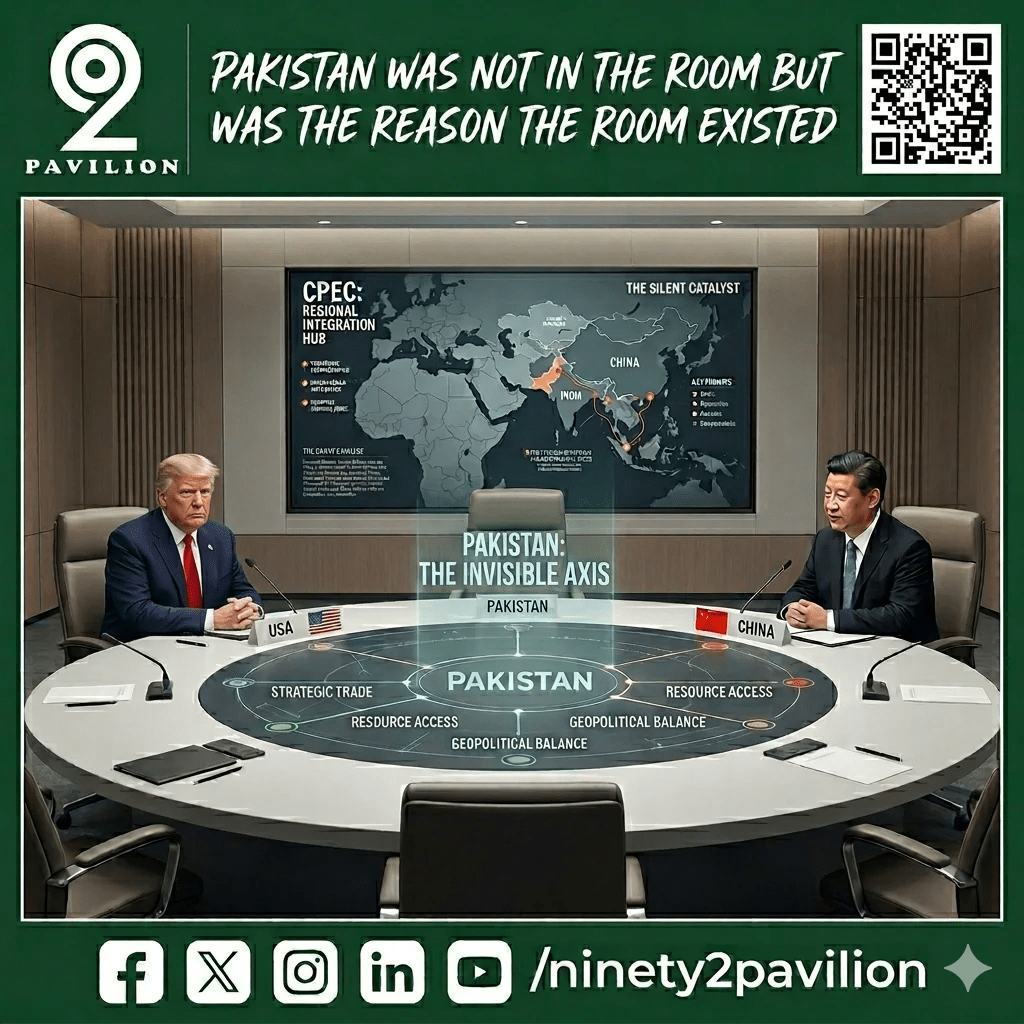
For Pakistan, the fallout of this visit is a complex tapestry of risk and unprecedented opportunity. Historically, Pakistan has been forced to walk a precarious tightrope between its foundational “all-weather” friendship with China and its critical, albeit often turbulent, security and financial partnership with the United States. When these two giants move toward a thaw, the immediate “fruit” for Pakistan is the reduction of “choice-pressure.” For years, Islamabad has been haunted by the specter of having to pick a side in a new Cold War. A stabilized U.S.-China relationship allows Pakistan to breathe, positioning itself not as a partisan camp-follower, but as a strategic bridge. If the two largest economies in the world are talking, Pakistan’s role as a gateway—leveraging its geography and its unique relationships with both—becomes a massive diplomatic asset rather than a liability.
Is it fruitful? The answer lies in the corridors of infrastructure and finance. As the U.S. and China discuss global stability, the pressure on Pakistan’s debt restructuring and investment climate begins to shift. A cooperative atmosphere means that Western financial institutions and Chinese development projects, like the CPEC, are less likely to be viewed as mutually exclusive. We are entering an era where Pakistan can potentially attract American tech investment while maintaining Chinese industrial support. The “fruit” here is the potential for Pakistan to act as a neutral economic zone where East meets West. This visit signals that the era of “bloc-politics” might be giving way to a more fluid, interest-based diplomacy. If Pakistan can play its cards with the same precision seen in the recent strategic shifts of its mining and mineral sectors—focusing on radical transparency and global integration—it can turn this superpower detente into a catalyst for its own industrial rebirth. The visit wasn’t just about Washington and Beijing; it was a signal to the world that the rules of the game are changing, and for a nation positioned at the crossroads of the future, that change is the greatest opportunity of the century.