News Desk 92Pavilion
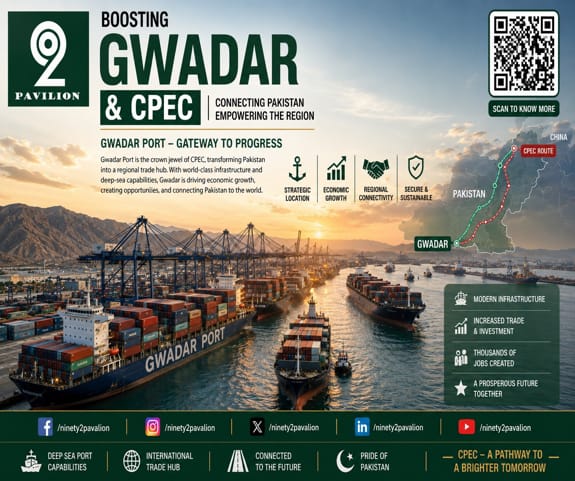
The federal government has revealed significant tariff cuts at Gwadar Port to boost international transit traffic and enhance the port’s role as a regional trade and logistics center.
Federal Minister for Maritime Affairs Junaid Anwar Chaudhry announced that container vessel berthing charges have been lowered by 25 percent, and port fees on international transshipment containers have been decreased by 40 percent.
The minister stated that port fees for transit container cargo have been lowered by as much as 31 percent. Furthermore, the government has implemented one month of complimentary storage for general cargo, superseding the former provision of five free days.
Authorities indicate that vessels transporting transit and transshipment goods will experience substantial operational benefits from the updated tariff framework, which is regarded as one of the most attractive incentive schemes available among domestic ports.
The authorities are confident that the recent initiatives will reduce shipping firms’ operational expenses, boost cargo handling efforts, enhance port usage, and contribute to broader economic advancement in the area.
Chairman Noor ul Haq Baloch of Gwadar Port stated that the initiative could enhance maritime trade, draw commercial activities, and generate new job opportunities in Balochistan.
The decision showcases Pakistan’s larger plan to establish Gwadar as a significant regional hub linking South Asia, Central Asia, and the Middle East via enhanced maritime and logistical infrastructure
Introduction
Pakistan’s political environment in 2026 remains dynamic and highly influential in shaping the country’s future. From parliamentary debates and economic policy decisions to opposition movements and electoral reforms, recent developments are playing a crucial role in determining national direction.
In this report by Eye of Pakistan, we analyze the latest political developments, government strategies, and opposition responses.
Government’s Policy Priorities in 2026
The federal government has emphasized:
Recent cabinet meetings focused on controlling inflation, stabilizing the Pakistani Rupee, and implementing fiscal discipline under ongoing economic reform programs.
Officials claim these measures aim to restore investor confidence and ensure sustainable growth.
Opposition’s Response and Political Strategy
Major opposition parties have intensified criticism of government policies, particularly regarding:
Rising inflation
Unemployment
Tax reforms
Utility price increases
Opposition leaders argue that economic pressure on the public has increased and demand greater transparency in parliamentary proceedings.
Political rallies and public gatherings have increased across major cities including Karachi, Lahore, and Islamabad.
Parliamentary Developments
Recent National Assembly sessions have seen heated debates over:
Lawmakers from both treasury and opposition benches continue to exchange strong viewpoints, reflecting a vibrant yet tense political atmosphere.
Election Reforms and Democratic Process
Discussions around electoral transparency and digital voting mechanisms remain central to political discourse.
The Election Commission is reportedly reviewing:
Analysts believe these reforms could significantly impact future general elections.
Public Reaction and Political Climate
Public opinion appears divided. While some citizens support structural reforms and long-term stabilization plans, others express concerns over economic hardships and governance challenges.
Political analysts suggest that the coming months will be critical in determining whether current policies translate into tangible relief for the public.
Conclusion
Pakistan’s political landscape in 2026 is marked by active debate, institutional reforms, and strategic maneuvering from both government and opposition parties. As policy decisions continue to unfold, their impact on economic stability and democratic processes will remain under close observation.
Stay connected with Eye of Pakistan for reliable and timely political updates.