
By: News Desk 92Pavilion
Education is often championed as the “great equalizer,” yet for millions of students globally, the classroom door remains heavy—bolted shut by the invisible but formidable weight of economic disparity. While we often speak of “learning gaps” in terms of curriculum or teaching quality, the reality is that the most significant hurdles to academic success frequently exist outside the school gates. Unraveling the economic barriers to learning requires looking beyond tuition fees and examining a complex web of systemic resource constraints, psychological stressors, and opportunity costs.
The Material Reality of the “Hidden” Costs
The most visible economic barrier is the direct cost of schooling. Even in regions where public primary and secondary education are technically “free,” the reality is often quite different. Families frequently face “hidden” costs—textbooks, uniforms, stationary, and exam fees—that can consume a staggering percentage of a low-income household’s budget.
In developing economies, this financial strain often manifests as a choice between survival and schooling. Research in 2024 and 2025 has highlighted that in regions like Sub-Saharan Africa and parts of South Asia, the lack of public financing leads to a reliance on private household funding (Zickafoose et al., 2024). When a family lives on less than $2 a day, the cost of a single bus pass or a required laboratory fee becomes a barrier as insurmountable as a physical wall.
The Cognitive Toll of Scarcity
Economic barriers are not just about what is in a student’s backpack; they are about what is in their mind. Modern neuroscientific and psychological research suggests that poverty acts as a “cognitive tax.” Living in a state of constant financial insecurity creates chronic stress, which can impair the development of executive functions such as working memory, emotional regulation, and cognitive flexibility.
The “family and environmental stress model” posits that economic pressure leads to increased psychological distress within the home (Miller et al., 2019). When parents are forced to work multiple jobs or face the constant threat of eviction, the resulting “chaotic” home environment often translates to lower academic achievement. Students from these backgrounds aren’t just competing with their peers on an academic level; they are battling a physiological state of high cortisol and “survival mode” that makes deep, focused learning incredibly difficult.
Infrastructure and the Digital Divide
As we move further into the late 2020s, the economic barrier has increasingly taken the form of a “digital divide.” Access to high-speed internet and modern hardware is no longer a luxury; it is a fundamental requirement for modern literacy.
Economic barriers at the institutional level mean that schools in lower-income areas often suffer from:
- Outdated Laboratory Equipment: Students learn science through theory rather than practice because they lack the funds for consumables and modern tools (ResearchGate, 2026).
- Technology Integration Deficits: A lack of infrastructure for technical training prevents students from gaining the digital skills required by the modern labor market.
- Infrastructure Gaps: Basic needs like electrification and safe transportation often go unmet, particularly affecting female students in rural areas (Daily Times, 2026).
The Cycle of Lowered Expectations
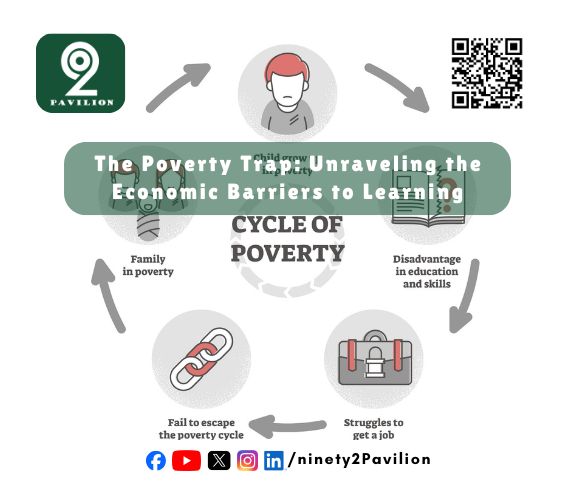
Perhaps the most insidious economic barrier is the psychological phenomenon of lowered self-esteem. Disadvantaged students often experience a self-destructive cycle where a lack of resources leads to a lack of early academic success, which in turn diminishes their confidence (Zheng et al., 2020). This “self-comparison” with wealthier counterparts can cause students to feel insufficient, eventually leading them to disengage from the education system entirely.
Furthermore, economic constraints often lead to “sociocultural exclusions.” In many societies, there remains a bias against vocational training, favoring white-collar jobs that require expensive university degrees (ResearchGate, 2026). This disconnect between academic output and labor market needs ensures that even those who manage to graduate often find themselves underemployed, perpetuating the cycle of poverty.
Toward a Multi-Sectoral Solution
Solving these issues requires more than just increasing education budgets, though that is a vital first step. Experts now advocate for a “multi-sectoral roadmap” that addresses the holistic needs of the child (Daily Times, 2026).
- Direct Financial Support: Expanding cash transfers, scholarships, and school meal programs to mitigate the immediate costs of attendance (Zickafoose et al., 2024).
- Infrastructure Investment: Ensuring schools have stable electricity, internet access, and safe transportation.
- Psychosocial Support: Integrating mental health services and “social-emotional learning” to help students manage the stressors of poverty.
- Curriculum Reform: Moving toward demand-driven education that provides practical, marketable skills, regardless of a student’s social standing.
Education can only be the “great equalizer” if we acknowledge that the starting line is not the same for everyone. By unravelling the economic barriers that stifle potential, we move closer to a world where a child’s ZIP code or family bank balance does not determine the ceiling of their dreams