
By: News Desk 92Pavilion
The journey of a student toward academic excellence and personal growth is rarely a solitary one; it is a collaborative venture where the most influential partner is often found at home. As of 2026, educational research from the Global Family Research Project and the National PTA continues to reinforce a fundamental truth: parental involvement is the single most consistent predictor of a child’s academic success, outweighing socioeconomic status or the prestige of the school itself. When parents transition from being passive observers to active participants in the learning process, they create a “bridge of consistency” between the classroom and the home, ensuring that the values of curiosity, discipline, and resilience are reinforced in every aspect of a child’s life.
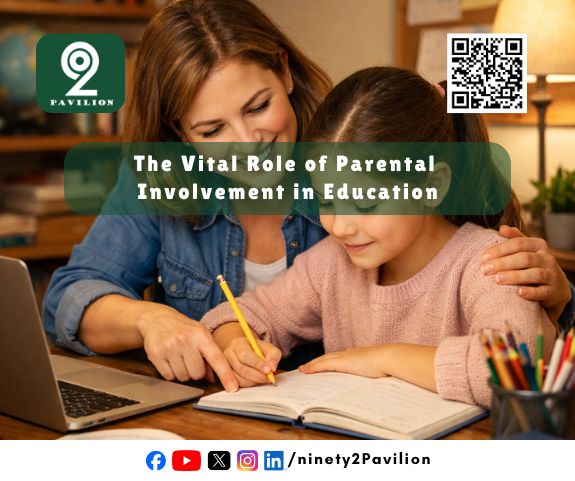
Parental involvement manifests in two critical dimensions: home-based support and school-based engagement. At home, the impact is seen in the establishment of high but achievable expectations. Data from 2024–25 longitudinal studies suggest that children whose parents express a clear belief in the value of education—regardless of the parents’ own educational attainment—demonstrate higher levels of intrinsic motivation and better emotional regulation. Simple acts, such as co-reading in early childhood, supervising homework schedules, and engaging in “academic talk” during daily routines, serve to expand a child’s vocabulary and cognitive flexibility. By 2026, the definition of home support has also evolved to include digital mentorship, where parents help students navigate AI-driven learning tools and maintain a healthy balance between screen time and deep focus.
On the school front, active engagement fosters a sense of accountability and community. When parents attend conferences, volunteer for school events, or participate in parent-teacher associations, they send a powerful message to the child: “Your education is a priority for our family.” This presence bridges the cultural and communication gaps that can sometimes exist between teachers and students. Educators often report that when they have a strong rapport with parents, they can intervene more effectively when a student faces academic or behavioral hurdles. This synergy creates a safety net that prevents students from falling through the cracks, leading to lower rates of chronic absenteeism and higher graduation rates across all demographics.
However, the role of the parent is not just about academic oversight; it is about emotional scaffolding. The 2026 “State of the Student” report highlights that students with involved parents report lower levels of school-related anxiety and higher social competence. This “soft skill” development is crucial in a modern economy that prizes collaboration and empathy. When a parent supports a child through a difficult math problem or a social conflict at school, they are teaching problem-solving skills that textbooks alone cannot provide. Ultimately, the role of parental involvement is to act as a catalyst that activates the potential within a student. It transforms education from a series of tasks to be completed into a shared family value, creating a legacy of learning that persists long after the final bell rings