Latest Posts
Building a Vibrant Cultural FutureA Journey Towards ProsperityArab nations face an inevitable declineBlogging Revenue in Pakistan’s 2026 EconomyWhy China is Investing in Pakistan’s Gwadar PortThe Rising Spirit of Pakistani SportsVoice-Over Economy in Pakistan 2026India’s Investment in Iran,Chabahar PortEvent Management Business in Pakistan 2026The Volatile Trajectory of Pakistan-Afghanistan Relations in 2026Why Pakistan Must Overhaul Its InfrastructureEvolution of Goods and Equipment in Modern SportsThe Current Situation of Sports in PakistanGovernment Initiatives for Sports in PakistanAssessing Sports Infrastructure and Facilities in PakistanSialkot and the Renaissance of Pakistan’s Sports Goods IndustryEmerging Sports Trends in 2026Legacy of Popular Traditional SportsJourney Through the Background of Sports in PakistanInfrastructure and Framework Deficits in Pakistani Sports InstitutionsLevelling the Field of SportsThe Roadmap for Pakistan’s Islamic Financial TransitionApartheid Structure in Occupied KashmirThe Strategic Role of the SCO in 2026Complexities of Illegal Immigrant RepatriationPakistan’s Strategic Role in Regional Power DynamicsPakistan’s Strategic Role in the South Asian Power PlayPakistan’s Strategic Tightrope in the US-China RivalryPakistan-China Relations in a Changing Geopolitical EnvironmentForeign Relation of Pakistan with Neighboring CountriesGlobal Response and the Reshaping World Order in 2026Impacts of International Structure on Pakistan’s Foreign PolicyEnduring Conflict Between India and PakistanAncient Roman and Modern EntertainmentCultivating Pakistan’s Future Tech WorkforceBuilding, Champions of the WorldDeciphering the Boundary Between Art and EntertainmentDevelopment of Pakistan’s Entertainment IndustryEntertainment and the Innovative Technology Industry in 2026Flourishing World of Entertainment in 2026How Technology Transformed Our EntertainmentInterrelationship Between Culture and Visual Entertainment MediaPakistan’s Entertainment Industry Set to ThrivePop Culture, Media Representation, and the Architecture of IdentityThe Evolution of Pakistan’s Entertainment IndustryThe Transformative Power of Entertainment on Modern SocietyStrategic Agenda for Pakistan’s Entertainment IndustryThe Economic Impact of the Entertainment IndustryPakistan Was Not in the Room but Was the Reason the Room Existed.

How Pakistani Cuisine Reflects a Nation’s Diversity

How Pakistani Cuisine Reflects a Nation’s Diversity

By: News Desk 92Pavilion

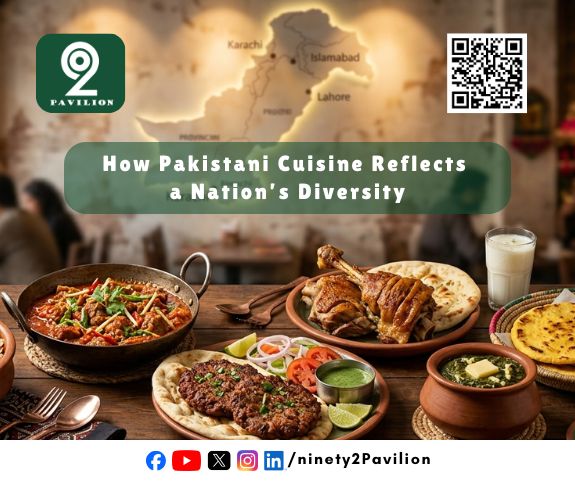
The culinary landscape of Pakistan is far more than a collection of recipes; it is a sensory map of a nation defined by its staggering geographical and ethnic variety. To taste the food of Pakistan is to travel through the high-altitude peaks of the Karakoram, the fertile plains of the Punjab, the rugged deserts of Balochistan, and the humid, tropical coastline of Sindh. In 2026, as global food critics increasingly turn their gaze toward South Asia, Pakistani cuisine is being celebrated as a “living archive”—a reflection of a country where every spice, grain, and cooking technique tells a story of migration, conquest, and local adaptation. This diversity ensures that there is no single “Pakistani flavor,” but rather a harmonious symphony of regional identities that coalesce at the dinner table.

In the southern port city of Karachi and the wider Sindh province, the food is a vibrant, spicy testament to a history of maritime trade and multiculturalism. The Sindhi Biryani, arguably the most famous version of the dish, is known for its intense heat, the inclusion of dried plums for a sour kick, and a complex layering of spices that mirrors the province’s cosmopolitan energy. Here, the influence of the sea is also evident in dishes like Palla Fish, a delicacy of the Indus River. As one moves north into the heart of Punjab, the palate shifts toward the agricultural richness of the land. Punjabi cuisine is characterized by its use of butter, ghee, and fresh dairy. Dishes like Sarson ka Saag (mustard greens) and Makki ki Roti (cornbread) are seasonal odes to the fertile soil, while the robust Lahori Karahi highlights the region’s obsession with perfectly tempered meat and fresh tomatoes.

Contrast this richness with the austere, meat-centric traditions of the Khyber Pakhtunkhwa and Balochistan provinces. In these rugged terrains, the food reflects a lifestyle of resilience and simplicity. The Pashtun cuisine of the north, famous for its Chapli Kebabs and Namak Mandi Karahi, relies on the natural quality of the meat, often seasoned only with salt and animal fat to preserve its original flavor. Similarly, in Balochistan, the ancient technique of Sajji—where a whole lamb or chicken is skewered and slow-roasted around an open fire—serves as a reminder of the region’s nomadic heritage. These dishes are less about the complexity of ground spices and more about the mastery of fire and time, offering a stark but beautiful contrast to the intricate gravies of the plains.

Even the remote northern territories of Gilgit-Baltistan and Hunza offer a unique culinary perspective, focusing on organic grains, apricots, and walnuts. Their diet, often cited as a secret to longevity, is far milder than the rest of the country, emphasizing soups and handmade noodles. This internal diversity is further enriched by the legacy of the Mughal Empire, which introduced the world to the refined “high-dining” of Nihari and Shahi Tukray, and the influence of Central Asian and Persian cultures. Ultimately, the food of Pakistan is a profound reflection of its people. It is a cuisine that manages to be both fiercely local and proudly global, proving that while a border may define a country, it is the diversity of its flavors that truly defines a nation

Share

Introduction

Pakistan’s political environment in 2026 remains dynamic and highly influential in shaping the country’s future. From parliamentary debates and economic policy decisions to opposition movements and electoral reforms, recent developments are playing a crucial role in determining national direction.

In this report by Eye of Pakistan, we analyze the latest political developments, government strategies, and opposition responses.

Government’s Policy Priorities in 2026

The federal government has emphasized:

  • Economic stabilization

  • Institutional reforms

  • Energy sector restructuring

  • Strengthening foreign diplomatic ties

Recent cabinet meetings focused on controlling inflation, stabilizing the Pakistani Rupee, and implementing fiscal discipline under ongoing economic reform programs.

Officials claim these measures aim to restore investor confidence and ensure sustainable growth.

Opposition’s Response and Political Strategy

Major opposition parties have intensified criticism of government policies, particularly regarding:

  • Rising inflation

  • Unemployment

  • Tax reforms

  • Utility price increases

Opposition leaders argue that economic pressure on the public has increased and demand greater transparency in parliamentary proceedings.

Political rallies and public gatherings have increased across major cities including Karachi, Lahore, and Islamabad.

Parliamentary Developments

Recent National Assembly sessions have seen heated debates over:

  • Budget allocations

  • Electoral reforms

  • Accountability laws

  • Provincial autonomy issues

Lawmakers from both treasury and opposition benches continue to exchange strong viewpoints, reflecting a vibrant yet tense political atmosphere.

Election Reforms and Democratic Process

Discussions around electoral transparency and digital voting mechanisms remain central to political discourse.

The Election Commission is reportedly reviewing:

  • Voter verification systems

  • Polling station security

  • Overseas voting procedures

Analysts believe these reforms could significantly impact future general elections.

Public Reaction and Political Climate

Public opinion appears divided. While some citizens support structural reforms and long-term stabilization plans, others express concerns over economic hardships and governance challenges.

Political analysts suggest that the coming months will be critical in determining whether current policies translate into tangible relief for the public.

Conclusion

Pakistan’s political landscape in 2026 is marked by active debate, institutional reforms, and strategic maneuvering from both government and opposition parties. As policy decisions continue to unfold, their impact on economic stability and democratic processes will remain under close observation.

Stay connected with Eye of Pakistan for reliable and timely political updates.