Latest Posts
Building a Vibrant Cultural FutureA Journey Towards ProsperityArab nations face an inevitable declineBlogging Revenue in Pakistan’s 2026 EconomyWhy China is Investing in Pakistan’s Gwadar PortThe Rising Spirit of Pakistani SportsVoice-Over Economy in Pakistan 2026India’s Investment in Iran,Chabahar PortEvent Management Business in Pakistan 2026The Volatile Trajectory of Pakistan-Afghanistan Relations in 2026Why Pakistan Must Overhaul Its InfrastructureEvolution of Goods and Equipment in Modern SportsThe Current Situation of Sports in PakistanGovernment Initiatives for Sports in PakistanAssessing Sports Infrastructure and Facilities in PakistanSialkot and the Renaissance of Pakistan’s Sports Goods IndustryEmerging Sports Trends in 2026Legacy of Popular Traditional SportsJourney Through the Background of Sports in PakistanInfrastructure and Framework Deficits in Pakistani Sports InstitutionsLevelling the Field of SportsThe Roadmap for Pakistan’s Islamic Financial TransitionApartheid Structure in Occupied KashmirThe Strategic Role of the SCO in 2026Complexities of Illegal Immigrant RepatriationPakistan’s Strategic Role in Regional Power DynamicsPakistan’s Strategic Role in the South Asian Power PlayPakistan’s Strategic Tightrope in the US-China RivalryPakistan-China Relations in a Changing Geopolitical EnvironmentForeign Relation of Pakistan with Neighboring CountriesGlobal Response and the Reshaping World Order in 2026Impacts of International Structure on Pakistan’s Foreign PolicyEnduring Conflict Between India and PakistanAncient Roman and Modern EntertainmentCultivating Pakistan’s Future Tech WorkforceBuilding, Champions of the WorldDeciphering the Boundary Between Art and EntertainmentDevelopment of Pakistan’s Entertainment IndustryEntertainment and the Innovative Technology Industry in 2026Flourishing World of Entertainment in 2026How Technology Transformed Our EntertainmentInterrelationship Between Culture and Visual Entertainment MediaPakistan’s Entertainment Industry Set to ThrivePop Culture, Media Representation, and the Architecture of IdentityThe Evolution of Pakistan’s Entertainment IndustryThe Transformative Power of Entertainment on Modern Society

Interrelationship Between Culture and Visual Entertainment Media

Interrelationship Between Culture and Visual Entertainment Media

By: News Desk 92Pavilion

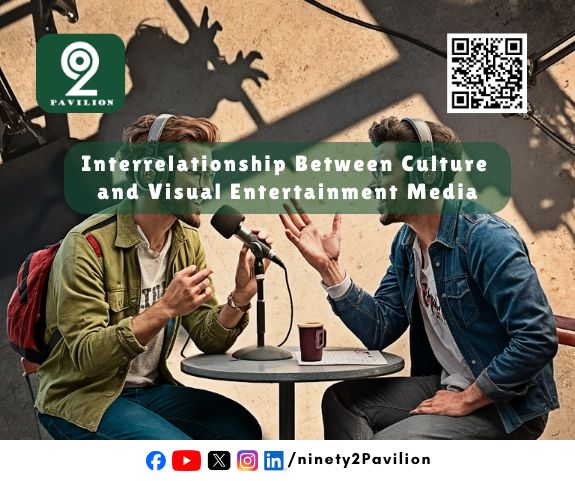
The relationship between culture and visual entertainment media is not a one-way street of influence, but rather a complex, recursive loop where each constantly feeds and redefines the other. In 2026, as visual media—ranging from cinematic epics to micro-content on social platforms—becomes the primary language of global communication, this interrelationship has reached a state of total immersion. Culture provides the raw material, the values, and the mythologies that media translates into imagery; in turn, those images become the “visual shorthand” through which society understands its own identity, aspirations, and fears. This symbiosis ensures that visual media is never just a neutral observer of the human condition, but an active participant in the ongoing construction of reality.

At its core, visual entertainment acts as a massive archival repository for cultural values. Every stylistic choice, from the color palettes of a television drama to the character archetypes in a video game, is rooted in a specific cultural context. For instance, the recent global “renaissance” of South Asian and East Asian media in the mid-2020s has brought localized traditions, aesthetic sensibilities, and social hierarchies into the global mainstream. These media products do not just export “entertainment”; they export “ways of being.” When a specific cultural practice is visualized on screen, it gains a form of global legitimacy, transforming local traditions into universal symbols. This process allows cultures to preserve their distinctiveness while simultaneously participating in a shared, globalized visual vocabulary.

However, the power of visual media to shape culture is perhaps more profound than its role as a mirror. Through a phenomenon known as “cultivation,” repeated exposure to certain visual tropes can gradually alter a society’s collective perception of what is normal, desirable, or dangerous. In 2026, the demand for “authentic representation” is a direct recognition of this power. When visual media broadens its lens to include a diverse array of body types, ethnicities, and gender identities, it effectively “re-cultures” the audience, fostering a more inclusive social imagination. Conversely, the “visual echo chambers” created by algorithmic curation can also entrench cultural divisions, as audiences are fed images that only confirm their existing cultural biases, making the bridge-building potential of media more difficult to realize.

The digital transformation of the 2020s has further accelerated this interrelationship through the “creator economy.” No longer is culture filtered through a handful of centralized media gatekeepers; instead, millions of individual creators are visualizing their own subcultures in real-time. This has led to a “fragmented flourishing,” where niche cultural movements can achieve global visibility almost overnight. Ultimately, the interrelationship between culture and visual entertainment media is the engine of social evolution. As we move further into an era of augmented and virtual realities, the boundary between “the life we live” and “the media we view” will continue to dissolve, making it more important than ever to understand that the stories we watch are the very architects of the world we inhabit

Share

Introduction

Pakistan’s political environment in 2026 remains dynamic and highly influential in shaping the country’s future. From parliamentary debates and economic policy decisions to opposition movements and electoral reforms, recent developments are playing a crucial role in determining national direction.

In this report by Eye of Pakistan, we analyze the latest political developments, government strategies, and opposition responses.

Government’s Policy Priorities in 2026

The federal government has emphasized:

  • Economic stabilization

  • Institutional reforms

  • Energy sector restructuring

  • Strengthening foreign diplomatic ties

Recent cabinet meetings focused on controlling inflation, stabilizing the Pakistani Rupee, and implementing fiscal discipline under ongoing economic reform programs.

Officials claim these measures aim to restore investor confidence and ensure sustainable growth.

Opposition’s Response and Political Strategy

Major opposition parties have intensified criticism of government policies, particularly regarding:

  • Rising inflation

  • Unemployment

  • Tax reforms

  • Utility price increases

Opposition leaders argue that economic pressure on the public has increased and demand greater transparency in parliamentary proceedings.

Political rallies and public gatherings have increased across major cities including Karachi, Lahore, and Islamabad.

Parliamentary Developments

Recent National Assembly sessions have seen heated debates over:

  • Budget allocations

  • Electoral reforms

  • Accountability laws

  • Provincial autonomy issues

Lawmakers from both treasury and opposition benches continue to exchange strong viewpoints, reflecting a vibrant yet tense political atmosphere.

Election Reforms and Democratic Process

Discussions around electoral transparency and digital voting mechanisms remain central to political discourse.

The Election Commission is reportedly reviewing:

  • Voter verification systems

  • Polling station security

  • Overseas voting procedures

Analysts believe these reforms could significantly impact future general elections.

Public Reaction and Political Climate

Public opinion appears divided. While some citizens support structural reforms and long-term stabilization plans, others express concerns over economic hardships and governance challenges.

Political analysts suggest that the coming months will be critical in determining whether current policies translate into tangible relief for the public.

Conclusion

Pakistan’s political landscape in 2026 is marked by active debate, institutional reforms, and strategic maneuvering from both government and opposition parties. As policy decisions continue to unfold, their impact on economic stability and democratic processes will remain under close observation.

Stay connected with Eye of Pakistan for reliable and timely political updates.