By: News Desk 92Pavilion
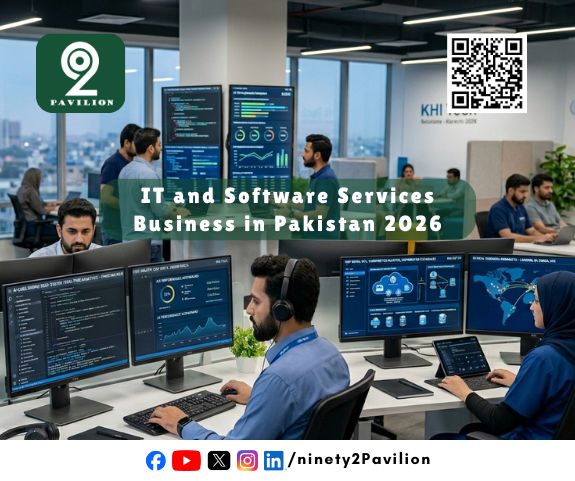
As of April 2026, the Information Technology (IT) and Software Services sector in Pakistan has moved beyond its role as a supportive industry to become the nation’s primary economic engine for foreign exchange and digital modernization. In a landscape defined by record-breaking export figures—surpassing $430 million in a single month earlier this year—the running business situation is characterized by a “Product-First” evolution. While the industry was traditionally built on staff augmentation and low-cost maintenance, the current year marks a decisive shift toward high-value software engineering, Artificial Intelligence (AI) integration, and the export of proprietary Software-as-a-Service (SaaS) solutions. For an IT service provider in Pakistan today, the path to earning money is no longer just about offering labor; it is about acting as a “Vibe Architect” or a “Cloud Strategist” for a global client base that demands speed, scalability, and technical sophistication.
Monetization in the 2026 Pakistani IT sector is driven by three dominant commercial models: Global Service Export, SaaS Productization, and Enterprise Modernization. The most lucrative revenue stream remains the export of services to North America, Europe, and the rapidly growing Gulf Cooperation Council (GCC) markets, particularly Saudi Arabia. Pakistani firms are earning substantial income by signing USD-denominated contracts, which provide a powerful natural hedge against local currency fluctuations. This “Dollar-Income” model has been further strengthened by recent policy relaxations, allowing companies to retain up to 50% of their earnings in specialized foreign currency accounts. To maximize these earnings, local firms have pivoted from general web development to specialized niches like Cybersecurity, FinTech infrastructure, and AI-driven predictive analytics, where daily rates are significantly higher.
The domestic market has also matured into a multi-billion PKR arena, driven by “Digital Transformation” mandates within Pakistan’s traditional industries. Legacy sectors like textiles, banking, and agriculture are now investing heavily in cloud-native operations and AI-automated workflows to remain competitive. IT firms are earning money through long-term “Managed Services” contracts, where they handle a corporation’s entire digital infrastructure—from ERP implementation to data security—on a recurring retainer basis. Furthermore, the rise of “Vibe Coding”—using AI to generate complex software from natural language commands—has allowed Pakistani boutique agencies to deliver projects three to five times faster than in previous years, effectively increasing their profit margins by reducing the man-hours required for code production.
Another emerging revenue stream is “SaaS Productization.” Pakistani developers are increasingly building their own digital products—such as HR management tools, e-commerce plugins, and educational platforms—and selling them on global marketplaces. This allows for passive, scalable income that is not tied to the number of employees or hours worked. Additionally, with the commissioning of the SEA-ME-WE-6 submarine cable late last year, the improved national bandwidth has paved the way for local “Data Center” and “Cloud Hosting” services, allowing IT providers to earn money by hosting data for local SMEs who previously relied on expensive international providers.
To stay profitable in the 2026 fiscal climate, successful IT leaders are focusing on “Talent Optimization.” Since human capital is the industry’s primary asset, firms are investing in “AI Leaders Fellowships” and specialized training to move their workforce up the value chain. By transitioning from “executors” to “consultants,” Pakistani IT businesses are capturing a larger share of the global tech budget. In summary, the IT and software services business in Pakistan in 2026 is a high-growth, sophisticated industry that has become the vanguard of the “Digital Pakistan” vision. It rewards those who can bridge the gap between technical execution and strategic business value, proving that in a world of automated solutions, the ability to architect complex digital ecosystems is the most valuable commodity in the Pakistani professional arsenal