By: News Desk 92Pavilion
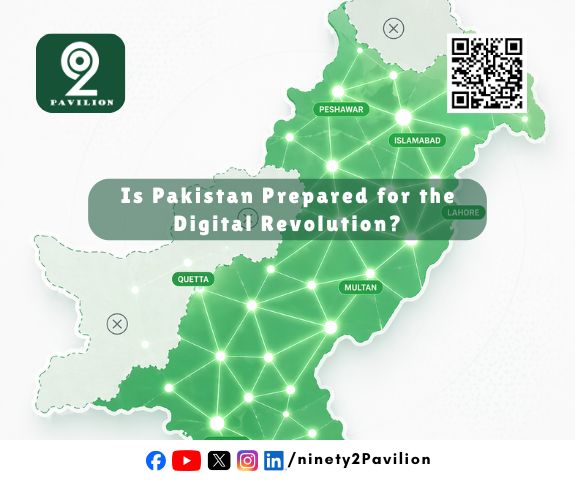
The question of whether Pakistan is prepared for the digital revolution has moved from the realm of speculation into a high-stakes national reality. As the global economy undergoes a fundamental restructuring driven by Artificial Intelligence, blockchain, and 5G connectivity, Pakistan stands at a unique crossroads. The nation possesses the fundamental ingredients for a digital explosion: a massive, tech-savvy youth population, a surging freelance economy, and a growing recognition within the corridors of power that digital transformation is no longer an elective but an existential necessity. However, the roadmap to becoming a true “Digital Powerhouse” in 2026 is a complex race against time, where the brilliance of individual talent must be matched by the resilience of national infrastructure and the stability of a forward-looking regulatory framework.
The primary indicator of Pakistan’s readiness is the sheer scale of its “Human Capital.” In 2026, the country has solidified its position as one of the world’s largest suppliers of digital labor, with millions of freelancers contributing to a record-breaking $5 billion in IT export remittances. This grassroots revolution was not built in government laboratories but in the bedrooms and co-working spaces of cities like Lahore, Karachi, and Faisalabad. This self-taught generation has demonstrated an incredible capacity to “leapfrog” traditional educational barriers, mastering high-value skills in AI, cloud architecture, and cybersecurity. The “Digital Readiness” of the Pakistani people is undeniable; the youth bulge is no longer just a demographic statistic but a dynamic workforce that is already integrated into the global digital supply chain.
However, the “Infrastructure Paradox” remains the most significant hurdle to Pakistan’s total preparedness. While the rollout of 5G in major urban centers and the expansion of fiber-optic networks have provided a boost, the reliability of the “Digital Backbone” is often called into question. In 2026, the frequent disruptions in internet connectivity—often linked to aging submarine cables or opaque regulatory firewalls—act as a “digital tax” on productivity. To be truly revolution-ready, Pakistan must guarantee the “Right to Internet” as a basic economic utility. A digital revolution cannot be sustained on sporadic connectivity; it requires a resilient, high-speed infrastructure that remains operational 24/7, providing the stable environment necessary for global firms to relocate their core operations to Pakistani soil.
On the policy front, the government’s ‘Uraan’ and ‘Digital Pakistan’ initiatives in 2026 have signaled a shift toward a “Pro-Innovation” stance. The introduction of the Personal Data Protection Bill and the operationalization of Special Technology Zones (STZs) are critical steps toward building “Digital Trust.” Furthermore, the integration of the ‘Raast’ instant payment system with international gateways has begun to bridge the “Fintech Gap,” allowing for smoother cross-border transactions. Yet, for these initiatives to be effective, there must be “Policy Continuity.” The digital revolution rewards stability and long-term vision; erratic changes in tax regimes or sudden blocks on digital platforms can erase years of progress in a single stroke. Preparedness, therefore, is as much about the stability of the law as it is about the speed of the fiber-optics.
Ultimately, Pakistan’s preparation for the digital revolution in late 2026 is a work in progress that leans heavily toward optimism. The nation has proven that it can produce world-class digital talent under pressure. The challenge now lies in “Institutionalizing Excellence.” This means moving beyond a “freelance-first” model toward a “product-first” economy, where Pakistani startups are not just servicing the world but creating the platforms of the future. By investing in specialized AI research centers, ensuring uninterrupted connectivity, and protecting digital rights, Pakistan can transform its raw energy into a sustainable digital legacy. The revolution is already here; the next two years will determine whether Pakistan merely participates in it or leads it from the front as the new Silicon Frontier of South Asia