By: News Desk 92pavilion
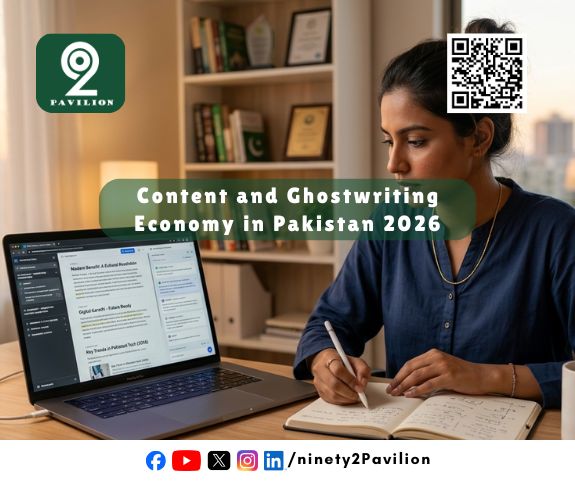
As of April 2026, the content writing and ghostwriting industry in Pakistan has transitioned from a fragmented freelance market into a sophisticated multi-billion-dollar export sector. While traditional freelance roles in software and design have long been the backbone of the digital economy, the current year marks a significant shift toward high-value intellectual property and strategic narrative building. The running business situation in Pakistan is currently defined by a “Human-AI Hybrid” model, where the country’s massive pool of English-proficient writers is leveraging advanced tools to produce content at a scale and quality that was previously impossible. For a Pakistani ghostwriter in 2026, the primary objective is no longer just putting words on a page; it is about acting as a “voice architect” for international founders, corporate executives, and digital entrepreneurs who lack the time to maintain their own online authority.
The economic landscape in Pakistan has made ghostwriting an exceptionally attractive business. With the national freelance earnings hitting record highs—over 550 million dollars in the first half of the current fiscal year—writing services have become a critical source of foreign exchange. The local market has moved beyond low-paying “content mills” to high-ticket specialized services. Ghostwriters in Karachi, Lahore, and Islamabad are now commanding premium rates for LinkedIn thought leadership, executive newsletters, and technical whitepapers. The demand is particularly high for “Subject Matter Experts” who can navigate complex niches like Green-Tech, AI ethics, and Islamic Finance. Because the cost of living in Pakistan remains low relative to the US and UK, a ghostwriter charging mid-tier international rates can earn a high-status income that far exceeds local corporate salaries, often reaching between 150,000 to 400,000 PKR per month for consistent, high-quality output.
To earn money in this competitive 2026 environment, Pakistani writers have shifted their focus to “Value-Based Retainers” rather than per-word pricing. This means a ghostwriter doesn’t just write an article; they manage a client’s entire monthly content strategy, including scriptwriting for short-form video and social media threads that drive engagement. The rise of “White-Label” agencies in Pakistan has also provided a robust revenue stream. These local agencies act as invisible partners for Western marketing firms, handling the bulk of the research and drafting while the Western agency manages the client relationship. This allows Pakistani writers to work on high-profile global brands while remaining behind the scenes. Additionally, the integration of local payment gateways has finally matured, allowing creators to receive payments through simplified channels that bypass the traditional hurdles of the past decade.
However, the 2026 market also presents the challenge of “AI Saturation.” With tools like Gemini and GPT-5 capable of generating basic drafts, the only way a Pakistani ghostwriter earns a premium today is by offering what AI cannot: deep cultural context, original research, and a distinct, relatable human voice. The “running situation” dictates that writers must be editors and strategists first. They use AI to handle the “grunt work” of outlining and grammar checking, freeing up their time to inject personality and unique insights into the text. Success in the current Pakistani market belongs to those who treat their writing not as a service, but as a productized business, utilizing personal branding on LinkedIn to attract global clients who are willing to pay for the “human edge” in an increasingly automated world