Latest Posts
Building a Vibrant Cultural FutureA Journey Towards ProsperityArab nations face an inevitable declineBlogging Revenue in Pakistan’s 2026 EconomyWhy China is Investing in Pakistan’s Gwadar PortThe Rising Spirit of Pakistani SportsVoice-Over Economy in Pakistan 2026India’s Investment in Iran,Chabahar PortEvent Management Business in Pakistan 2026The Volatile Trajectory of Pakistan-Afghanistan Relations in 2026Why Pakistan Must Overhaul Its InfrastructureEvolution of Goods and Equipment in Modern SportsThe Current Situation of Sports in PakistanGovernment Initiatives for Sports in PakistanAssessing Sports Infrastructure and Facilities in PakistanSialkot and the Renaissance of Pakistan’s Sports Goods IndustryEmerging Sports Trends in 2026Legacy of Popular Traditional SportsJourney Through the Background of Sports in PakistanInfrastructure and Framework Deficits in Pakistani Sports InstitutionsLevelling the Field of SportsThe Roadmap for Pakistan’s Islamic Financial TransitionApartheid Structure in Occupied KashmirThe Strategic Role of the SCO in 2026Complexities of Illegal Immigrant RepatriationPakistan’s Strategic Role in Regional Power DynamicsPakistan’s Strategic Role in the South Asian Power PlayPakistan’s Strategic Tightrope in the US-China RivalryPakistan-China Relations in a Changing Geopolitical EnvironmentForeign Relation of Pakistan with Neighboring CountriesGlobal Response and the Reshaping World Order in 2026Impacts of International Structure on Pakistan’s Foreign PolicyEnduring Conflict Between India and PakistanAncient Roman and Modern EntertainmentCultivating Pakistan’s Future Tech WorkforceBuilding, Champions of the WorldDeciphering the Boundary Between Art and EntertainmentDevelopment of Pakistan’s Entertainment Industry

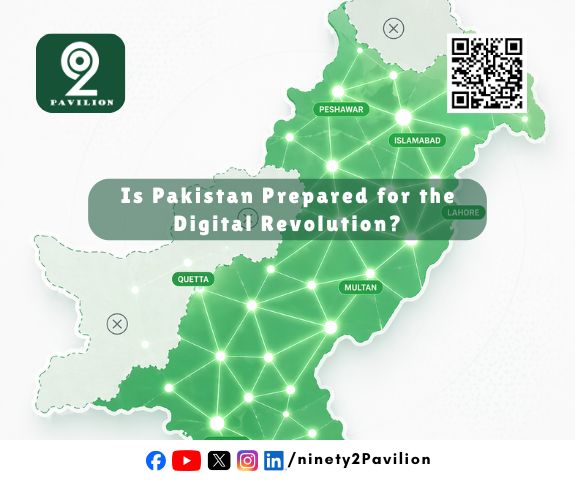
Is Pakistan Prepared for the Digital Revolution?

Is Pakistan Prepared for the Digital Revolution?

By: News Desk 92Pavilion

The question of whether Pakistan is prepared for the digital revolution has moved from the realm of speculation into a high-stakes national reality. As the global economy undergoes a fundamental restructuring driven by Artificial Intelligence, blockchain, and 5G connectivity, Pakistan stands at a unique crossroads. The nation possesses the fundamental ingredients for a digital explosion: a massive, tech-savvy youth population, a surging freelance economy, and a growing recognition within the corridors of power that digital transformation is no longer an elective but an existential necessity. However, the roadmap to becoming a true “Digital Powerhouse” in 2026 is a complex race against time, where the brilliance of individual talent must be matched by the resilience of national infrastructure and the stability of a forward-looking regulatory framework.

The primary indicator of Pakistan’s readiness is the sheer scale of its “Human Capital.” In 2026, the country has solidified its position as one of the world’s largest suppliers of digital labor, with millions of freelancers contributing to a record-breaking $5 billion in IT export remittances. This grassroots revolution was not built in government laboratories but in the bedrooms and co-working spaces of cities like Lahore, Karachi, and Faisalabad. This self-taught generation has demonstrated an incredible capacity to “leapfrog” traditional educational barriers, mastering high-value skills in AI, cloud architecture, and cybersecurity. The “Digital Readiness” of the Pakistani people is undeniable; the youth bulge is no longer just a demographic statistic but a dynamic workforce that is already integrated into the global digital supply chain.

However, the “Infrastructure Paradox” remains the most significant hurdle to Pakistan’s total preparedness. While the rollout of 5G in major urban centers and the expansion of fiber-optic networks have provided a boost, the reliability of the “Digital Backbone” is often called into question. In 2026, the frequent disruptions in internet connectivity—often linked to aging submarine cables or opaque regulatory firewalls—act as a “digital tax” on productivity. To be truly revolution-ready, Pakistan must guarantee the “Right to Internet” as a basic economic utility. A digital revolution cannot be sustained on sporadic connectivity; it requires a resilient, high-speed infrastructure that remains operational 24/7, providing the stable environment necessary for global firms to relocate their core operations to Pakistani soil.

On the policy front, the government’s ‘Uraan’ and ‘Digital Pakistan’ initiatives in 2026 have signaled a shift toward a “Pro-Innovation” stance. The introduction of the Personal Data Protection Bill and the operationalization of Special Technology Zones (STZs) are critical steps toward building “Digital Trust.” Furthermore, the integration of the ‘Raast’ instant payment system with international gateways has begun to bridge the “Fintech Gap,” allowing for smoother cross-border transactions. Yet, for these initiatives to be effective, there must be “Policy Continuity.” The digital revolution rewards stability and long-term vision; erratic changes in tax regimes or sudden blocks on digital platforms can erase years of progress in a single stroke. Preparedness, therefore, is as much about the stability of the law as it is about the speed of the fiber-optics.

Ultimately, Pakistan’s preparation for the digital revolution in late 2026 is a work in progress that leans heavily toward optimism. The nation has proven that it can produce world-class digital talent under pressure. The challenge now lies in “Institutionalizing Excellence.” This means moving beyond a “freelance-first” model toward a “product-first” economy, where Pakistani startups are not just servicing the world but creating the platforms of the future. By investing in specialized AI research centers, ensuring uninterrupted connectivity, and protecting digital rights, Pakistan can transform its raw energy into a sustainable digital legacy. The revolution is already here; the next two years will determine whether Pakistan merely participates in it or leads it from the front as the new Silicon Frontier of South Asia


Share

Introduction

Pakistan’s political environment in 2026 remains dynamic and highly influential in shaping the country’s future. From parliamentary debates and economic policy decisions to opposition movements and electoral reforms, recent developments are playing a crucial role in determining national direction.

In this report by Eye of Pakistan, we analyze the latest political developments, government strategies, and opposition responses.

Government’s Policy Priorities in 2026

The federal government has emphasized:

  • Economic stabilization

  • Institutional reforms

  • Energy sector restructuring

  • Strengthening foreign diplomatic ties

Recent cabinet meetings focused on controlling inflation, stabilizing the Pakistani Rupee, and implementing fiscal discipline under ongoing economic reform programs.

Officials claim these measures aim to restore investor confidence and ensure sustainable growth.

Opposition’s Response and Political Strategy

Major opposition parties have intensified criticism of government policies, particularly regarding:

  • Rising inflation

  • Unemployment

  • Tax reforms

  • Utility price increases

Opposition leaders argue that economic pressure on the public has increased and demand greater transparency in parliamentary proceedings.

Political rallies and public gatherings have increased across major cities including Karachi, Lahore, and Islamabad.

Parliamentary Developments

Recent National Assembly sessions have seen heated debates over:

  • Budget allocations

  • Electoral reforms

  • Accountability laws

  • Provincial autonomy issues

Lawmakers from both treasury and opposition benches continue to exchange strong viewpoints, reflecting a vibrant yet tense political atmosphere.

Election Reforms and Democratic Process

Discussions around electoral transparency and digital voting mechanisms remain central to political discourse.

The Election Commission is reportedly reviewing:

  • Voter verification systems

  • Polling station security

  • Overseas voting procedures

Analysts believe these reforms could significantly impact future general elections.

Public Reaction and Political Climate

Public opinion appears divided. While some citizens support structural reforms and long-term stabilization plans, others express concerns over economic hardships and governance challenges.

Political analysts suggest that the coming months will be critical in determining whether current policies translate into tangible relief for the public.

Conclusion

Pakistan’s political landscape in 2026 is marked by active debate, institutional reforms, and strategic maneuvering from both government and opposition parties. As policy decisions continue to unfold, their impact on economic stability and democratic processes will remain under close observation.

Stay connected with Eye of Pakistan for reliable and timely political updates.

Education in Pakistan 2026

By: News Desk 92Pavilion Education in Pakistan stands as a complex paradox of modest statistical gains and deep-rooted systemic crises. As of 2026, the national

Share
Read More »