By: News Desk 92Pavilion
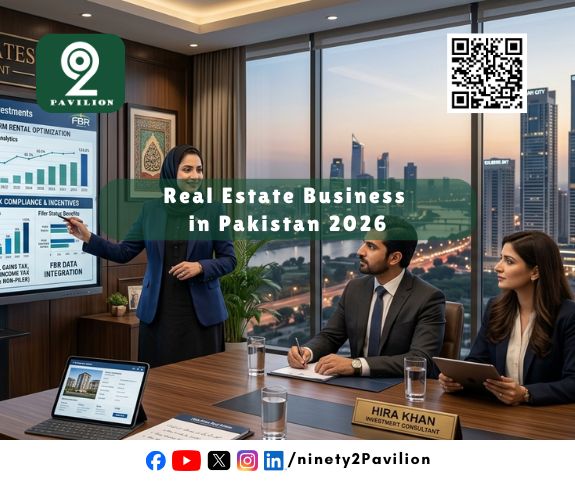
In the professional landscape of April 2026, the real estate sector in Pakistan has undergone a fundamental structural transformation. Moving away from the speculative “plot-flipping” culture of the previous decade, the running business situation is now defined by a shift toward vertical development, rental yield optimization, and rigorous tax compliance. As urban land in cities like Karachi and Lahore becomes increasingly scarce, the “High-Rise Revolution” has taken center stage. For a real estate professional or investor in 2026, the path to earning money is no longer just about buying land and waiting; it is about acting as a developer or an asset manager who understands the intersection of urban density, smart infrastructure, and the newly tightened regulatory framework managed by the Federal Board of Revenue (FBR).
The primary revenue engine in the current Pakistani market is the “Construction-to-Rental” model. With the 2025-26 Federal Budget introducing stringent penalties on “idle” or unproductive land—specifically through Section 7E, which treats vacant plots as deemed income—investors are now incentivized to build. Earnings are increasingly generated through the development of mixed-use high-rises and gated townhouse communities that offer immediate rental yields. In major urban centers, apartment prices have seen double-digit growth; for instance, Karachi’s apartment index surged by over 20% in early 2026. To earn money in this environment, real estate agencies have evolved into “Investment Consultancies,” earning commissions not just on the sale of property, but on the long-term management of rental portfolios for overseas Pakistanis and corporate clients.
A significant development in 2026 is the “Infrastructure-Led Appreciation” trend. Business activity is currently concentrated along new transit corridors, such as the Rawalpindi Ring Road and the expanded suburbs of Lahore and Gujranwala. Real estate earners are capitalizing on these “growth zones” by securing land ahead of infrastructure completion and developing commercial hubs that cater to the rising middle-class demand for organized retail and office spaces. Furthermore, the 2026 market has seen the rise of Real Estate Investment Trusts (REITs), allowing smaller investors to pool capital into large-scale commercial projects. This has democratized the sector, allowing professionals to earn “dividend-style” income from high-value assets like IT parks and shopping malls without needing the capital to own the entire building.
Taxation and documentation have become the ultimate gatekeepers of profit in 2026. The “Filer vs. Non-Filer” gap has widened significantly, with transaction taxes for non-compliant individuals reaching up to 12%, while active taxpayers (Filers) enjoy rates as low as 3%. Consequently, the most profitable real estate businesses are those that operate with 100% transparency, utilizing digital land registries and FBR-integrated valuation tables. To stay profitable, successful practitioners are also focusing on “Secondary City Value,” where cities like Faisalabad and Multan offer lower entry costs and higher growth potential than the saturated “Big Three” markets. In summary, the real estate business in Pakistan in 2026 is a sophisticated, data-driven industry. It rewards those who prioritize built-up units over raw land and compliance over speculation, proving that in a maturing market, the real wealth lies in the utility and productivity of the asset rather than its mere existence