By: News Desk 92Pavilion
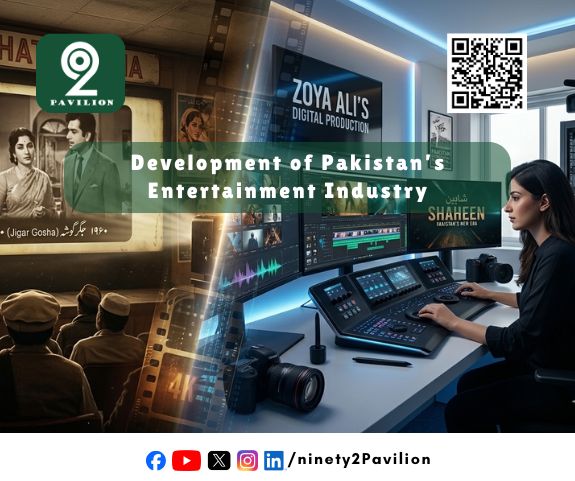
The story of the entertainment industry in Pakistan is one of profound resilience, cyclical decay, and, most recently, a technologically driven renaissance. As of 2026, the sector has transitioned from the “industrial” model of the 20th century into a highly fragmented yet culturally potent digital ecosystem. Historically, the industry—often referred to as Lollywood during its peak in Lahore—suffered a near-collapse in the late 1990s due to a lack of institutional support, dwindling screen counts, and the advent of low-quality, repetitive narratives. However, the subsequent decades have seen a strategic shift in the center of gravity toward Karachi, where a new generation of creators has successfully bridged the gap between traditional storytelling and modern cinematic standards.
A defining feature of this development has been the undisputed dominance of television. While the film industry struggled with financial viability and a lack of distribution infrastructure, Pakistani television dramas became the country’s primary cultural export. By 2026, this sector has moved beyond routine “soap opera” formats into high-stakes, event-driven programming. Producers have increasingly pivoted toward “selective strategy,” focusing on fewer, higher-quality serials that emphasize writer-led scripts and moral inquiry. This recalibration is a direct response to a more discerning global audience that now consumes Pakistani content through streaming giants and social media, rather than just traditional cable networks.
In tandem with television’s refinement, the music industry has undergone a radical transformation. The mid-2020s have seen a “return of the long form,” where artists are moving away from disposable singles and film soundtracks to release full-length albums as cohesive artistic statements. This shift has been catalyzed by a booming independent scene and the maturity of digital platforms like YouTube and Spotify, where local creators now bypass traditional gatekeepers. Pakistan’s hip-hop and indie-folk movements, in particular, have used these digital tools to build niche but fiercely loyal global fandoms, turning music into a “world-building” project rather than a commercial byproduct.
The cinema sector, though still facing structural challenges such as screen scarcity and high production costs, has begun to experiment with the technological frontier. In early 2026, the industry saw the release of its first feature-length film created entirely through Artificial Intelligence, signaling a bold move toward cost-effective, tech-driven filmmaking. This “digital-first” approach is becoming a necessity as producers navigate the “stark reality” of a shrinking theatrical landscape. By integrating AI into creative workflows and production pipelines, Pakistani filmmakers are attempting to sustain meaning and artistic ambition even when traditional exhibition avenues are limited.
Ultimately, the development of Pakistan’s entertainment industry in 2026 is defined by a newfound self-awareness. It is an industry that has learned to stop chasing volume and instead prioritize “value and relevance.” Through government-led initiatives like the National Centre of Films and the surge in digital commerce, the sector is gradually institutionalizing its creative resolve. While the journey from a survivalist model to a flourishing global player is ongoing, the synergy between traditional star power and modern digital literacy suggests that Pakistan’s cultural footprint is poised to expand significantly on the world stage