By: News Desk 92Pavilion
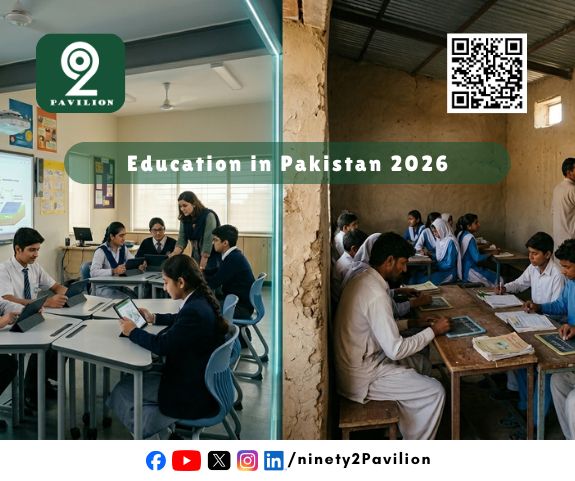
Education in Pakistan stands as a complex paradox of modest statistical gains and deep-rooted systemic crises. As of 2026, the national literacy rate has seen a slight uptick to approximately 63%, with youth literacy (ages 15–24) offering a glimmer of hope at 77%. However, these numbers mask a grimmer reality: Pakistan continues to grapple with one of the highest populations of out-of-school children (OOSC) in the world. Recent data from the 2024–25 Household Integrated Economic Survey (HIES) indicates that nearly 26 million children remain outside the formal education system, a figure that represents a significant portion of the country’s future workforce. This crisis is not merely a matter of enrollment but a profound issue of equity and quality.
The educational landscape is sharply divided along socioeconomic and provincial lines. While Punjab shows relatively higher literacy rates and better infrastructure, provinces like Balochistan face severe exclusion, with some estimates suggesting nearly 70% of school-aged children are out of school in certain districts. Gender disparity remains a persistent hurdle; rural girls, in particular, face the brunt of educational poverty due to cultural barriers, poverty, and the physical distance to schools. UNESCO reports have highlighted that a girl living an hour away from a school is significantly less likely to attend than one living within fifteen minutes. This “distance barrier” is compounded by a lack of basic facilities, as many public schools still operate without electricity or clean drinking water.
Beyond access lies the “learning poverty” crisis. Even for those in school, the quality of instruction is often alarmingly low. The World Bank notes that a vast majority of 10-year-olds in Pakistan cannot read or understand a simple text. The pedagogical approach remains heavily reliant on rote memorization and a “vision gap” where curriculum documents promise critical thinking while classrooms reward the reproduction of authorized facts. Furthermore, the coexistence of three parallel systems—low-cost public schools, elite private institutions, and religious madaris—perpetuates social stratification rather than offering a ladder for upward mobility.
Financially, the sector remains under-prioritized. Pakistan historically allocates less than 2% of its GDP to education, falling far short of the international benchmark of 4–6%. Most of this budget is consumed by teacher salaries, leaving little for innovation or infrastructure. While initiatives like the Benazir Income Support Programme (BISP) and digital learning platforms have made small dents in the problem, the sheer scale of the challenge requires radical structural reform. To bridge the divide, the government must move beyond technical fixes and prioritize equity-oriented financing. Without a synchronized effort to improve both the accessibility and the intrinsic value of the classroom experience, the “youth bulge” that Pakistan counts as an asset may instead become a demographic challenge in an increasingly competitive global economy