Latest Posts
Building a Vibrant Cultural FutureA Journey Towards ProsperityArab nations face an inevitable declineBlogging Revenue in Pakistan’s 2026 EconomyWhy China is Investing in Pakistan’s Gwadar PortThe Rising Spirit of Pakistani SportsVoice-Over Economy in Pakistan 2026India’s Investment in Iran,Chabahar PortEvent Management Business in Pakistan 2026The Volatile Trajectory of Pakistan-Afghanistan Relations in 2026Why Pakistan Must Overhaul Its InfrastructureEvolution of Goods and Equipment in Modern SportsThe Current Situation of Sports in PakistanGovernment Initiatives for Sports in PakistanAssessing Sports Infrastructure and Facilities in PakistanSialkot and the Renaissance of Pakistan’s Sports Goods IndustryEmerging Sports Trends in 2026Legacy of Popular Traditional SportsJourney Through the Background of Sports in PakistanInfrastructure and Framework Deficits in Pakistani Sports InstitutionsLevelling the Field of SportsThe Roadmap for Pakistan’s Islamic Financial TransitionApartheid Structure in Occupied KashmirThe Strategic Role of the SCO in 2026Complexities of Illegal Immigrant RepatriationPakistan’s Strategic Role in Regional Power DynamicsPakistan’s Strategic Role in the South Asian Power PlayPakistan’s Strategic Tightrope in the US-China RivalryPakistan-China Relations in a Changing Geopolitical EnvironmentForeign Relation of Pakistan with Neighboring CountriesGlobal Response and the Reshaping World Order in 2026Impacts of International Structure on Pakistan’s Foreign PolicyEnduring Conflict Between India and PakistanAncient Roman and Modern EntertainmentCultivating Pakistan’s Future Tech WorkforceBuilding, Champions of the WorldDeciphering the Boundary Between Art and EntertainmentDevelopment of Pakistan’s Entertainment Industry

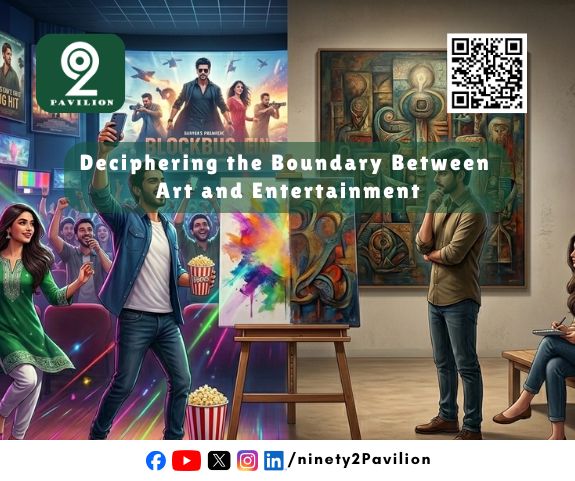
Deciphering the Boundary Between Art and Entertainment

Deciphering the Boundary Between Art and Entertainment

By: News Desk 92Pavilion

The debate surrounding the distinction between art and entertainment is as old as creative expression itself, yet in the hyper-saturated digital landscape of 2026, the line has become increasingly porous. At first glance, the two appear to serve fundamentally different masters: art is often associated with the profound, the challenging, and the enduring, while entertainment is seen as the realm of the pleasurable, the accessible, and the ephemeral. However, a deeper analysis reveals that they are not mutually exclusive categories but rather two ends of a spectrum that frequently overlap, inform, and elevate one another. To understand the difference is to understand the intent of the creator and the resulting transformation—or lack thereof—in the audience.

Entertainment is primarily designed to provide an escape. Its objective is to capture attention, offer pleasure, and alleviate the mundane pressures of daily life. Whether it is a blockbuster action film, a catchy pop anthem, or a mobile game, entertainment succeeds when it meets the audience’s expectations and provides a predictable, satisfying emotional arc. It is often a commodity, crafted with market trends and consumer satisfaction in mind. In 2026, the rise of AI-curated content has perfected the “entertainment loop,” delivering exactly what the viewer wants at the exact moment they want it. Entertainment asks for our time and, in return, offers us a brief respite from reality. It is an external experience, focused on the immediate “now.”

Art, conversely, is an invitation to engagement rather than escape. While it can certainly be entertaining, its primary goal is not always to please. Art often seeks to provoke, to disturb, or to reveal a truth that is uncomfortable or complex. It is an expression of the human condition that demands the audience bring their own experiences to the table. Unlike entertainment, which often provides answers, art is more interested in asking questions. A piece of art—whether a painting, a symphony, or a challenging novel—may leave a person feeling unsettled or pensive long after the encounter has ended. It is an internal experience that aims for a lasting transformation of the viewer’s perspective. Art does not just fill time; it expands our understanding of it.

The challenge in modern discourse is that the most successful creative works often inhabit both realms simultaneously. A masterpiece like a high-concept television series or a narrative-driven video game can provide the visceral thrills of entertainment while maintaining the thematic depth of high art. These “hybrid” works suggest that the difference lies not in the medium, but in the “afterlife” of the experience. If a work is consumed and forgotten once the credits roll, it likely functioned as entertainment. If it lingers, sparks conversation, and changes the way one views the world, it has achieved the status of art. Ultimately, the flourishing world of 2026 creative industries proves that we need both: the light of entertainment to enjoy our lives and the mirror of art to understand them
Share

Introduction

Pakistan’s political environment in 2026 remains dynamic and highly influential in shaping the country’s future. From parliamentary debates and economic policy decisions to opposition movements and electoral reforms, recent developments are playing a crucial role in determining national direction.

In this report by Eye of Pakistan, we analyze the latest political developments, government strategies, and opposition responses.

Government’s Policy Priorities in 2026

The federal government has emphasized:

  • Economic stabilization

  • Institutional reforms

  • Energy sector restructuring

  • Strengthening foreign diplomatic ties

Recent cabinet meetings focused on controlling inflation, stabilizing the Pakistani Rupee, and implementing fiscal discipline under ongoing economic reform programs.

Officials claim these measures aim to restore investor confidence and ensure sustainable growth.

Opposition’s Response and Political Strategy

Major opposition parties have intensified criticism of government policies, particularly regarding:

  • Rising inflation

  • Unemployment

  • Tax reforms

  • Utility price increases

Opposition leaders argue that economic pressure on the public has increased and demand greater transparency in parliamentary proceedings.

Political rallies and public gatherings have increased across major cities including Karachi, Lahore, and Islamabad.

Parliamentary Developments

Recent National Assembly sessions have seen heated debates over:

  • Budget allocations

  • Electoral reforms

  • Accountability laws

  • Provincial autonomy issues

Lawmakers from both treasury and opposition benches continue to exchange strong viewpoints, reflecting a vibrant yet tense political atmosphere.

Election Reforms and Democratic Process

Discussions around electoral transparency and digital voting mechanisms remain central to political discourse.

The Election Commission is reportedly reviewing:

  • Voter verification systems

  • Polling station security

  • Overseas voting procedures

Analysts believe these reforms could significantly impact future general elections.

Public Reaction and Political Climate

Public opinion appears divided. While some citizens support structural reforms and long-term stabilization plans, others express concerns over economic hardships and governance challenges.

Political analysts suggest that the coming months will be critical in determining whether current policies translate into tangible relief for the public.

Conclusion

Pakistan’s political landscape in 2026 is marked by active debate, institutional reforms, and strategic maneuvering from both government and opposition parties. As policy decisions continue to unfold, their impact on economic stability and democratic processes will remain under close observation.

Stay connected with Eye of Pakistan for reliable and timely political updates.

Education in Pakistan 2026

By: News Desk 92Pavilion Education in Pakistan stands as a complex paradox of modest statistical gains and deep-rooted systemic crises. As of 2026, the national

Share
Read More »