Latest Posts
Building a Vibrant Cultural FutureA Journey Towards ProsperityArab nations face an inevitable declineBlogging Revenue in Pakistan’s 2026 EconomyWhy China is Investing in Pakistan’s Gwadar PortThe Rising Spirit of Pakistani SportsVoice-Over Economy in Pakistan 2026India’s Investment in Iran,Chabahar PortEvent Management Business in Pakistan 2026The Volatile Trajectory of Pakistan-Afghanistan Relations in 2026Why Pakistan Must Overhaul Its InfrastructureEvolution of Goods and Equipment in Modern SportsThe Current Situation of Sports in PakistanGovernment Initiatives for Sports in PakistanAssessing Sports Infrastructure and Facilities in PakistanSialkot and the Renaissance of Pakistan’s Sports Goods IndustryEmerging Sports Trends in 2026Legacy of Popular Traditional SportsJourney Through the Background of Sports in PakistanInfrastructure and Framework Deficits in Pakistani Sports InstitutionsLevelling the Field of SportsThe Roadmap for Pakistan’s Islamic Financial TransitionApartheid Structure in Occupied KashmirThe Strategic Role of the SCO in 2026Complexities of Illegal Immigrant RepatriationPakistan’s Strategic Role in Regional Power DynamicsPakistan’s Strategic Role in the South Asian Power PlayPakistan’s Strategic Tightrope in the US-China RivalryPakistan-China Relations in a Changing Geopolitical EnvironmentForeign Relation of Pakistan with Neighboring CountriesGlobal Response and the Reshaping World Order in 2026Impacts of International Structure on Pakistan’s Foreign PolicyEnduring Conflict Between India and PakistanAncient Roman and Modern EntertainmentCultivating Pakistan’s Future Tech WorkforceBuilding, Champions of the WorldDeciphering the Boundary Between Art and EntertainmentDevelopment of Pakistan’s Entertainment Industry

Impacts of International Structure on Pakistan’s Foreign Policy

Impacts of International Structure on Pakistan’s Foreign Policy

By: News Desk 92Pavilion

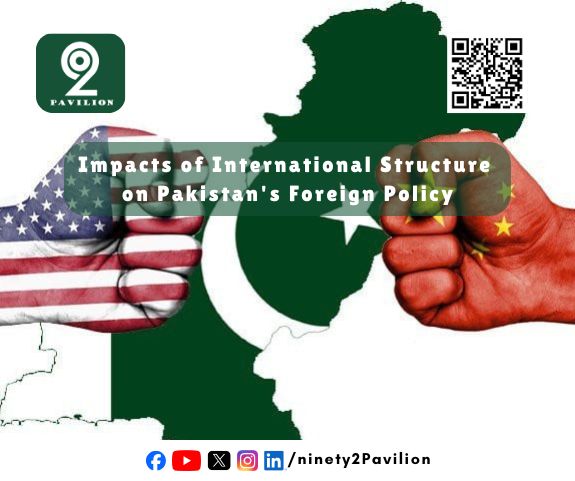
The international structure has moved decisively away from the post-Cold War unipolarity toward a complex, fragmented multipolarity. This shift is characterized by the intensifying rivalry between the United States and China, the resurgence of middle powers, and the erosion of a single “rules-based” global order. For Pakistan, a nation historically adept at navigating great-power alliances, this evolving international structure has fundamentally altered the calculus of its foreign policy. No longer able to rely on a stable, binary alignment, Islamabad is forced to adopt a strategy of “strategic hedging,” attempting to maximize economic and security benefits from competing power centers while avoiding becoming a permanent casualty of their friction.

The most profound impact of the current international structure is the “China-US Row.” As the Asia-Pacific becomes the primary theater of global competition, Pakistan occupies a sensitive geostrategic position. China remains Pakistan’s “all-weather” strategic partner, with the China-Pakistan Economic Corridor (CPEC) serving as the backbone of its economic future. However, 2026 has also seen a surprising warming of ties with Washington. Following a pragmatic recalibration, the U.S. has recognized Pakistan’s utility as a functional intermediary in Middle Eastern disputes, particularly between Washington and Tehran. This has created a delicate balancing act: Islamabad must secure Western financial support and military technology without alienating Beijing, which views deepened U.S.-Pakistan security cooperation with inherent suspicion.

Furthermore, the rise of regional “middle powers” such as Saudi Arabia, the UAE, and Turkey has provided Pakistan with more diplomatic breathing room. In the fragmented international structure of 2026, these nations are pursuing more autonomous foreign policies, often independent of Washington’s directives. Pakistan has leveraged this by positioning itself as a “security provider” and a “diplomatic bridge.” The country’s defense manufacturing depth and operational experience have made it a critical partner for Gulf states seeking to diversify their security arrangements. This regionalization of power allows Pakistan to diversify its dependencies, moving away from a narrow reliance on any single superpower and toward a more “non-aligned” pragmatism that prioritizes national interest over bloc politics.

However, the international structure also imposes severe constraints. The “India-centric” tilt of the U.S. and the strengthening of ties between New Delhi and Israel have reinforced a sense of strategic encirclement in Islamabad. The deadlock at the United Nations regarding Security Council reform—where Pakistan remains a vocal opponent of India’s permanent membership bid—underscores the friction between Pakistan’s regional objectives and the aspirations of rising global powers. Moreover, the erosion of international norms has meant that regional flashpoints, such as Kashmir and the western border with Afghanistan, are increasingly volatile. Without a robust multilateral framework to mediate these disputes, Pakistan finds itself forced to invest more in traditional military deterrence, even as its economy demands a shift toward “geo-economics.”

Ultimately, the impacts of the international structure on Pakistan’s foreign policy in 2026 are dualistic. While the chaos of a multipolar world offers unprecedented opportunities for mediation and strategic autonomy, it also exposes the nation to the risks of great-power entrapment and regional isolation. Success in this new era requires a foreign policy that is as agile as it is principled—one that leverages Pakistan’s unique geography not as a battleground for others, but as a bridge for global trade and regional stability. For Islamabad, the challenge is to convert its current geopolitical relevance into lasting economic resilience, ensuring that it remains a player in the international order rather than a mere pawn in its restructuring

Share

Introduction

Pakistan’s political environment in 2026 remains dynamic and highly influential in shaping the country’s future. From parliamentary debates and economic policy decisions to opposition movements and electoral reforms, recent developments are playing a crucial role in determining national direction.

In this report by Eye of Pakistan, we analyze the latest political developments, government strategies, and opposition responses.

Government’s Policy Priorities in 2026

The federal government has emphasized:

  • Economic stabilization

  • Institutional reforms

  • Energy sector restructuring

  • Strengthening foreign diplomatic ties

Recent cabinet meetings focused on controlling inflation, stabilizing the Pakistani Rupee, and implementing fiscal discipline under ongoing economic reform programs.

Officials claim these measures aim to restore investor confidence and ensure sustainable growth.

Opposition’s Response and Political Strategy

Major opposition parties have intensified criticism of government policies, particularly regarding:

  • Rising inflation

  • Unemployment

  • Tax reforms

  • Utility price increases

Opposition leaders argue that economic pressure on the public has increased and demand greater transparency in parliamentary proceedings.

Political rallies and public gatherings have increased across major cities including Karachi, Lahore, and Islamabad.

Parliamentary Developments

Recent National Assembly sessions have seen heated debates over:

  • Budget allocations

  • Electoral reforms

  • Accountability laws

  • Provincial autonomy issues

Lawmakers from both treasury and opposition benches continue to exchange strong viewpoints, reflecting a vibrant yet tense political atmosphere.

Election Reforms and Democratic Process

Discussions around electoral transparency and digital voting mechanisms remain central to political discourse.

The Election Commission is reportedly reviewing:

  • Voter verification systems

  • Polling station security

  • Overseas voting procedures

Analysts believe these reforms could significantly impact future general elections.

Public Reaction and Political Climate

Public opinion appears divided. While some citizens support structural reforms and long-term stabilization plans, others express concerns over economic hardships and governance challenges.

Political analysts suggest that the coming months will be critical in determining whether current policies translate into tangible relief for the public.

Conclusion

Pakistan’s political landscape in 2026 is marked by active debate, institutional reforms, and strategic maneuvering from both government and opposition parties. As policy decisions continue to unfold, their impact on economic stability and democratic processes will remain under close observation.

Stay connected with Eye of Pakistan for reliable and timely political updates.

Education in Pakistan 2026

By: News Desk 92Pavilion Education in Pakistan stands as a complex paradox of modest statistical gains and deep-rooted systemic crises. As of 2026, the national

Share
Read More »