By: News Desk 92Pavilion
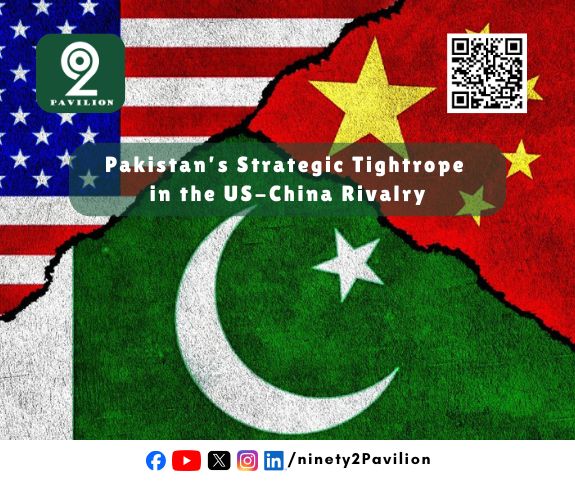
The global geopolitical landscape is defined by the hardening of the systemic rivalry between the United States and China, a competition that has moved beyond trade and technology into a struggle for regional influence and ideological preeminence. For Pakistan, this rivalry presents the most significant foreign policy challenge since the end of the Cold War. Geographically positioned at the crossroads of China’s belt-and-road ambitions and the United States’ Indo-Pacific interests, Islamabad finds itself in a precarious position. The era of “strategic ambiguity” is under immense pressure as both superpowers increasingly signal that the middle ground is shrinking. However, Pakistan’s current policy in 2026 remains rooted in a refusal to join a zero-sum bloc, instead pursuing a “geo-economic” vision that seeks to leverage its location as a bridge rather than a battleground.
The relationship with China remains Pakistan’s primary strategic anchor. As the China-Pakistan Economic Corridor (CPEC) moves into its high-tech industrial phase, the economic interdependence between the two nations has reached a point of no return. For Beijing, Pakistan is a crucial outlet to the Arabian Sea, offering a shortcut for energy supplies that bypasses the contentious Malacca Strait. For Islamabad, China provides the large-scale infrastructure investment and diplomatic shielding at the United Nations that no other power can match. However, this deep alignment has introduced friction with Washington. The U.S. remains suspicious of China’s long-term naval intentions at Gwadar Port and views the economic debt associated with CPEC as a potential lever for Chinese geopolitical expansion.
Conversely, the United States remains an indispensable partner for Pakistan’s economic survival and security apparatus. Despite the pivot toward India as a primary counterweight to China in the Indo-Pacific, Washington retains significant influence over the international financial institutions—such as the IMF and World Bank—upon which Pakistan’s fragile economy depends. Furthermore, the U.S. remains one of Pakistan’s largest export destinations and a critical source of military hardware and counter-terrorism cooperation. In 2026, the U.S. has recalibrated its approach, moving away from the “security-only” lens of the war-on-terror era and toward a more nuanced engagement focused on climate resilience, green energy, and technology transfers. This shift is designed to offer Pakistan a viable alternative to Chinese investment, creating a competitive environment where Islamabad must balance the benefits of Western technology and capital against Chinese infrastructure and strategic support.
The challenge for Pakistan’s foreign office is to avoid being “de-hyphenated” or forced into a binary choice. The current international structure has forced Islamabad to adopt a policy of “constrained hedging.” This involves cooperating with China on hard infrastructure and regional security while collaborating with the U.S. on digital governance, education, and financial transparency. However, the risk of “entrapment” is constant. In 2026, as the U.S. and China decouple their supply chains, Pakistan faces difficult decisions regarding 5G infrastructure, semiconductor supply lines, and maritime security protocols. Choosing a Chinese technology stack might alienate Western investors, while opting for U.S.-led frameworks could jeopardize the “all-weather” trust with Beijing.
Ultimately, Pakistan’s ability to navigate this rivalry depends on its internal economic strength. A weak economy makes the country a pawn in the great-power game; a resilient one allows it to be a player. By positioning itself as a transit hub for Central Asian energy and a facilitator for regional dialogue, Pakistan aims to make itself too useful to both powers for either to demand a total break from the other. As we move further into 2026, the “Eagle and the Dragon” will continue to cast long shadows over the Indus, but Pakistan’s path forward lies in maintaining a delicate, dynamic equilibrium that prioritizes sovereign national interests over the dictates of a new Cold War