By: News Desk 92Pavilion | Updated: August 15, 2026
Quick Answer: International think tanks say the Mecca Joint Defence Agreement between Saudi Arabia, Pakistan, and Turkey reflects a broader shift in how Gulf states view their security. Signed on August 7 in Mecca, the pact treats an attack on any one member as an attack on all three. Analysts at the Atlantic Council and other institutions describe it as a signal to Washington about the limits of American reliability, even as they caution it does not represent a full break from the United States.
What the Agreement Says
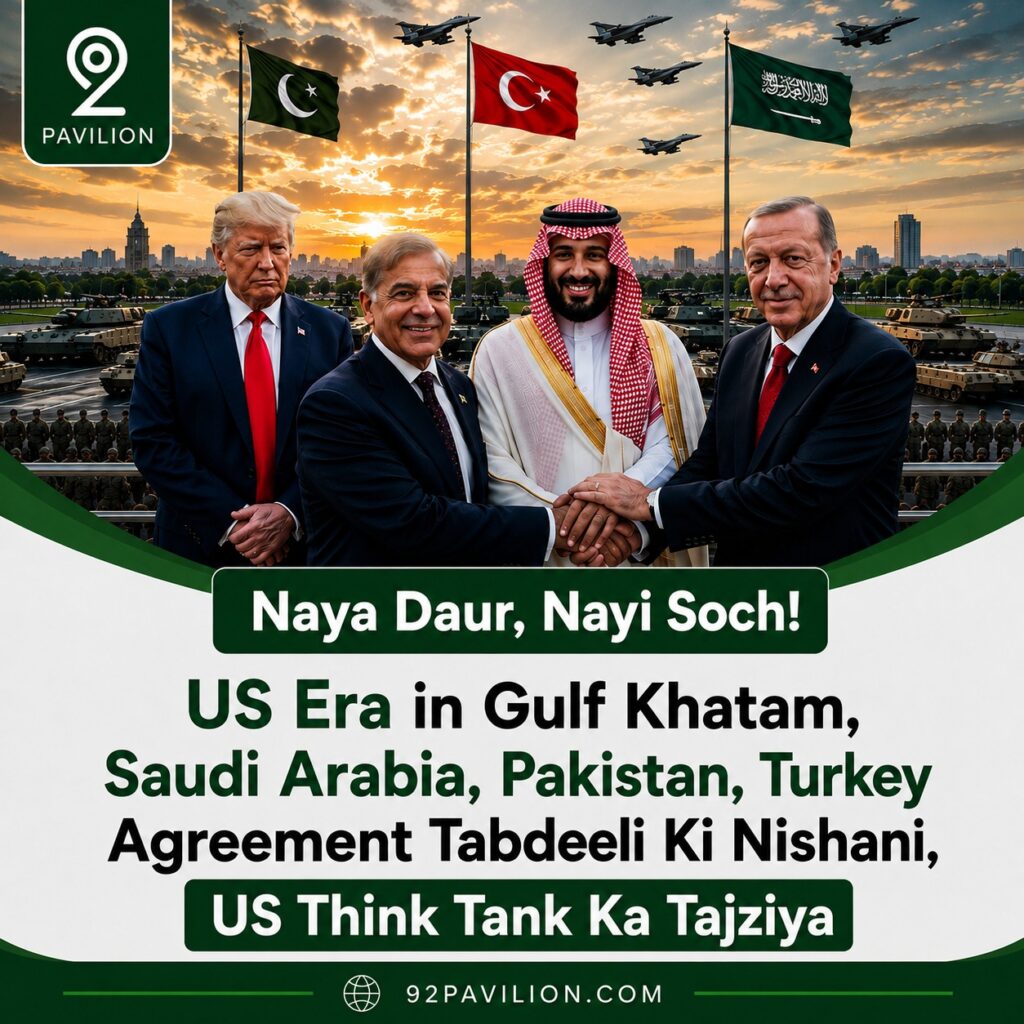
Leaders from Saudi Arabia, Pakistan, and Turkey signed the Mecca Joint Defence Agreement on August 7, 2026. Under its terms, an armed attack against any one of the three states will be treated as an attack against all of them. The pact takes its name from the Saudi city where it was signed, during a meeting that brought together Crown Prince Mohammed bin Salman, Pakistani Prime Minister Shehbaz Sharif, and Turkish President Recep Tayyip Erdoğan.
Why the Timing Matters
The agreement arrives at a tense moment for the region. Iran’s war has threatened to reignite, and Houthi attacks from Yemen have already resumed. Meanwhile, Gulf states have grown increasingly uncertain about relying on the United States as their primary security guarantor, especially after Iran launched a series of drone and missile attacks that struck Saudi Arabia directly.
Building on Existing Ties
This trilateral pact does not stand alone. It builds on a bilateral Strategic Mutual Defence Agreement that Saudi Arabia and Pakistan signed in September 2025 at Al-Yamamah Palace in Riyadh. That earlier deal formalised decades of military cooperation, during which Pakistan had long provided training and technical assistance to Saudi forces. Turkey and Pakistan had also separately deepened their defence ties, exchanging warships and training aircraft in recent years.
By mid-2026, Pakistan had already deployed several thousand troops, fighter aircraft, drones, and an air-defence system to Saudi Arabia. In July, Islamabad also opened talks with Kuwait on a potentially expanded security arrangement, underscoring how quickly this web of defence relationships has grown.
What Each Country Brings to the Table
According to analysts, the three countries offer genuinely complementary strengths. Turkey fields NATO’s second-largest army and has built a sophisticated domestic drone industry. Saudi Arabia brings the Gulf region’s deepest financial reserves. Pakistan contributes a large, combat-experienced military along with the Muslim world’s only nuclear arsenal.
Nihat Ali Ozcan, a strategist at Ankara-based think tank TEPAV, described the arrangement as a natural fit: Turkish technology in need of new markets, Pakistani manpower in need of financing, and Saudi wealth in need of additional manpower.
How Experts at the Atlantic Council View It
Experts at the Atlantic Council called the agreement “an inflection point” in the emerging multipolar order across the Middle East and South Asia. At the same time, they cautioned against overstating its practical impact. Saudi Arabia has held mutual defence commitments with Pakistan since 2025, and with the Gulf Cooperation Council since 2000, yet none of those arrangements has triggered anything resembling NATO’s Article 5 in practice.
Analysts also noted that Pakistani officials have consistently maintained that their earlier 2025 agreement with Saudi Arabia did not extend to a nuclear umbrella, a distinction that remains relevant to how the new trilateral pact is understood.
A Message Aimed at Washington
Writing in The Conversation, one analysis argued that the most consequential audience for the agreement isn’t in Tehran or Tel Aviv, but in Washington. The piece described the pact as, in effect, a verdict on American reliability as a security partner, particularly after the US and Saudi Arabia had signed a separate deal in July concerning the kingdom’s own defence posture.
Commentators have also floated the label “Islamic NATO” to describe the arrangement, while some voices in Israel have gone further, characterising it as an anti-Israel alliance, a framing regional analysts have pushed back against.
What Comes Next
According to Middle East Eye, analysts view the pact not as an isolated event but as the culmination of years of deepening trilateral cooperation among the three countries. Turkey has also reportedly sought to join the earlier Saudi-Pakistan pact, with talks described as being at an advanced stage even before the Mecca signing. As regional tensions continue, experts say the durability and practical impact of the agreement will likely become clearer through how the three countries respond to future crises.
Frequently Asked Questions
When was the Mecca Joint Defence Agreement signed?
It was signed on August 7, 2026, in Mecca, Saudi Arabia.
Which countries are part of the agreement?
Saudi Arabia, Pakistan, and Turkey are the three signatories.
What does the agreement commit each country to?
It states that an armed attack on any one member will be treated as an attack on all three, similar in structure to NATO’s Article 5.
Does this agreement replace ties with the United States?
Analysts say it does not represent a full break from Washington, but it does signal growing Gulf interest in diversifying security partnerships beyond the US.
This report is based on reporting from the Atlantic Council, The Conversation, Middle East Eye, and the Council on Foreign Relations.
92Pavilion brings you international and regional affairs analysis as events unfold. Stay with us for updates on this developing story.