
By: News Desk 92Pavilion | Updated: August 25, 2026
Quick Answer: Lawyer Jibran Nasir, representing the family of murdered businessman Mir Raza Ali, has criticised Sindh police for failing to use available camera technology in the investigation, despite the same technology being capable of issuing automatic traffic fines. Nasir said 24 questions sent to the Sindh chief minister remain unanswered, as the case enters its second month without a resolved investigation.
A Case Still Without Answers
More than three weeks after Mir Raza Ali’s death, his family’s lawyer continues to raise pointed questions about how Sindh police have handled the investigation. Jibran Nasir, a well-known rights activist representing the family, told media in Karachi that 24 questions sent in a letter to the Sindh chief minister had gone unanswered.
Raza, a 25-year-old IBA graduate and owner of the Karachi-based dessert brand Wafflix, was found dead on July 29 in the city’s Gulistan-e-Jauhar area. What police initially treated as a possible suicide has since been reclassified as murder, following a second post-mortem that identified a gunshot wound and signs of torture.
The Camera Technology Argument
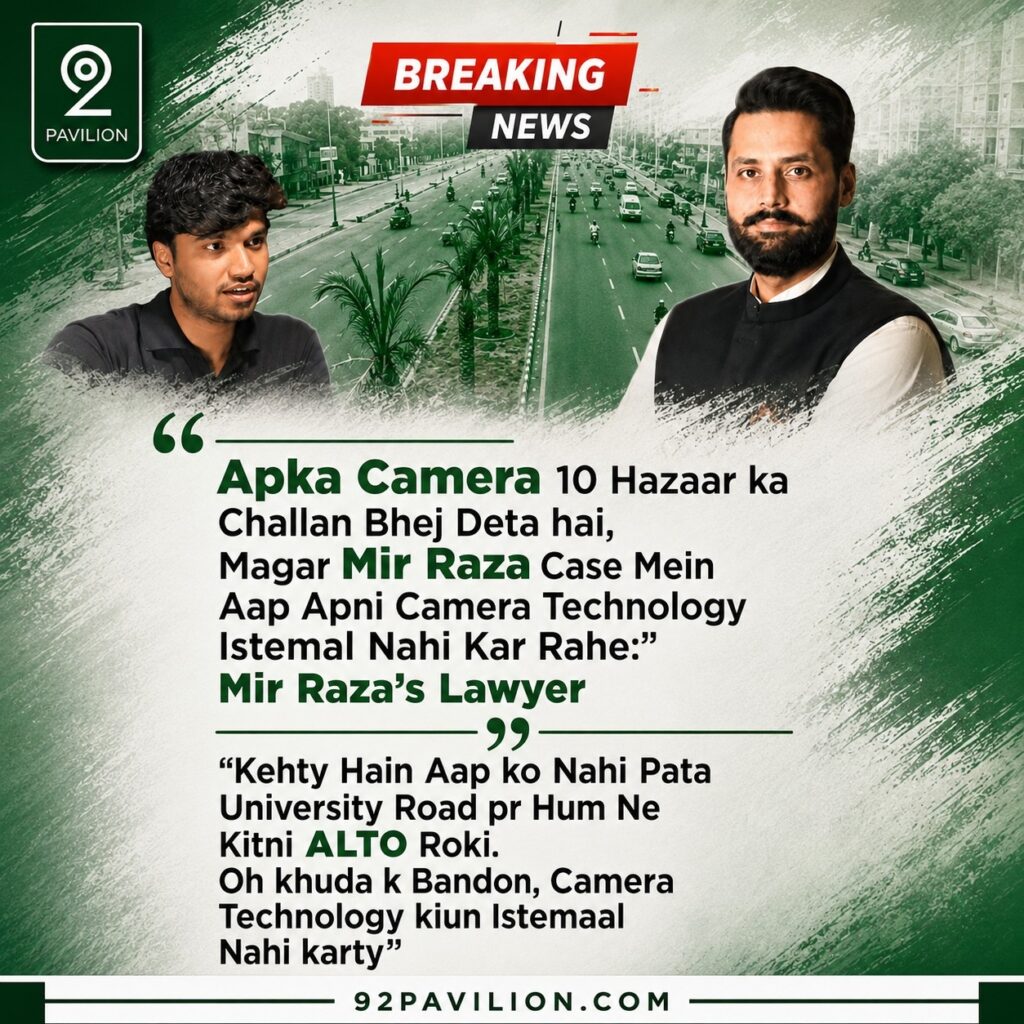
Nasir’s most pointed criticism centres on the city’s traffic camera network. He noted that Pakistan’s automated camera system is capable of issuing a Rs10,000 fine for traffic violations without any human intervention, yet that same camera infrastructure was not meaningfully used to help trace the vehicles involved in Raza’s abduction and murder.
Specifically, Nasir questioned investigators over how many white Alto vehicles had been stopped on University Road on the night in question, and whether officers had checked details like seatbelt use or mobile phone activity during those stops. He argued that if the technology exists to automatically fine ordinary traffic violations, it should have been used far more effectively in a murder investigation involving a specific vehicle and location.
A Vehicle Still Untraced
According to Nasir, both the motorcycle and the white Alto believed to be connected to the case had still not been traced by investigators, more than three weeks after the crime. He said the failure to locate these vehicles, despite the availability of camera technology across the city, pointed to deeper problems with how the investigation had been conducted from the outset.
Nasir also raised concerns about whether the judge assigned to a newly formed judicial commission would be assisted by the same police team that had already failed to establish key facts in the first 15 days of the investigation.
The Judicial Commission Controversy
The Sindh government has formed a judicial commission to investigate Raza’s death, a move Karachi Mayor Murtaza Wahab has defended as an effort to ensure justice. However, Raza’s family has pushed back against the commission’s formation, filing a petition in the Sindh High Court instead calling for a joint investigation team (JIT) to take over the case.
The family’s petition argued that the ordinary investigative process had failed to establish even the basic circumstances of Raza’s abduction, torture, and murder. It further alleged that the original investigation team had prematurely pursued a theory of suicide, failed to properly record statements from immediate family members, and mishandled both physical and digital evidence, including CCTV footage and Raza’s smartwatch.
The Sindh High Court has issued notices to all parties, with the case scheduled for further hearing on August 31.
Where the Investigation Stands
Separately, the investigating officer in the case has asked the court for more time to submit a formal investigation report, citing pending forensic results for Raza’s mobile phone and other recovered items. The court has ordered that report to be submitted by September 7.
Nasir has previously alleged broader negligence in how evidence was handled, including claims that Raza’s smartwatch was kept by a senior police officer for eight days after being taken from the family, and that a guesthouse DVR relevant to the case was carried around by a police station house officer rather than being properly secured.
Frequently Asked Questions
What is Jibran Nasir’s main criticism of the investigation?
He says police failed to use available automated camera technology to trace vehicles connected to the case, despite that same technology being used routinely to issue traffic fines.
Has the vehicle involved in the case been identified?
According to the family’s lawyer, both the motorcycle and a white Alto car linked to the case had still not been traced as of this report.
Why is the family opposing the judicial commission?
The family has filed a Sindh High Court petition seeking a joint investigation team instead, arguing the ordinary investigation process has already failed and expressing concern that the same police team could be involved in the commission’s work.
When is the next court hearing in the case?
The Sindh High Court has scheduled the next hearing for August 31, while the investigating officer has been ordered to submit a full report by September 7.
This report is based on reporting from ARY News, The Express Tribune, Dawn, and Geo News.
92Pavilion brings you Sindh’s city and legal affairs news as it happens. Stay with us for updates on this developing story.