By: News Desk 92Pavilion | Updated: July 2026
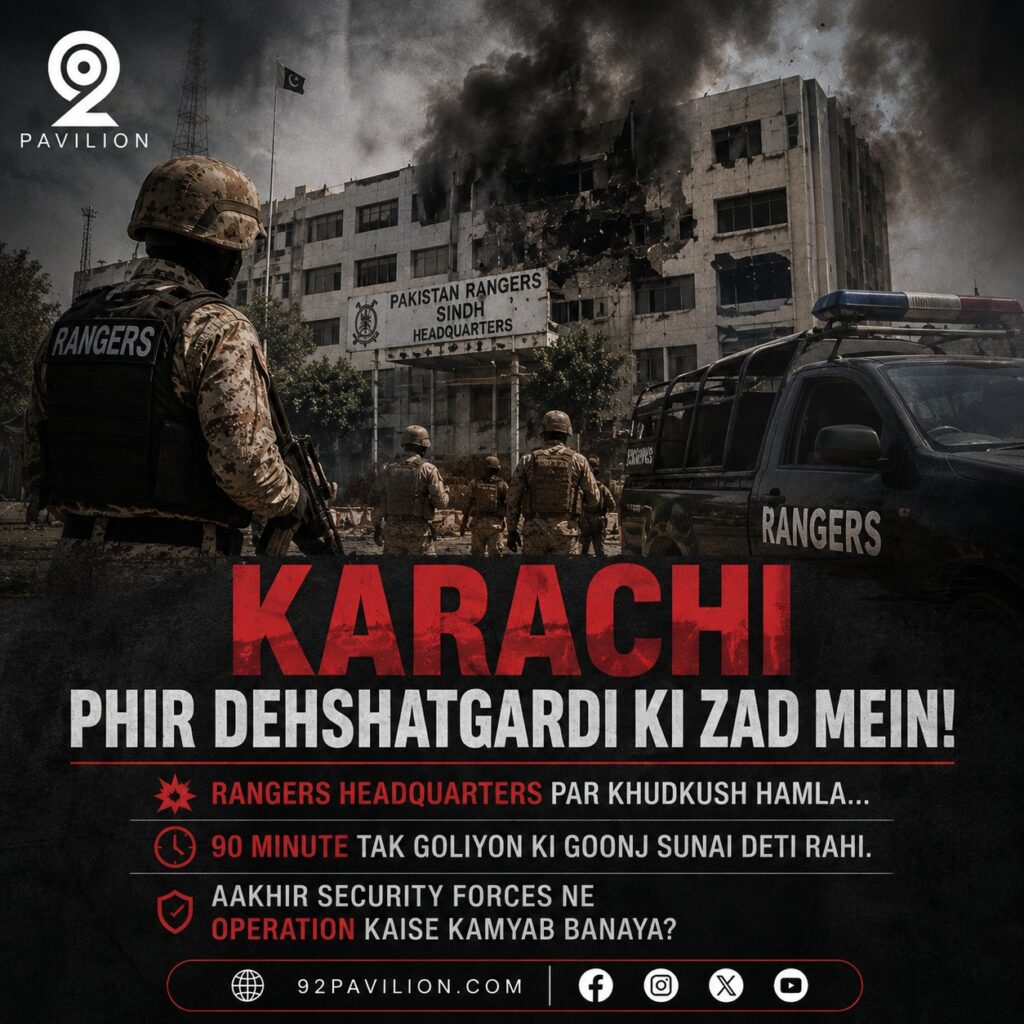
Quick Answer: On the night of June 27, 2026, militants carried out a Rangers headquarters attack on the Pakistan Rangers (Sindh) Transport Company workshop in Karachi’s Gulistan-e-Jauhar area. A suicide bomber detonated himself at the main gate, killing three Rangers personnel and wounding four. Security forces killed two attackers and captured a third alive. ISPR says the assault was carried out by the banned outfit Jamaat-ul-Ahrar (JuA), operating out of Afghanistan.
How the Attack Unfolded
The assault began around 8 pm. A group of four militants targeted the main gate of the Rangers Transport Company workshop. A suicide bomber blew himself up at the entrance, instantly killing three Rangers personnel stationed there. The remaining attackers opened fire with submachine guns.
Security personnel responded immediately, killing two of the attackers on the spot. A third, wounded, was captured alive. The Bomb Disposal Squad was called in, and investigators later recovered 43 spent SMG shell casings and an unexploded hand grenade from the scene.
What the Captured Attacker Revealed
The captured militant identified himself as Usman, alias Ali, and told investigators he had entered Pakistan from Jalalabad, Afghanistan. According to his statement, three of the four attackers were Afghan nationals, while the fourth, Abdul Hadi, was a Pakistani citizen from Bajaur.
During interrogation, he said the group arrived in Karachi about a week before the attack and stayed in an under-construction building in Korangi with help from local facilitators. They reportedly conducted reconnaissance of the workshop before carrying out the assault.
ISPR’s Official Position
The military’s media wing, ISPR, attributed the Rangers headquarters attack to Jamaat-ul-Ahrar (JuA), describing it as an “Indian proxy.” The group split from the Tehreek-i-Taliban Pakistan (TTP) in 2014 under Omar Khalid Khorasani, though the two organizations rejoined forces in 2024. The captured attacker claimed that Afghanistan-based commanders Umar Qari, Maulvi Ahrar, and Abdul Wajid had directed the group to carry out the assault.
The Investigation and Uncomfortable Questions
Sindh’s Counter Terrorism Department has registered five separate cases in connection with the attack. But the incident has raised an uncomfortable question: if the attackers spent a full week inside Karachi before striking, how did they reach a Rangers facility undetected?
Commentary following the attack pointed out that securing a Rangers compound from the inside is the Rangers’ job, but identifying and stopping militant cells operating within the city falls to Sindh Police and the CTD. Analysts have drawn comparisons to previous security lapses in Karachi, including the 2018 attack on the Chinese consulate and the 2023 assault on the Karachi Police Office.
Reaction From Officials and Business Leaders
Former Federation of Pakistan Chambers of Commerce and Industry (FPCCI) president Zubair Tufail strongly condemned the attack, calling it a direct assault on national security. Sindh Chief Minister Murad Ali Shah directed police leadership to submit a detailed report on the incident without delay.
Authorities have also intensified a crackdown on Afghan nationals residing illegally in Karachi’s Malir district, with several arrests reported in the days following the attack.
Frequently Asked Questions
Q: When did the Rangers headquarters attack happen?
A: On the night of June 27, 2026, in Karachi’s Gulistan-e-Jauhar area.
Q: How many Rangers personnel were killed?
A: Three personnel were killed and four others were wounded.
Q: Who claimed responsibility?
A: ISPR attributed the attack to the banned outfit Jamaat-ul-Ahrar (JuA), which operates from Afghanistan.
Q: How many attackers were involved?
A: Four attackers took part. Two were killed, one was captured alive, and the suicide bomber died in the initial blast.
This report is based on statements from ISPR and reporting from Dawn, Arab News, Business Recorder, and The Express Tribune.