
By: 92 Pavilion | Updated: August 29, 2026 Category: Pakistan
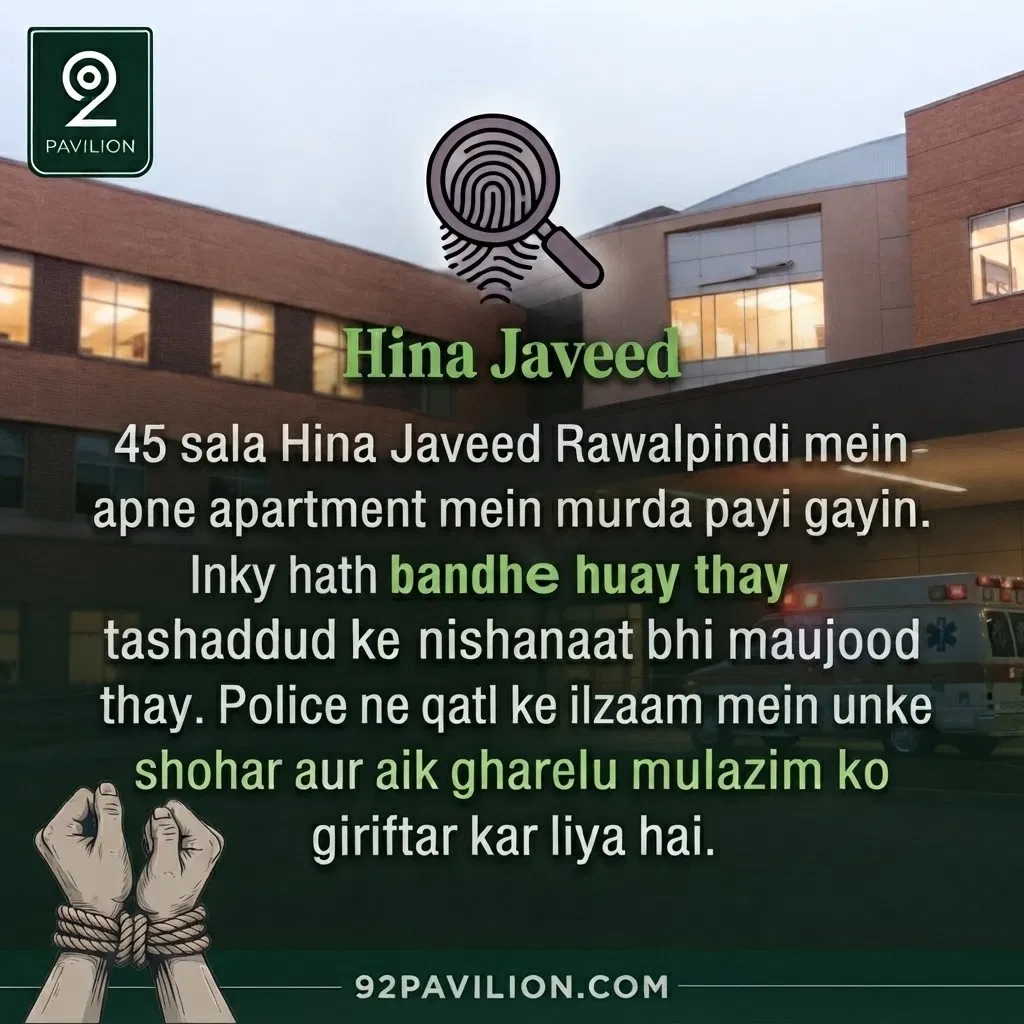
Quick Answer: A Rawalpindi court has extended the physical remand of Faisal Asghar and domestic worker Zeeshan, the two men arrested in connection with the murder of 45-year-old Hina Javed, by four more days. Hina was found dead at her in-laws’ residence in Askari Apartments, Lal Kurti, on August 20, with her hands bound and signs of torture on her body. The next court date is set for September 2.
How the Case Began
Hina Javed, 45, was found dead in the washroom of her apartment in Askari Apartments, Civil Lines, on the evening of August 20, according to Dawn. Police said her body bore signs of torture, with a wire fastened around her neck and tied to the shower rod, and her hands bound behind her back.
Hina’s father-in-law had initially called police to report a break-in at the residence. Her brother, Fahid Javed, told police he received a call from the father-in-law at around 6:53 pm informing him of an emergency, and arrived at the apartment roughly 30 minutes later to find his sister’s body.
The FIR and Initial Arrests
A first information report was registered on August 20 at the Civil Lines police station under Sections 302 (premeditated murder) and 34 (common intention) of the Pakistan Penal Code. In the FIR, Fahid alleged that his sister had been murdered by her husband, her father-in-law, and their domestic servant, and that she had been subjected to severe mistreatment throughout her marriage.
According to Gulf News, Hina had entered an arranged marriage with Faisal Asghar, then 52, about nine months earlier. She worked in the media department of Pakistan’s parliament. Police detained Asghar and the domestic servant, identified as Zeeshan, on murder charges, while her elderly father-in-law was questioned as part of the investigation.
A Servant’s Confession
According to Geo News, Zeeshan confessed to strangling and torturing Hina during a marital dispute between her and her husband. He told investigators he had been called to the residence during the altercation, and that when Hina tried to flee, both he and Asghar grabbed her. When she resisted, he said, he pressed her throat. Zeeshan also admitted to frequently stealing from the household. Police sources noted that Zeeshan had given three different accounts of events following his arrest, raising further questions investigators are still working to resolve.
Forensic Investigation Underway
A special investigation team, headed by Investigation SSP Saifullah, took Asghar and Zeeshan to Lahore under tight security, where their samples were submitted to the Punjab Forensic Science Agency for DNA and polygraph examinations. According to the Express Tribune, a preliminary post-mortem report found a fracture to a neck bone along with injuries to Hina’s ribs and hip. Police say the precise cause of death will not be officially established until the complete post-mortem and forensic reports are finalised.
Latest Court Proceedings
A judicial magistrate extended the physical remand of Asghar and Zeeshan by four more days on Saturday, according to Pakistan Today. Police say they need the additional time to recover alleged tools and other evidence connected to the case. The suspects are due back in court on September 2, when police are expected to submit a further progress report.
Advocate Shah Khawar, counsel for Hina’s family, told reporters after an earlier hearing that the investigation was proceeding in the right direction, noting that police had collected evidence and conducted forensic examinations.
First Lady Calls for Thorough Investigation
The case has drawn attention at the highest levels of government. Pakistan’s First Lady, Aseefa Bhutto-Zardari, publicly called for a thorough investigation, expressing “deep concern and sorrow” over the murder and urging the Punjab government to ensure a proper inquiry, according to Gulf News. She said those responsible must be brought to justice and called for stronger measures to protect women from violence in Pakistan.
Frequently Asked Questions
When was Hina Javed found dead?
She was found dead in her apartment’s washroom in Rawalpindi on the evening of August 20, 2026.
Who has been arrested in connection with her death?
Her husband, Faisal Asghar, and a domestic servant, Zeeshan, have been arrested. Her father-in-law has been questioned as part of the investigation.
Has anyone confessed to the crime?
According to police sources, Zeeshan confessed to strangling Hina during a domestic dispute, though he has since given differing accounts of the events.
When is the next court hearing?
The suspects are due back in court on September 2, following a four-day extension of their physical remand.