By: News Desk 92Pavilion
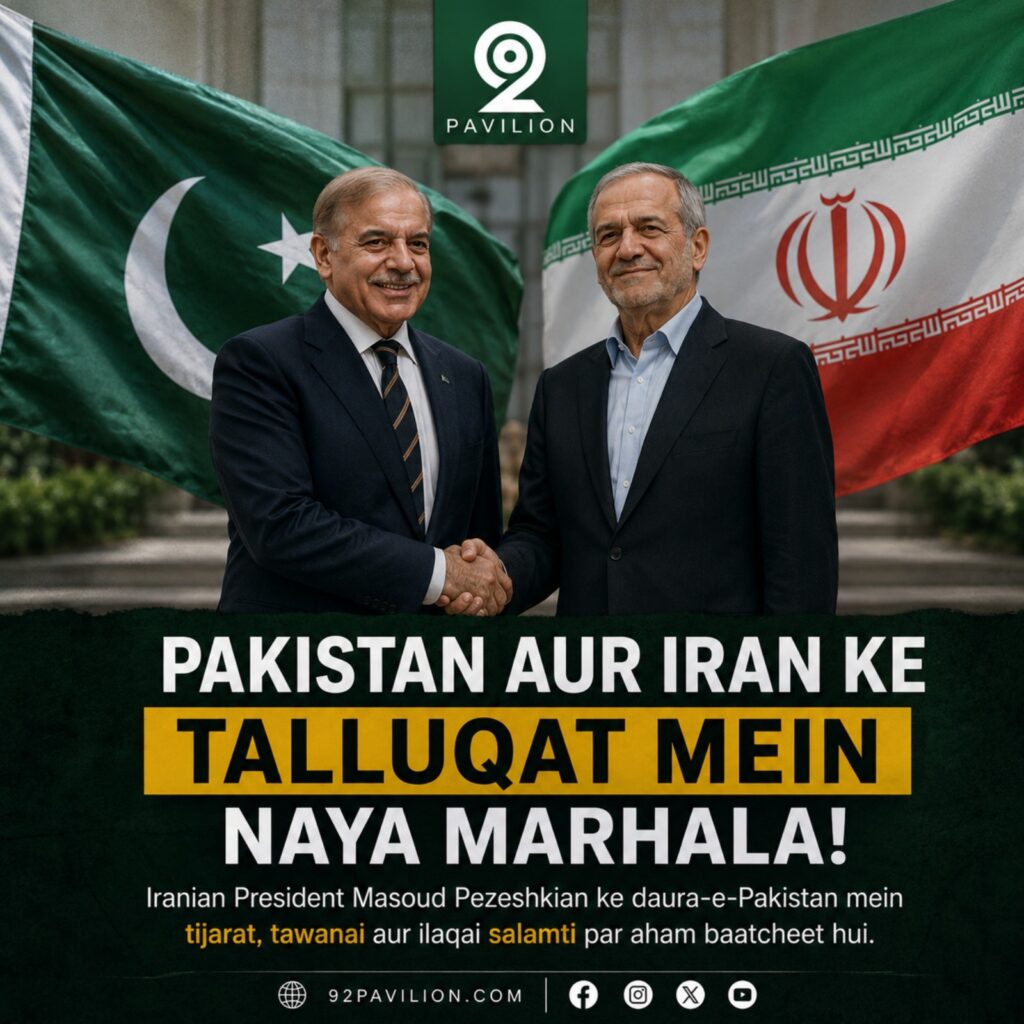
Islamabad: Iranian President Dr. Masoud Pezeshkian arrived in Islamabad this week for a state visit that Pakistani and Iranian officials describe as a milestone in the two neighbours’ relationship. It was Pezeshkian’s second trip to Pakistan since taking office, and his first overseas visit following the recent US-Israel conflict with Iran.
A Visit Rooted in Gratitude
Officials on both sides say the trip was as much about diplomacy as it was about thanking Pakistan for its role in ending months of hostility between Tehran and Washington. Islamabad had spent weeks quietly mediating between the two sides, work that eventually produced the Islamabad Memorandum of Understanding, signed on June 18 by US President Donald Trump and President Pezeshkian, with Prime Minister Shehbaz Sharif signing as mediator.
That agreement set in motion a formal 60-day roadmap toward a broader settlement, with the first round of follow-up talks held in Switzerland just days before Pezeshkian’s arrival in Pakistan.
What Was Discussed
During the visit, Pezeshkian held talks with President Asif Ali Zardari and Prime Minister Sharif. Senate Chairman Yousaf Raza Gilani, National Assembly Speaker Sardar Ayaz Sadiq and Deputy Prime Minister and Foreign Minister Ishaq Dar also met the Iranian leader.
According to Pakistan’s Foreign Office, the two sides reviewed the full spectrum of bilateral relations and explored ways to strengthen cooperation in trade, energy, border security and regional connectivity. They also discussed how to implement the understandings reached under the Islamabad MoU, along with wider regional developments.
Prime Minister Sharif offered Pezeshkian a strong assurance of continued support during their meeting, telling him that Pakistan would stand by Iran going forward. He added that Islamabad intends to keep playing its mediating role until lasting peace is achieved in the region.
A Relationship Rebuilt Through Crisis
This was not Pezeshkian’s first visit to Pakistan under similar circumstances. After the 12-day Iran-Israel war in June 2025, he chose Pakistan as his first foreign destination, travelling first to Lahore and then to Islamabad. That trip produced twelve bilateral agreements and a pledge to raise annual trade between the two countries to $10 billion, up from roughly $3 billion at the time.
Since the latest round of US-Israel strikes on Iran began in February, Sharif and Pezeshkian have spoken by phone at least seven times, according to officials, often for conversations lasting close to an hour. Pakistan’s army chief, Field Marshal Asim Munir, travelled to Tehran twice during the crisis, while Interior Minister Mohsin Naqvi also made several visits as part of the country’s mediation push.
Why the Visit Matters
Analysts say the frequency and depth of these exchanges point to a shift in the relationship. Pakistan is no longer simply passing messages between Tehran and Washington; it has become a genuine stakeholder in the outcome of the broader negotiations. For Iran, the visit offered a chance to convert a fragile diplomatic breakthrough into political capital at home and abroad, at a moment when factional pressures within Iran mirror the divisions that once complicated the 2015 nuclear deal.
For Pakistan, the visit reinforces its growing profile as a regional mediator, built on decades of cultural and historical ties with Iran. Officials in Islamabad say the coming weeks, as technical talks continue in Switzerland, will show whether this diplomatic momentum can be converted into a lasting settlement.
This report draws on statements from Pakistan’s Ministry of Foreign Affairs and official readouts of the Pezeshkian-Sharif and Pezeshkian-Zardari meetings in Islamabad.