By: News Desk 92Pavilion | Updated: August 5, 2026
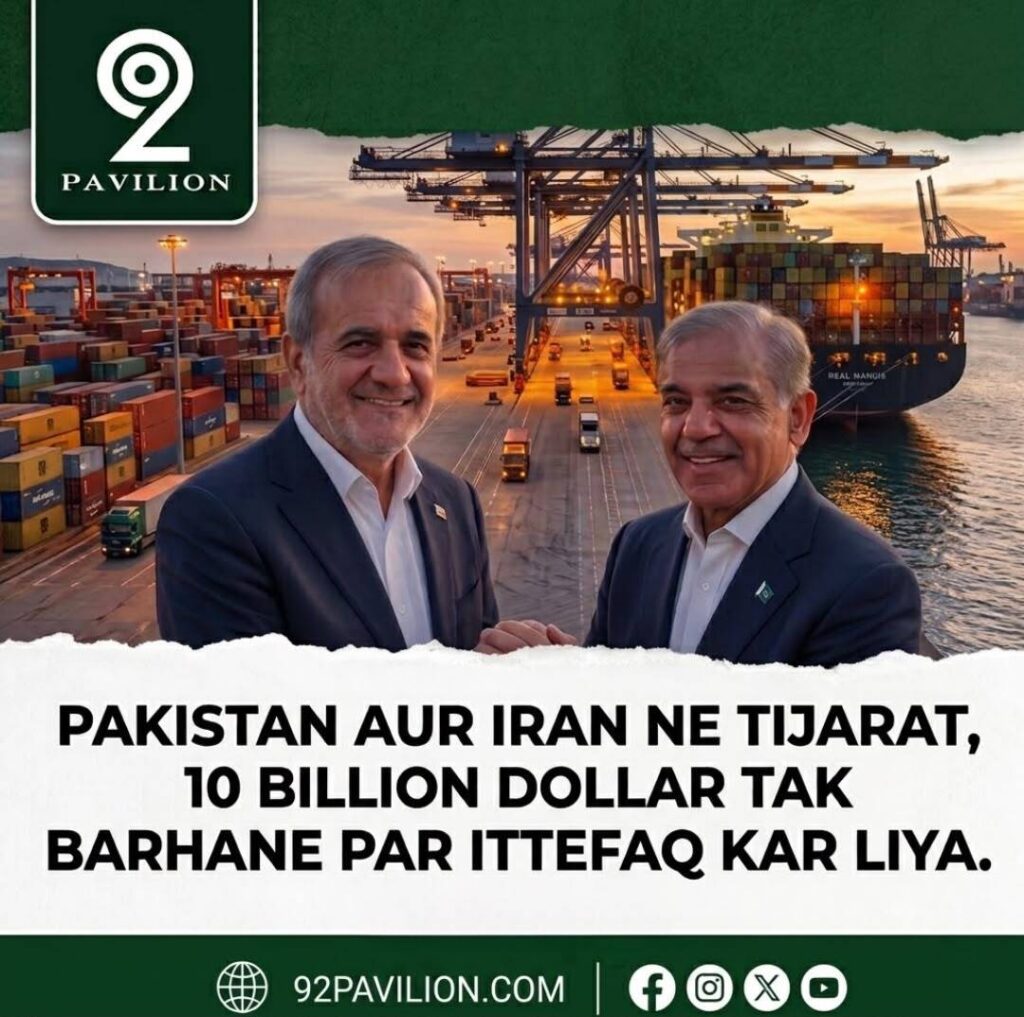
Quick Answer: Pakistan Iran trade cooperation took a step forward this week, as both countries reaffirmed their commitment to reaching $10 billion in bilateral trade. The agreement came during the 10th Pakistan-Iran Joint Trade Committee meeting in Islamabad, followed by a separate meeting between Prime Minister Shehbaz Sharif and a visiting Iranian delegation. Officials from both sides also agreed to fast-track a long-discussed free trade agreement.
A Renewed Push for Deeper Trade Ties
Commerce Minister Jam Kamal Khan and Iran’s Minister for Industry, Mine and Trade, Mohammad Atabak, co-chaired the Joint Trade Committee session in Islamabad. Both sides used the meeting to reaffirm a target they’ve discussed for years: raising bilateral trade to $10 billion.
Jam Kamal said reaching that goal would require sustained collaboration, stronger institutional links, and closer engagement between the public and private sectors in both countries. He also stressed the need to speed up negotiations on the proposed Pakistan-Iran Free Trade Agreement.
What Iran Brought to the Table
Atabak described Pakistan as a long-term strategic trading partner for Iran. He expressed interest in strengthening trade and logistics cooperation through Pakistan’s Karachi and Gwadar ports, seeing them as key gateways for expanding regional commerce.
He also pointed to electricity trade and improved regional connectivity as fresh opportunities for both economies, alongside his hope that free trade talks could conclude successfully in the near future.
A Meeting With the Prime Minister
The trade committee talks were followed by a separate meeting between Prime Minister Shehbaz Sharif and a six-member delegation led by Atabak. Sharif said Pakistan places high value on its relationship with Iran and remains committed to promoting peace and stability across the region.
Referring to his recent conversations with Iranian President Masoud Pezeshkian, Sharif said both countries had agreed to deepen economic cooperation, particularly in trade. He expressed confidence that the $10 billion target was achievable through sustained effort, highlighting agriculture and food products as areas with strong potential for growth.
Why Trade Has Lagged Behind the Ambition
Pakistan and Iran share a 900-kilometer border along with deep cultural and historical ties, yet bilateral trade has remained well below what both countries have hoped for over the years. Security concerns along the border, international sanctions on Iran, banking restrictions, and limited transport infrastructure have all played a role in holding trade back.
Before sanctions intensified more than a decade ago, trade between the two countries had once surpassed $1.2 billion in a single fiscal year. Pakistan traditionally exported goods like rice, meat, textiles, fruits, and surgical equipment to Iran, while importing chemicals, plastics, oil, and steel products in return.
What’s Being Planned Next
Beyond the trade target itself, officials from both sides discussed removing barriers to border logistics, customs processes, and cargo movement. Jam Kamal specifically pointed to joint border markets as a way to support local livelihoods on both sides of the frontier.
Analysts have also noted that planned Special Economic Zones along the border could help revive trade further, alongside the broader push toward a finalized free trade agreement.
Frequently Asked Questions
What is the Pakistan Iran trade target?
Both countries have reaffirmed a goal of reaching $10 billion in annual bilateral trade.
When was this agreement reaffirmed?
The commitment was renewed during the 10th Pakistan-Iran Joint Trade Committee meeting in Islamabad, held in early August 2026.
What has held back Pakistan-Iran trade in the past?
Security concerns, international sanctions on Iran, banking restrictions, and limited transport infrastructure have all constrained trade growth.
Is a free trade agreement close to completion?
Officials from both countries say negotiations are progressing well, though no final signing date has been confirmed.
This report is based on statements from Pakistan’s Ministry of Commerce and reporting from ProPakistani, ARY News, Dawn, and The Express Tribune.
92Pavilion brings you the latest on Pakistan’s economic partnerships. Stay with us for continued coverage.