Latest Posts
Building a Vibrant Cultural FutureA Journey Towards ProsperityArab nations face an inevitable declineBlogging Revenue in Pakistan’s 2026 EconomyWhy China is Investing in Pakistan’s Gwadar PortThe Rising Spirit of Pakistani SportsVoice-Over Economy in Pakistan 2026India’s Investment in Iran,Chabahar PortEvent Management Business in Pakistan 2026The Volatile Trajectory of Pakistan-Afghanistan Relations in 2026Why Pakistan Must Overhaul Its InfrastructureEvolution of Goods and Equipment in Modern SportsThe Current Situation of Sports in PakistanGovernment Initiatives for Sports in PakistanAssessing Sports Infrastructure and Facilities in PakistanSialkot and the Renaissance of Pakistan’s Sports Goods IndustryEmerging Sports Trends in 2026Legacy of Popular Traditional SportsJourney Through the Background of Sports in PakistanInfrastructure and Framework Deficits in Pakistani Sports InstitutionsLevelling the Field of SportsThe Roadmap for Pakistan’s Islamic Financial TransitionApartheid Structure in Occupied KashmirThe Strategic Role of the SCO in 2026Complexities of Illegal Immigrant RepatriationPakistan’s Strategic Role in Regional Power DynamicsPakistan’s Strategic Role in the South Asian Power PlayPakistan’s Strategic Tightrope in the US-China RivalryPakistan-China Relations in a Changing Geopolitical EnvironmentForeign Relation of Pakistan with Neighboring CountriesGlobal Response and the Reshaping World Order in 2026Impacts of International Structure on Pakistan’s Foreign PolicyEnduring Conflict Between India and PakistanAncient Roman and Modern EntertainmentCultivating Pakistan’s Future Tech WorkforceBuilding, Champions of the WorldDeciphering the Boundary Between Art and EntertainmentDevelopment of Pakistan’s Entertainment Industry

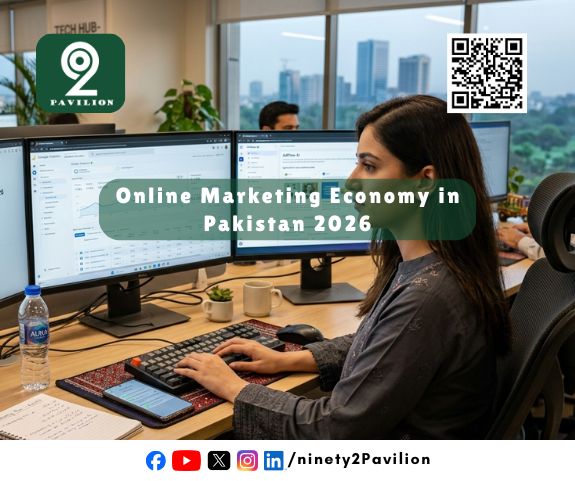
Online Marketing Economy in Pakistan 2026

Online Marketing Economy in Pakistan 2026

By: News Desk 92Pavilion

In the current business landscape of April 2026, online marketing in Pakistan has transitioned from an optional promotional tool into the primary lifeblood of the national economy. As traditional brick-and-mortar retail faces the dual pressures of rising operational costs and a rapidly digitizing consumer base, the “Digital First” mandate has taken hold across every major urban center from Karachi to Peshawar. The running business situation in Pakistan is characterized by a massive migration of advertising capital away from legacy media like television and billboards toward highly targeted, performance-driven digital ecosystems. For an online marketer in 2026, the path to monetization is no longer just about managing social media pages; it is about acting as a high-level growth architect who integrates artificial intelligence, data analytics, and cross-platform storytelling to drive measurable revenue for local and international brands.

To earn money in this environment, Pakistani marketers have moved into specialized, high-margin services such as “Performance-Based Arbitrage” and “Full-Funnel CRO” (Conversion Rate Optimization). Local startups and established textile giants alike are now willing to pay a premium for experts who can lower their Customer Acquisition Cost (CAC) while increasing the Lifetime Value (LTV) of their mobile-first audience. This shift has allowed savvy marketing agencies in Pakistan to move away from low-cost labor models toward “Value-Based Retainers,” where they earn a percentage of the total sales generated through their digital campaigns. Furthermore, with the Pakistani freelance community now exceeding three million active contributors, the competition has birthed a new class of “Micro-Agencies” that specialize in niche markets like Amazon FBA management for Pakistani exporters or TikTok-driven “Social Commerce” for local fashion brands.

The 2026 landscape is also heavily defined by the rise of “Localized AI Marketing.” Successful practitioners are using generative AI to create high-velocity content that resonates specifically with the Pakistani demographic, utilizing Roman Urdu and regional cultural cues to build trust. This cultural nuance is a significant competitive advantage that AI cannot yet fully replicate without human guidance. Marketers are earning substantial income by offering “AI-Integrated Strategy” packages, where they help traditional businesses automate their customer service via intelligent chatbots while simultaneously running hyper-personalized email and WhatsApp marketing campaigns. The integration of WhatsApp Business as a primary closing channel in Pakistan has created a unique “Chat-to-Conversion” revenue model, where marketers are paid based on the volume of qualified leads they funnel into private sales groups.

Furthermore, the “Dollar-Earning” potential remains the cornerstone of the industry’s appeal. By offering SEO, Programmatic Advertising, and Influencer Management to clients in the Middle East, Europe, and North America, Pakistani digital marketers are acting as “Service Exporters.” This allows them to capitalize on the currency exchange gap, maintaining a high-standard lifestyle locally while charging competitive international rates. To stay profitable in the current fiscal climate, professionals are also diversifying into “Affiliate Media Buying,” where they use their own capital to run ads for global products, earning commissions in USD. In summary, the online marketing business in Pakistan in 2026 is a mature, technical, and highly resilient field. It rewards those who view marketing as a science rather than an art, proving that in an era of digital saturation, the ability to capture attention and convert it into commerce is the most valuable skill set in the Pakistani professional arsenal

Share

Introduction

Pakistan’s political environment in 2026 remains dynamic and highly influential in shaping the country’s future. From parliamentary debates and economic policy decisions to opposition movements and electoral reforms, recent developments are playing a crucial role in determining national direction.

In this report by Eye of Pakistan, we analyze the latest political developments, government strategies, and opposition responses.

Government’s Policy Priorities in 2026

The federal government has emphasized:

  • Economic stabilization

  • Institutional reforms

  • Energy sector restructuring

  • Strengthening foreign diplomatic ties

Recent cabinet meetings focused on controlling inflation, stabilizing the Pakistani Rupee, and implementing fiscal discipline under ongoing economic reform programs.

Officials claim these measures aim to restore investor confidence and ensure sustainable growth.

Opposition’s Response and Political Strategy

Major opposition parties have intensified criticism of government policies, particularly regarding:

  • Rising inflation

  • Unemployment

  • Tax reforms

  • Utility price increases

Opposition leaders argue that economic pressure on the public has increased and demand greater transparency in parliamentary proceedings.

Political rallies and public gatherings have increased across major cities including Karachi, Lahore, and Islamabad.

Parliamentary Developments

Recent National Assembly sessions have seen heated debates over:

  • Budget allocations

  • Electoral reforms

  • Accountability laws

  • Provincial autonomy issues

Lawmakers from both treasury and opposition benches continue to exchange strong viewpoints, reflecting a vibrant yet tense political atmosphere.

Election Reforms and Democratic Process

Discussions around electoral transparency and digital voting mechanisms remain central to political discourse.

The Election Commission is reportedly reviewing:

  • Voter verification systems

  • Polling station security

  • Overseas voting procedures

Analysts believe these reforms could significantly impact future general elections.

Public Reaction and Political Climate

Public opinion appears divided. While some citizens support structural reforms and long-term stabilization plans, others express concerns over economic hardships and governance challenges.

Political analysts suggest that the coming months will be critical in determining whether current policies translate into tangible relief for the public.

Conclusion

Pakistan’s political landscape in 2026 is marked by active debate, institutional reforms, and strategic maneuvering from both government and opposition parties. As policy decisions continue to unfold, their impact on economic stability and democratic processes will remain under close observation.

Stay connected with Eye of Pakistan for reliable and timely political updates.

Education in Pakistan 2026

By: News Desk 92Pavilion Education in Pakistan stands as a complex paradox of modest statistical gains and deep-rooted systemic crises. As of 2026, the national

Share
Read More »