Latest Posts
Building a Vibrant Cultural FutureA Journey Towards ProsperityArab nations face an inevitable declineBlogging Revenue in Pakistan’s 2026 EconomyWhy China is Investing in Pakistan’s Gwadar PortThe Rising Spirit of Pakistani SportsVoice-Over Economy in Pakistan 2026India’s Investment in Iran,Chabahar PortEvent Management Business in Pakistan 2026The Volatile Trajectory of Pakistan-Afghanistan Relations in 2026Why Pakistan Must Overhaul Its InfrastructureEvolution of Goods and Equipment in Modern SportsThe Current Situation of Sports in PakistanGovernment Initiatives for Sports in PakistanAssessing Sports Infrastructure and Facilities in PakistanSialkot and the Renaissance of Pakistan’s Sports Goods IndustryEmerging Sports Trends in 2026Legacy of Popular Traditional SportsJourney Through the Background of Sports in PakistanInfrastructure and Framework Deficits in Pakistani Sports InstitutionsLevelling the Field of SportsThe Roadmap for Pakistan’s Islamic Financial TransitionApartheid Structure in Occupied KashmirThe Strategic Role of the SCO in 2026Complexities of Illegal Immigrant RepatriationPakistan’s Strategic Role in Regional Power DynamicsPakistan’s Strategic Role in the South Asian Power PlayPakistan’s Strategic Tightrope in the US-China RivalryPakistan-China Relations in a Changing Geopolitical EnvironmentForeign Relation of Pakistan with Neighboring CountriesGlobal Response and the Reshaping World Order in 2026Impacts of International Structure on Pakistan’s Foreign PolicyEnduring Conflict Between India and PakistanAncient Roman and Modern EntertainmentCultivating Pakistan’s Future Tech WorkforceBuilding, Champions of the WorldDeciphering the Boundary Between Art and EntertainmentDevelopment of Pakistan’s Entertainment Industry

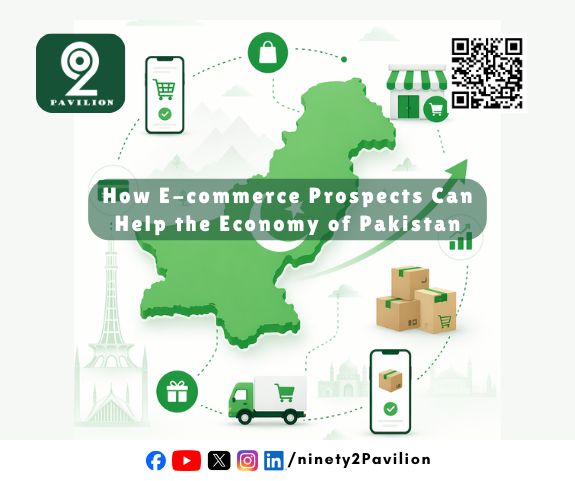
How E-commerce Prospects Can Help the Economy of Pakistan

How E-commerce Prospects Can Help the Economy of Pakistan

By: News Desk 92Pavilion

In the rapidly evolving global economic landscape of 2026, Pakistan stands at a transformative crossroads where digital commerce is no longer a peripheral luxury but a central pillar of national development. With an estimated e-commerce market valuation surpassing $5.7 billion in late 2025 and projections aiming for an ambitious $20 billion by 2029, the sector represents one of the most promising avenues for stabilizing and expanding the national economy. This digital shift is fundamentally altering the traditional retail paradigm, offering a scalable model that bypasses the limitations of physical infrastructure, reduces operational overheads, and democratizes market access for millions of citizens. As the country navigates fiscal challenges, the “E-commerce Renaissance” offers a high-velocity engine for GDP growth, foreign exchange influx, and socio-economic empowerment.

The primary driver behind this economic potential is Pakistan’s unique demographic advantage. In 2026, over 64% of the population is under the age of 30, forming a vast, digitally native workforce and consumer base. This “Youth Bulge” is increasingly comfortable with mobile-first transactions, with over 70% of e-commerce traffic now originating from smartphones. This shift toward mobile commerce, or m-commerce, has significantly lowered the barrier to entry for small and medium-sized enterprises (SMEs) in regions like Sialkot, Faisalabad, and Multan. By leveraging social commerce platforms—which are expected to account for 35% of online retail sales this year—home-based entrepreneurs can reach a national and even global audience without the need for expensive storefronts. This decentralization of commerce is critical for rural development, as it allows wealth to circulate beyond the major urban hubs of Karachi and Lahore.

Furthermore, the e-commerce sector is a massive catalyst for the formalization of the economy. In 2026, the widespread adoption of the ‘Raast’ instant payment system and the proliferation of fintech solutions like JazzCash, Easypaisa, and SadaPay are gradually chipping away at the historical dominance of Cash-on-Delivery (COD). While COD still remains a preferred method for many, the uptrend in digital payments is essential for creating a transparent, traceable financial ecosystem. This formalization not only increases the tax base but also allows small businesses to build a digital credit history, which is vital for accessing formal banking loans and scaling their operations. The government’s recent launch of the “Pakistan Business Portal” in March 2026 further streamlines this process, providing a unified digital window for registration and compliance that reduces the “red tape” traditionally associated with Pakistani business.

The role of e-commerce in boosting export remittances is equally transformative. Pakistan has emerged as a global hub for e-commerce service providers and virtual assistants, particularly for platforms like Amazon and eBay. In 2026, the focus has shifted toward “D2C (Direct-to-Consumer) Exports,” where local brands in fashion, leather, and sports goods are selling directly to international customers. This model allows Pakistani exporters to retain higher margins by cutting out international middlemen, effectively turning local workshops into global brands. By championing this “Export-First” digital strategy, Pakistan is not only diversifying its export basket but also building a resilient stream of foreign exchange that is less susceptible to the volatility of traditional commodity markets.

Ultimately, the prospects of e-commerce in Pakistan depend on the continued improvement of digital infrastructure and the maintenance of a stable regulatory environment. While the current situation is one of record growth, issues like internet stability and high logistics costs remain challenges that require urgent institutional attention. However, the momentum of 2026 suggests that the digital marketplace is the most effective tool for “Championing Equal Access” to economic opportunity. By fostering an environment where innovation thrives and digital rights are protected, Pakistan is not just adopting a new way of shopping; it is building a modernized, inclusive, and technologically sovereign economy that can withstand the pressures of the 21st century


Share

Introduction

Pakistan’s political environment in 2026 remains dynamic and highly influential in shaping the country’s future. From parliamentary debates and economic policy decisions to opposition movements and electoral reforms, recent developments are playing a crucial role in determining national direction.

In this report by Eye of Pakistan, we analyze the latest political developments, government strategies, and opposition responses.

Government’s Policy Priorities in 2026

The federal government has emphasized:

  • Economic stabilization

  • Institutional reforms

  • Energy sector restructuring

  • Strengthening foreign diplomatic ties

Recent cabinet meetings focused on controlling inflation, stabilizing the Pakistani Rupee, and implementing fiscal discipline under ongoing economic reform programs.

Officials claim these measures aim to restore investor confidence and ensure sustainable growth.

Opposition’s Response and Political Strategy

Major opposition parties have intensified criticism of government policies, particularly regarding:

  • Rising inflation

  • Unemployment

  • Tax reforms

  • Utility price increases

Opposition leaders argue that economic pressure on the public has increased and demand greater transparency in parliamentary proceedings.

Political rallies and public gatherings have increased across major cities including Karachi, Lahore, and Islamabad.

Parliamentary Developments

Recent National Assembly sessions have seen heated debates over:

  • Budget allocations

  • Electoral reforms

  • Accountability laws

  • Provincial autonomy issues

Lawmakers from both treasury and opposition benches continue to exchange strong viewpoints, reflecting a vibrant yet tense political atmosphere.

Election Reforms and Democratic Process

Discussions around electoral transparency and digital voting mechanisms remain central to political discourse.

The Election Commission is reportedly reviewing:

  • Voter verification systems

  • Polling station security

  • Overseas voting procedures

Analysts believe these reforms could significantly impact future general elections.

Public Reaction and Political Climate

Public opinion appears divided. While some citizens support structural reforms and long-term stabilization plans, others express concerns over economic hardships and governance challenges.

Political analysts suggest that the coming months will be critical in determining whether current policies translate into tangible relief for the public.

Conclusion

Pakistan’s political landscape in 2026 is marked by active debate, institutional reforms, and strategic maneuvering from both government and opposition parties. As policy decisions continue to unfold, their impact on economic stability and democratic processes will remain under close observation.

Stay connected with Eye of Pakistan for reliable and timely political updates.

Education in Pakistan 2026

By: News Desk 92Pavilion Education in Pakistan stands as a complex paradox of modest statistical gains and deep-rooted systemic crises. As of 2026, the national

Share
Read More »