Latest Posts
Loading latest posts…

Mohammad Abbas Shines as England Reach 248-9 on Rain-Hit Day at Lord’s

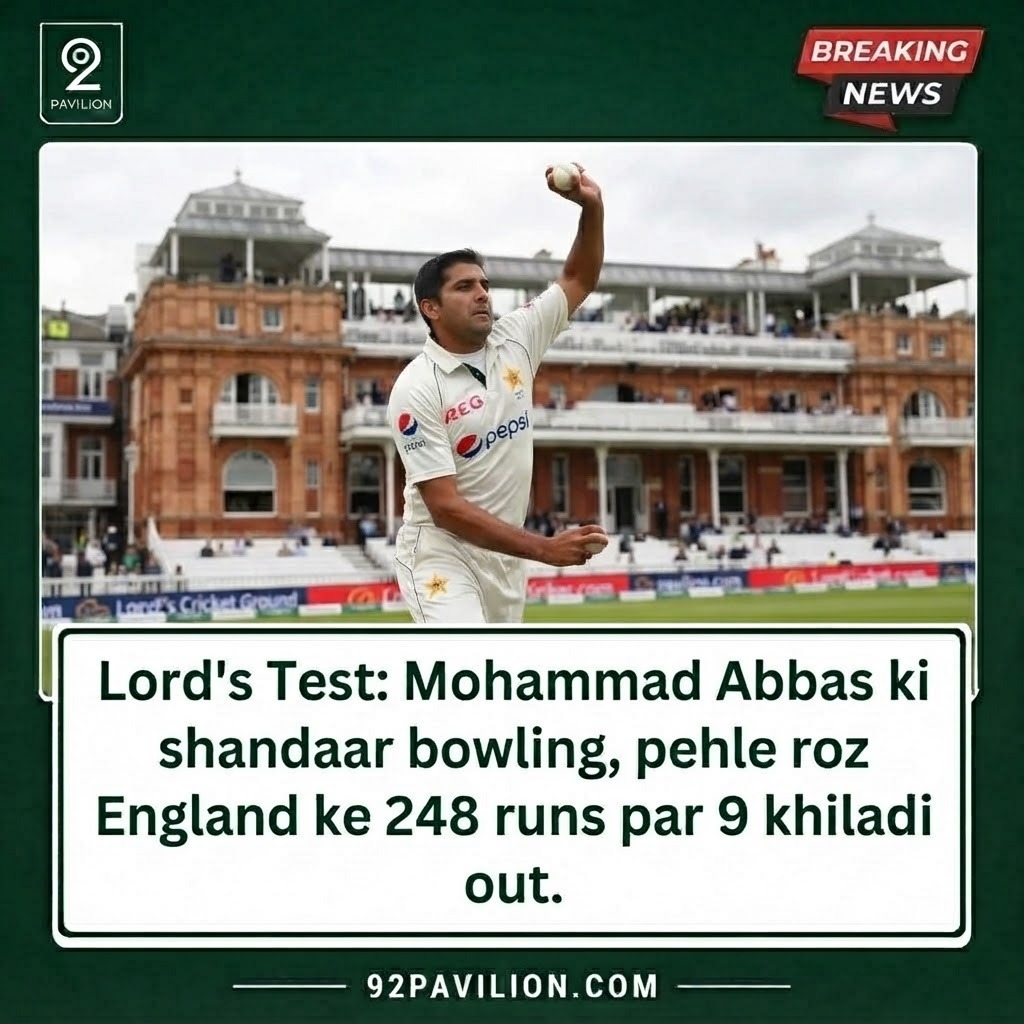
Mohammad Abbas celebrating a wicket in front of the Lord's Cricket Ground pavilion during the Pakistan vs England Test

Mohammad Abbas Shines as England Reach 248-9 on Rain-Hit Day at Lord’s

By: News Desk 92Pavilion | Updated: August 28, 2026

Quick Answer: Mohammad Abbas took four wickets as Pakistan restricted England to 248-9 on a rain-affected opening day of the second Test at Lord’s on Thursday. Only 56 overs were possible before bad light ended play early, with England’s last pair unbeaten at the close.

How the Day Unfolded

Pakistan won the toss and chose to bowl first at Lord’s, a decision that paid off early. Mohammad Abbas struck in a lengthy morning spell, removing openers Emilio Gay and Ben Duckett before also getting rid of captain Joe Root, who fell for just 4 runs. England slipped to 77-4 as Mohammad Ali joined the attack, bowling England’s Harry Brook with a delivery that jagged back sharply into his stumps.

Cox and Smith Steady the Innings

England found some stability through the middle session as Jordan Cox and Jamie Smith rebuilt the innings with a 105-ball stand worth 105 runs. Pakistan’s wicketkeeper Mohammad Rizwan grassed a chance off Smith when he was on just 15, and the England batter went on to make 61. Cox reached 55 before Khurram Shahzad had him bowled, ending the partnership.

Sharp Catching Moments

Despite the missed chance off Smith, Pakistan’s fielding produced two standout moments. Rizwan took a diving one-handed catch to remove Gay early in the innings, and substitute fielder Salman Ali Agha, filling in for the injured Imam-ul-Haq, pulled off a brilliant cartwheeling catch at second slip to dismiss Cox on 55.

Abbas Completes His Four-Wicket Haul

Abbas went wicketless through the afternoon session before returning in the evening to remove Jofra Archer, taking his tally for the day to four wickets. He came close to matching teammate Mohammad Ali’s tally for a five-wicket haul at his favourite ground, but bad light brought an early end to play with roughly an hour of scheduled time remaining. “This is my favorite ground,” Abbas said after play was called off.

Where the Match Stands

England ended the day on 248-9, with Gus Atkinson unbeaten on 34 and Josh Tongue not out on 1. Play had already started late on Thursday because of rain, and only 56 overs were bowled in total before bad light forced an early finish. Pakistan will look to wrap up the England innings quickly when play resumes, having already lost the first Test of the series.

Frequently Asked Questions

How many wickets did Mohammad Abbas take on day one?

Abbas finished the day with four wickets, dismissing Emilio Gay, Ben Duckett, Joe Root, and Jofra Archer.

What was England’s score at the end of day one?

England finished on 248-9 when bad light ended play early.

Why did play end early?

Bad light stopped proceedings with about an hour of scheduled play still remaining, after the day had already started late due to rain.


Who else took wickets for Pakistan?

Mohammad Ali dismissed Harry Brook, and Khurram Shahzad removed Jordan Cox.

This report is based on match coverage from Cricket Times and the Associated Press.

92Pavilion brings you timely, verified updates on Pakistan and the region. Stay with us for continued coverage.


Share

Introduction

Pakistan’s political environment in 2026 remains dynamic and highly influential in shaping the country’s future. From parliamentary debates and economic policy decisions to opposition movements and electoral reforms, recent developments are playing a crucial role in determining national direction.

In this report by Eye of Pakistan, we analyze the latest political developments, government strategies, and opposition responses.

Government’s Policy Priorities in 2026

The federal government has emphasized:

  • Economic stabilization

  • Institutional reforms

  • Energy sector restructuring

  • Strengthening foreign diplomatic ties

Recent cabinet meetings focused on controlling inflation, stabilizing the Pakistani Rupee, and implementing fiscal discipline under ongoing economic reform programs.

Officials claim these measures aim to restore investor confidence and ensure sustainable growth.

Opposition’s Response and Political Strategy

Major opposition parties have intensified criticism of government policies, particularly regarding:

  • Rising inflation

  • Unemployment

  • Tax reforms

  • Utility price increases

Opposition leaders argue that economic pressure on the public has increased and demand greater transparency in parliamentary proceedings.

Political rallies and public gatherings have increased across major cities including Karachi, Lahore, and Islamabad.

Parliamentary Developments

Recent National Assembly sessions have seen heated debates over:

  • Budget allocations

  • Electoral reforms

  • Accountability laws

  • Provincial autonomy issues

Lawmakers from both treasury and opposition benches continue to exchange strong viewpoints, reflecting a vibrant yet tense political atmosphere.

Election Reforms and Democratic Process

Discussions around electoral transparency and digital voting mechanisms remain central to political discourse.

The Election Commission is reportedly reviewing:

  • Voter verification systems

  • Polling station security

  • Overseas voting procedures

Analysts believe these reforms could significantly impact future general elections.

Public Reaction and Political Climate

Public opinion appears divided. While some citizens support structural reforms and long-term stabilization plans, others express concerns over economic hardships and governance challenges.

Political analysts suggest that the coming months will be critical in determining whether current policies translate into tangible relief for the public.

Conclusion

Pakistan’s political landscape in 2026 is marked by active debate, institutional reforms, and strategic maneuvering from both government and opposition parties. As policy decisions continue to unfold, their impact on economic stability and democratic processes will remain under close observation.

Stay connected with Eye of Pakistan for reliable and timely political updates.