Latest Posts
Loading latest posts…

Saeed Ghani: New Province Is a Decision Only Sindh’s People Can Make

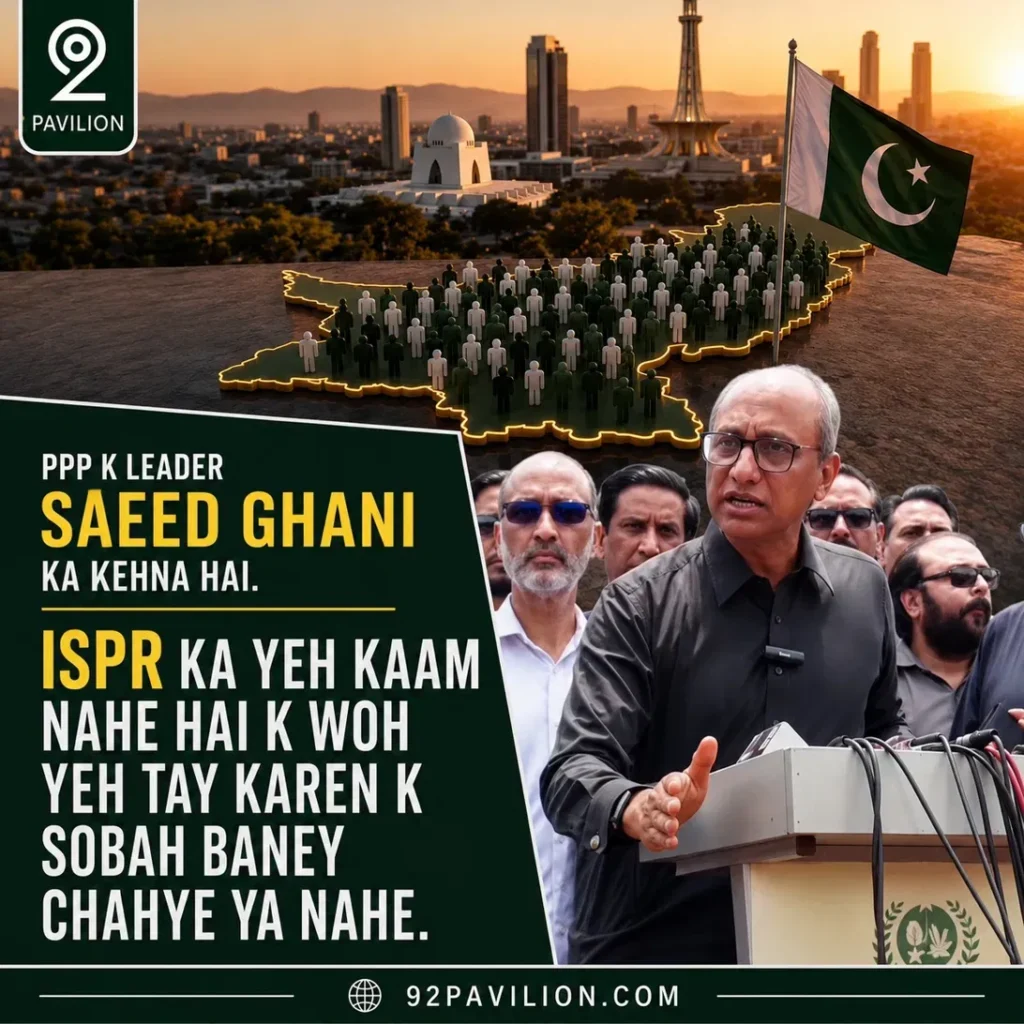
Sindh Local Government Minister Saeed Ghani addresses reporters at a press conference in Karachi

Saeed Ghani: New Province Is a Decision Only Sindh’s People Can Make

By: News Desk 92Pavilion | Updated: August 19, 2026

Quick Answer: Pakistan Peoples Party (PPP) leader and Sindh Local Government Minister Saeed Ghani has firmly rejected renewed calls to divide Sindh or carve out a new province, saying the decision rests solely with the province’s people and the constitutional process — not with any outside institution.

Ghani’s Position

Speaking to reporters in Karachi, Saeed Ghani said Sindh’s political parties and public are united in opposing the creation of a new province. He argued that if a new province were proposed in Punjab, it would be for Punjab’s people to decide; if proposed in Khyber Pakhtunkhwa, it would be for that province’s people alone — no outside party could impose such a decision on Sindh. Under the Constitution, a new province can only be created through a resolution passed by a two-thirds majority in the relevant provincial assembly.

Ghani added that rhetoric aimed at sowing hatred or division among citizens was dangerous for the country, particularly at a time when Pakistan needs political stability. He criticised MQM-P leaders Khalid Maqbool Siddiqui, Farooq Sattar, and Mustafa Kamal, accusing them of reviving what he called “the politics of hatred.”

Context: Why This Issue Came Up

Ghani’s remarks came in response to an MQM-P press conference renewing calls for Sindh’s division and the creation of new provinces. The debate follows a resolution already passed by the Punjab Assembly in support of a separate South Punjab province, reigniting broader discussion over how — and by whose authority — such changes should be made.

Note on the ISPR reference: Some social media graphics attribute a line to Ghani stating that deciding on a new province “is not ISPR’s job.” No verified news report was found in which Ghani used this exact phrasing directly. A related reference appears only in a later opinion piece, which asked rhetorically when ISPR had ever demanded a new province for Sindh — a comment made by a critic, not a direct quote from Ghani himself. It is consistent with Ghani’s broader, well-documented position that the decision belongs to the people and parliament, but the specific ISPR quote should be treated as unverified until a primary source is confirmed.

Frequently Asked Questions

Who is Saeed Ghani?

A senior PPP leader currently serving as Sindh’s Local Government Minister.

What is his position on new provinces?

That a new province can only be created through the constitutional process and with the consent of the province’s own people.

What prompted this statement?

A press conference by MQM-P renewing calls to divide Sindh and create new provinces.

Is the quote about ISPR verified?

No primary news source confirming this exact quote was found; it should be treated as unverified.

This report draws on coverage from The Express Tribune, Daily Times, Geo News, and Business Recorder.

92Pavilion brings you Sindh and Pakistan’s political news. Stay with us for continued coverage.
Share

Introduction

Pakistan’s political environment in 2026 remains dynamic and highly influential in shaping the country’s future. From parliamentary debates and economic policy decisions to opposition movements and electoral reforms, recent developments are playing a crucial role in determining national direction.

In this report by Eye of Pakistan, we analyze the latest political developments, government strategies, and opposition responses.

Government’s Policy Priorities in 2026

The federal government has emphasized:

  • Economic stabilization

  • Institutional reforms

  • Energy sector restructuring

  • Strengthening foreign diplomatic ties

Recent cabinet meetings focused on controlling inflation, stabilizing the Pakistani Rupee, and implementing fiscal discipline under ongoing economic reform programs.

Officials claim these measures aim to restore investor confidence and ensure sustainable growth.

Opposition’s Response and Political Strategy

Major opposition parties have intensified criticism of government policies, particularly regarding:

  • Rising inflation

  • Unemployment

  • Tax reforms

  • Utility price increases

Opposition leaders argue that economic pressure on the public has increased and demand greater transparency in parliamentary proceedings.

Political rallies and public gatherings have increased across major cities including Karachi, Lahore, and Islamabad.

Parliamentary Developments

Recent National Assembly sessions have seen heated debates over:

  • Budget allocations

  • Electoral reforms

  • Accountability laws

  • Provincial autonomy issues

Lawmakers from both treasury and opposition benches continue to exchange strong viewpoints, reflecting a vibrant yet tense political atmosphere.

Election Reforms and Democratic Process

Discussions around electoral transparency and digital voting mechanisms remain central to political discourse.

The Election Commission is reportedly reviewing:

  • Voter verification systems

  • Polling station security

  • Overseas voting procedures

Analysts believe these reforms could significantly impact future general elections.

Public Reaction and Political Climate

Public opinion appears divided. While some citizens support structural reforms and long-term stabilization plans, others express concerns over economic hardships and governance challenges.

Political analysts suggest that the coming months will be critical in determining whether current policies translate into tangible relief for the public.

Conclusion

Pakistan’s political landscape in 2026 is marked by active debate, institutional reforms, and strategic maneuvering from both government and opposition parties. As policy decisions continue to unfold, their impact on economic stability and democratic processes will remain under close observation.

Stay connected with Eye of Pakistan for reliable and timely political updates.