By: News Desk 92Pavilion | Updated: August 13, 2026
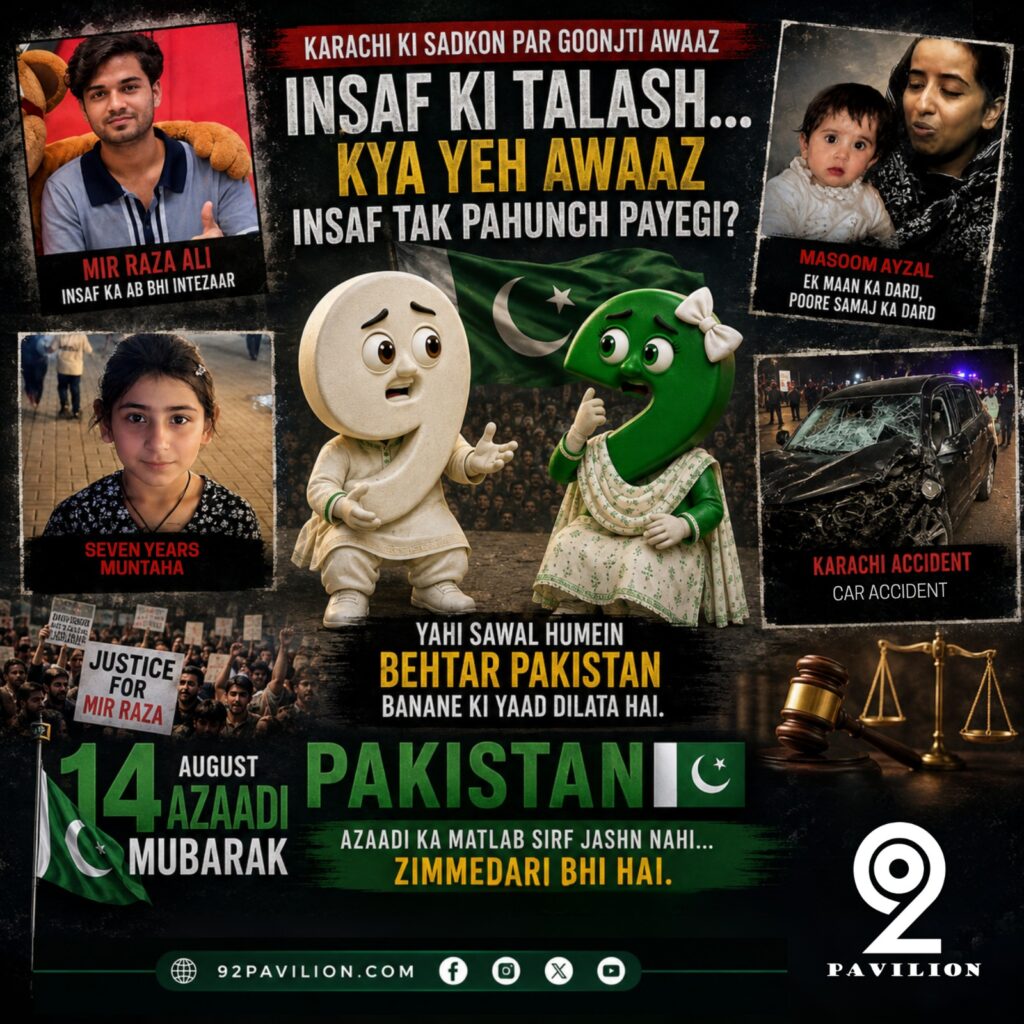
Karachi’s streets carry a question this August. Does justice in Pakistan reach ordinary families? Or only slogans? Every year, 14 August brings flags, songs, and pride. This year, it also brings names people cannot forget. Mir Raza Ali. Baby Aizal. Muntaha Zahra. A car crash on a Karachi road. Four stories, one shared demand. Real justice in Pakistan, not just promises.
Why Justice Still Feels Out Of Reach
Independence Day in Pakistan celebrates freedom won in 1947. But freedom without justice loses its meaning fast. Families across Karachi and beyond are still waiting for answers. They want honest investigations, not delayed paperwork. They want accountability, not silence after the news cycle ends. This gap between promise and practice raises a harder question. What does independence mean if justice in Pakistan keeps arriving late?
Social media has changed how these stories travel. A single hashtag can turn a private tragedy into a national conversation within hours. That visibility puts pressure on police and courts to act faster. But pressure alone does not fix weak systems. Pakistan still needs stronger forensic capacity, clearer timelines, and consistent follow-through after the outrage fades.
Mir Raza Ali: A Family Still Waiting For Answers
Mir Raza Ali, a young Karachi businessman, went missing from PECHS in July 2026. His body was found two days later near Gulistan-e-Jauhar. What first looked like a straightforward case soon turned complicated. A disputed first post-mortem raised early doubts. A second report suggested murder, not suicide. The Sindh government then ordered a judicial inquiry. His father has publicly said the family only wants justice. Karachi’s streets saw public protests demanding “Justice For Mir Raza.” For his parents, every delay reopens the same wound. Their son’s case has become a symbol of a bigger problem. Can Pakistan’s justice system move fast enough for grieving families?
Baby Aizal: A Case That Exposed Legal Gaps
Some stories are harder to write than others. An 18-month-old girl in Karachi, known publicly as Aizal, died after an alleged assault. The accused was a young relative. Her mother has spoken publicly about police delays in the case. She has also raised concerns about how the law is handling the accused’s age. This case forced a painful national conversation. It asked whether Pakistan’s child protection laws actually protect children. For many parents, Aizal’s name is now shorthand for a system that moves too slowly.
Muntaha Zahra: A Nation’s Anger Over Child Safety
Seven-year-old Muntaha Zahra left her home in Sargodha for a nearby shop. She never returned. Her family found out through CCTV footage and a desperate search. Her case sparked protests and a nationwide outcry over child safety. The prime suspect was later killed during a police operation, before facing trial. That outcome left many Pakistanis with more questions than answers. Grief for Muntaha has become a call for faster justice. It is a call for stronger child protection, from Sargodha to Karachi.
Karachi’s Roads: Another Silent Justice Crisis
Not every fight for justice in Pakistan involves a courtroom. Karachi’s roads claim lives quietly, almost every week. Poor infrastructure, unsafe driving, and weak enforcement all play a part. A crushed car on a Karachi street is rarely front-page news for long. But for the family left behind, the loss is just as permanent. Road safety deserves the same urgency as any other justice conversation. Preventable accidents are also, in their own way, a failure of accountability.
Freedom With Responsibility
Freedom is not only celebration. It is also responsibility. This idea sits at the heart of every case above. A nation’s freedom is measured by how it treats its weakest citizens. It is measured by whether a grieving father gets answers. It is measured by whether a mother’s fight for her child matters. On 14 August, flags and fireworks matter less than follow-through. Real freedom means holding institutions accountable long after the headlines fade.
What Real Justice In Pakistan Would Look Like
Justice in Pakistan does not need to stay abstract. It can mean faster forensic reporting, so families are not left guessing. It can mean transparent investigations that citizens can actually follow. It can mean child protection laws that close loopholes, not leave them open. It can mean safer roads, built with real enforcement, not just paint and signboards. None of this is impossible. Other countries have built stronger systems with less at stake. Pakistan’s institutions can do the same, if public pressure keeps them honest.
Media outlets also carry responsibility here. Reporting on cases like Mir Raza Ali or Muntaha Zahra needs accuracy, not speculation. Sensational headlines can distract from the real issue. Slow, inconsistent accountability. A more informed public asks better questions. Better questions push institutions to respond.
A Question Worth Carrying Into 14 August
This 14 August, national pride still deserves to be said with pride. But pride should come with a promise, not just a slogan. Justice in Pakistan cannot depend on how loud a case trends online. It has to work quietly, consistently, for every family, every single time. That is the real test of independence this year, and every year after.
Frequently Asked Questions
What does “the search for justice” mean for Pakistan’s Independence Day?
It refers to Pakistani families still waiting for outcomes. Cases like Mir Raza Ali, Baby Aizal, and Muntaha Zahra show this. Independence Day arrives, but their wait continues.
Why is the Mir Raza Ali case significant for justice in Pakistan?
The Mir Raza Ali case raised questions about medico-legal transparency in Pakistan. A disputed first post-mortem, followed by a second report suggesting murder, led to a judicial inquiry ordered by the Sindh government.
How did the Muntaha Zahra case affect child safety discussions in Pakistan?
The Muntaha Zahra case in Sargodha triggered nationwide protests over child safety. It renewed public demand for faster investigations and stronger protection laws for children across Pakistan.
What can ordinary citizens do to support justice in Pakistan?
Citizens can raise awareness, support transparent journalism, and push local representatives for accountability. Public pressure has already led to judicial inquiries in cases like Mir Raza Ali’s.
What does “freedom is not just celebration, it is also responsibility” mean?
It reminds Pakistanis that Independence Day needs real accountability. Not only flags and festivities, but consistent follow-through from institutions.