By: News Desk 92Pavilion | Updated: August 11, 2026
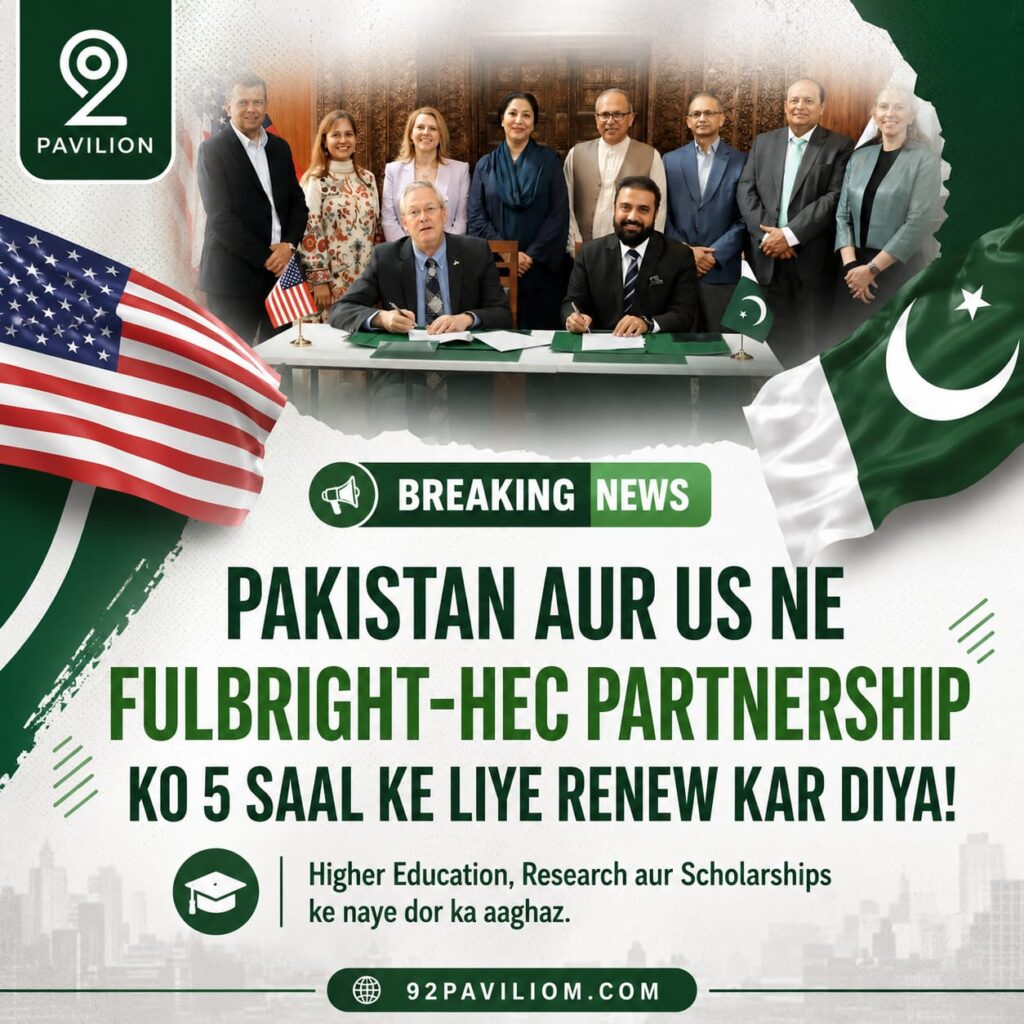
Quick Answer: Pakistan’s Higher Education Commission (HEC) and the United States Educational Foundation in Pakistan (USEFP) have signed a new five-year agreement renewing the Fulbright-HEC partnership. The deal, covering Financial Year 2026-27 through 2031-32, will fund Fulbright Master’s and PhD programmes, a Visiting Scholar Programme, the Foreign Language Teaching Assistant Programme, and the Hubert H. Humphrey Fellowship, with a target of supporting 66 PhD scholars over five years.
What Was Signed and By Whom
The agreement was signed at USEFP headquarters in Islamabad on August 11 by USEFP Executive Director Dr Peter Moran and HEC Executive Director Professor Dr Ziaul Haq. The Ministry of Education and Professional Training welcomed the renewal, saying it reaffirms both countries’ shared commitment to academic excellence, human capital development, research, and international educational cooperation.
What the Partnership Covers
The renewed agreement runs from Financial Year 2026-27 through Financial Year 2031-32 and encompasses four main programmes: the Fulbright Master’s and PhD Programmes, the Visiting Scholar Programme for post-doctoral scholars, the Foreign Language Teaching Assistant (FLTA) Programme, and the Hubert H. Humphrey Fellowship Programme.
Under the deal, the programme has set a target of supporting 66 PhD scholars over the five-year period, in addition to opportunities available through the other programme streams. HEC has committed at least $4.54 million annually to fund the initiative, and any interest earned on HEC funds held by USEFP will be reinvested into student grants.
A Merit-Based Selection Process
Officials say the selection process under the renewed agreement will remain strictly merit-based, with no fixed quotas for any particular group, region, or category. HEC will take part directly in the selection panels and help identify priority fields of study aligned with Pakistan’s development needs.
Reviving a 14-Year Dormant Working Group
The renewed Fulbright-HEC partnership is described as an outcome of the revival of the Pakistan-US Higher Education Working Group, which had been dormant for nearly 14 years before being reactivated. Officials say the Working Group has provided an important institutional platform for sustained engagement between the two countries on higher education, scholarships, academic mobility, skills development, and research collaboration.
Building on a Decade-Long Partnership
The new agreement builds on the original Fulbright-HEC PhD partnership signed in February 2016, under which $25.786 million was committed to support 125 Pakistani scholars between FY 2016 and FY 2020. Officials describe the latest agreement as the third phase of the Fulbright-HEC collaboration, extending a decade-long effort to strengthen Pakistan’s academic and research capacity.
What Comes Next
Beyond scholarships, HEC and USEFP plan joint visibility and awareness initiatives across Pakistan, drawing on HEC’s network of higher education institutions to broaden outreach. The agreement also leaves room for future cooperation on faculty and administrator exchanges and other academic initiatives.
Frequently Asked Questions
How long is the renewed Fulbright-HEC agreement?
It is a five-year agreement, covering Financial Year 2026-27 through Financial Year 2031-32.
How many PhD scholars will it support?
The programme has set a target of supporting 66 PhD scholars over the five-year period, alongside other programme streams.
Who signed the agreement?
USEFP Executive Director Dr Peter Moran and HEC Executive Director Professor Dr Ziaul Haq signed it in Islamabad on August 11, 2026.
What programmes does it cover?
The Fulbright Master’s and PhD Programmes, the Visiting Scholar Programme, the FLTA Programme, and the Hubert H. Humphrey Fellowship Programme.
This report is based on reporting from Dawn, The Express Tribune, Radio Pakistan, ARY News, and ProPakistani.
92Pavilion brings you Pakistan’s education news as it happens. Stay with us for updates on this developing story.