
By: News Desk 92Pavilion | Updated: August 11, 2026
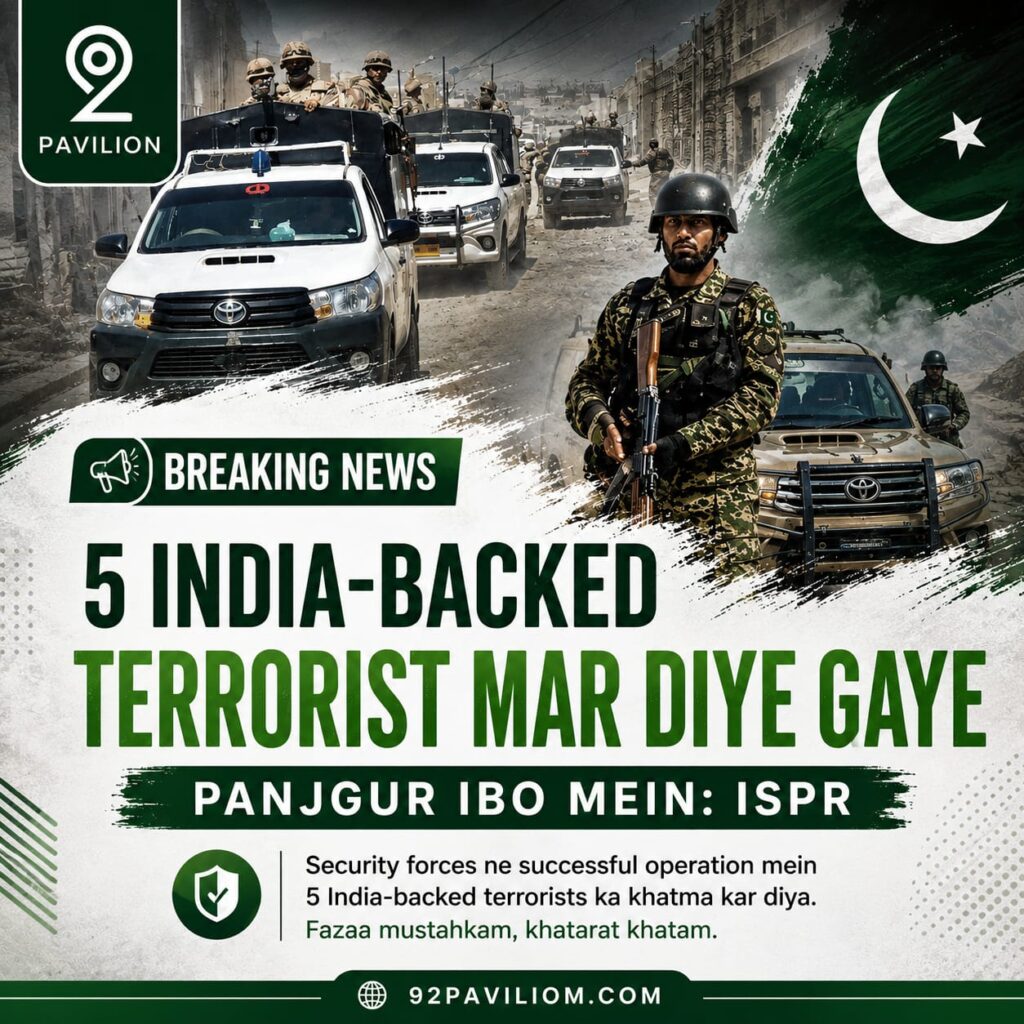
Quick Answer: Security forces killed five terrorists, including a militant commander, during an intelligence-based operation in Balochistan’s Panjgur district on August 10. The ISPR said the operation targeted Fitna al-Hindustan, a group it describes as India-backed, and formed part of the ongoing Operation Radd-ul-Fitna-3. Weapons, ammunition, and IEDs were recovered and destroyed, and a follow-up clearance operation was carried out in the area.
How the Operation Unfolded
Security forces carried out the intelligence-based operation (IBO) in the Sarkini and Chedgi areas of Panjgur district on August 10, as part of the wider counter-terrorism campaign known as Operation Radd-ul-Fitna-3. According to security sources, the operation targeted a hideout used by militants linked to Fitna al-Hindustan, a group Pakistani authorities say operates with Indian backing.
Five terrorists were killed during the exchange, including the group’s local commander, identified as Wazir, son of Jamal. Security forces recovered four motorcycles, machine guns, heavy weapons, and a large quantity of ammunition from the site.
What the ISPR Said
Confirming the operation, the Inter-Services Public Relations (ISPR) said it was conducted as part of ongoing efforts to eliminate Indian-sponsored proxies and restore lasting peace in the region. The military’s media wing said a significant cache of weapons, ammunition, and improvised explosive devices (IEDs) was recovered from the site and later destroyed.
Following the main operation, security forces carried out a sanitisation operation in the surrounding area to clear any remaining threats and secure the location, the ISPR added. The military’s media wing said security forces and law enforcement agencies would continue operations until foreign-sponsored terrorism is completely eliminated, under the broader vision of Azm-e-Istehkam.
Who the Slain Militants Were
Security sources said the militants killed in the operation were allegedly involved in a range of criminal and terrorist activities in the area, including robbery, extortion, kidnapping, and attacks on local traders and residents. The elimination of the group’s commander, Wazir, is being seen as a significant setback for the network’s operations in Panjgur.
Balochistan’s Wider Security Picture
The operation comes against the backdrop of a difficult security environment in Balochistan and Khyber Pakhtunkhwa. A report by the Centre for Research and Security Studies (CRSS) found that the two provinces accounted for nearly 96 percent of all violence-related fatalities recorded nationwide in the second quarter of 2026, with KP recording more than 61 percent of deaths and Balochistan accounting for around 34 percent.
Balochistan also recorded 94 violent incidents during the quarter, or roughly 35 percent of the nationwide total, underscoring why security forces continue to prioritise intelligence-based operations in districts like Panjgur.
Reaction and Follow-Up
Interior Minister Mohsin Naqvi praised the security forces involved in the operation, according to security sources. Authorities say the clearance operation in the area is ongoing, aimed at eliminating any remaining Fitna al-Hindustan presence in the vicinity.
Frequently Asked Questions
Where did the Panjgur operation take place?
In the Sarkini and Chedgi areas of Panjgur district, Balochistan, on August 10, 2026.
How many terrorists were killed?
Five terrorists were killed, including the group’s local commander, Wazir, son of Jamal.
Which group was targeted?
The operation targeted Fitna al-Hindustan, which Pakistani security officials describe as an India-backed militant network.
What was recovered from the site?
Security forces recovered weapons, ammunition, IEDs, and four motorcycles, all of which were later destroyed.
This report is based on reporting from the ISPR, Geo News, The News International, BOL News, and Islamabad Post.
92Pavilion brings you Pakistan’s national security news as it happens. Stay with us for updates on this developing story.